Finding our way
Finding our way
 Venerable Thubten Chodron
  Blossoms of the Dharma
  Dec 28, 1999
From Blossoms of the Dharma: Living as a Buddhist Nun, published in 1999. This book, no longer in print, gathered together some of the presentations given at the 1996 Life as a Buddhist Nun conference in Bodhgaya, India.
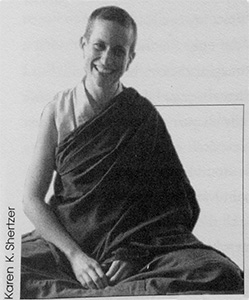
Bhikshuni Thubten Chodron
Understanding what Dharma practice is can be difficult, and I have made many mistakes trying to follow the path. Although I meant well and thought I was practicing properly at the time, only later did I come to see my misunderstandings. My hope is that by sharing these with you, you may avoid them. However, that may not be possible, because in some cases, we only learn by going through the difficulties ourselves and confronting the pain and confusion of our fixed attitudes. This certainly is true for me.
One mistake I made was assuming that because I understood the words of the Dharma, I understood their meaning. For example, I thought that my Dharma practice was developing well, because when I lived in India, I didn’t get angry very much. After some time, my teacher sent me to live at a Dharma center in Italy, where I was the only American nun among a group of macho Italian monks. You can imagine the conflicts we had! But I couldn’t figure out why I was having problems because I thought my patience had matured. Every evening I would study chapter six of Shantideva’s text Guide to a Bodhisattva’s Way of Life, which dealt with patience, and every day I would again get mad at the people around me. Although I knew the words of Shantideva’s text well and thought I was practicing them properly, my mind continued to blame others for all the conflicts and problems.
It took me a long time to figure out what practicing patience meant, and I am still working on it. Whenever people live together there are conflicts, simply because people see things in different ways. When I lived in the nunnery in France, I handled my anger by sitting on my meditation cushion and contemplating patience. I never thought to approach the other person and say, “The way the situation appears to me is like this. How do you see it?” and to listen and discuss openly what had happened. I thought that since the cause of suffering was in my own mind, only meditation would solve the problem. Meanwhile, I was convinced that my version of the story was the one right one, and if I just did one of the mental juggling acts that Shantideva taught, the anger would go away. But all my mental juggling acts were intellectual machinations and didn’t touch my anger.
Years later, I attended a workshop on communication skills and conflict resolution. It became clear that when I was angry, I could do other things besides withdrawing from the situation and meditating. Of course, we have to look at our mind and develop patience, but we can also discuss the problem with the other person. We can share how we feel in a situation without blaming the other person for our feelings. I began to understand that I had to make more effort to communicate and that I could learn a lot by opening up and discussing things with other people. This can sometimes be scary, and I still find it difficult to go to a person and say, “There’s a problem here. Let’s talk about it.” However, I see that developing good communication skills and meditating on patience and compassion go hand in hand. If I approach the other person, deeply listen to them, and understand his or her experience, my anger automatically dissipates and compassion arises.
We may wonder: Why do we need to learn communication and conflict resolution skills? If we develop an altruistic intention (bodhicitta), won’t these skills naturally arise? No, a bodhisattva does not automatically know how to do everything; he or she must still train in many skills. For example, having an altruistic intention does not mean one knows how to fly an airplane. One has to learn that skill. Similarly, although bodhicitta gives us an excellent foundation, we still need to learn skills for communicating with others, resolving conflicts, mediating disputes, and so on. The internal attitude of bodhicitta is complemented well by practical communication skills.
Individualism and Community Life
The Buddha established the sangha for several reasons. One is that he wanted monks and nuns to support, encourage, and help each other on the path. He set up a community so that we could learn from each other, so that we do not become isolated individuals doing whatever we fancy. For this reason, many of our precepts deal with how to live together harmoniously as a community and how to admonish each other so that we have to face our rationalizations and excuses. Thus the sangha community is a mirror helping us to purify our mind and to grow in compassion, tolerance, and understanding.
We frequently have difficulty distinguishing between our individualism and our individuality. The former is the self-centered pursuit of individual rather than collective interests. It is closely linked to self-grasping and self-centeredness, two of our principal obstructions. Adhering to our individualism makes living in community a trial for ourselves and others. Our individuality, on the other hand, is our unique combination of various qualities. In Dharma practice we learn to discriminate between qualities that are realistic and beneficial and those that are not. Then we set about increasing the former and applying the antidotes to the latter. In this way, we develop and use our individuality for the benefit of both ourselves and others.
Our Western cultural conditioning often results in confusion between individualism and individuality. Thus, we may find it difficult to follow our teachers’ advice or to live together with other sangha members, because we feel our individuality and autonomy are being threatened, when really only our self-centered individualism is at stake. When we live in community, we realize we are full of opinions about everything from how fast to chant in our group ceremonies to how to realize emptiness. If we hold tightly onto our own ideas, neglecting to see that they are simply opinions and not reality, we find being with other people quite miserable because they seldom agree with us! We need to be aware that being ordained involves re-socialization and gradually relinquishing our stubborn, closed-minded individualism. Monastic training—learning to think and act like a monastic—is designed to accomplish this.
While in Taiwan to receive the bhikshuni ordination, I observed my individualism very clearly. The thirty-two day training program, culminating in the three ordinations of sramanerika, bhikshuni, and bodhisattva, is extremely strict. Everyone must do the same thing at the same time in the same way. The juniors must listen to and follow the instructions of the seniors. Each morning, before receiving teachings, all five hundred monastics had to file into the main hall and from there file into the teaching hall. In my eyes, this was a waste of time, and I saw another way to do it that would save time by filing directly into the teaching hall. With my American emphasis on efficiency, I wanted to “fix the problem.” But there were some difficulties: first, I did not speak Chinese, and second, even if I had, the elders would not have been particularly interested in hearing my solution, because their method worked for them. This forced me to do something quite difficult: be quiet and do things somebody else’s way. Such an insignificant situation put me face to face with my American fix-it mentality and my Western individualism. It forced me to learn to be content and to cooperate in doing things another way.
Accepting and rejoicing in the positive aspects of our own and others’ individuality are important. For example, each of our Dharma sisters and brothers will have his or her own way of practicing. Not everyone will practice the way we do. Variety does not mean we have to judge one as better than the others. It simply reflects that each person has his or her own inclination and disposition. We should not compete with other practitioners. We do not need to feel inadequate because others are doing things that we are not able to. For example, some nuns are Vinaya scholars. I am interested in Vinaya but am not an expert in it. Yet I am delighted that some nuns are learned in this area because we need nuns who specialize in Vinaya and we can learn from them. Some nuns are meditators and do years of retreat. I am not ready to do a long retreat—I need to accumulate more positive potential and purify more before I can do that. But I am so glad there are nuns who do long retreat. I am happy there are nuns working in hospices and health care, nuns teaching children, and nuns organizing Buddhist events. I cannot do all those things but I rejoice that others can. Each of us will express her devotion to the Three Jewels and her gratitude to sentient beings in a different way, and the world needs all of them. If there were only meditators or scholars or social workers, the Dharma would not be round and full. We need everyone to express her practice in her individual way, and we need to say to one another, “Thank you. I’m so glad you’re doing that.”
Cultural forms and the essence of the dharma
Of the five hundred people ordained in 1986 in Taiwan, only two of us were Westerners. For the first two weeks, no one translated for us except for a few kind Chinese nuns who summarized the proceedings for us during the breaktimes. For those two weeks, the two of us went to all the sessions in a full daily program barely understanding what we were doing. For me, as a college graduate, to do something I did not understand and to be content with learning about it gradually was very difficult. Because I wanted very much to receive the bhikshuni vow, I was forced to give up my arrogant attitude and accept the situation.
Because I was present for many hours at events that I did not understand, I began to look at what subsequently has become an important issue for me: what is culture and what is Dharma? Having finally mastered many Tibetan customs, I was now in a Chinese monastery where the customs were different. Both of these traditions are Buddhist; yet superficially, in terms of dress, language, and ways of doing things, they are different. What significance does this have for me as a Westerner? What in my training as a nun is due to the culture of the countries where Buddhism has resided for centuries and what is the actual Dharma that transcends culture? What is the essence of the Buddha’s teachings that we must practice, bring back to our Western countries, and teach others? What is cultural form that we need not bring to the West?
For me, this topic is of crucial importance and is a work in progress. My conclusion so far is that the Four Noble Truths, love, compassion, the altruistic intention of bodhicitta, and the wisdom realizing emptiness are the essence of the Dharma. These cannot be seen with the eyes; the understanding exists in our heart. The real Dharma is developed within our mind, and the forms are skillful tools that exist within each culture. We must be able to distinguish these so that we develop the real Dharma within ourselves and do not fool ourselves into thinking we are good practitioners simply because we are surrounded with Asian items.
For many years, I tried to act like the Tibetan nuns—shy, self-effacing, sweet. But it didn’t work. Why? Because I was from a different culture and had a different upbringing than the Tibetan nuns. In school I was taught to express my thoughts, to doubt and question, to think on my own, and to be articulate. I had to confront the fact that copying a cultural form and others’ external behavior was not necessarily practicing the Dharma; it was simply squeezing myself to conform to a particular personality type or culture that I had idealized as being “real Buddhism.” I began to notice that my teachers had very different personalities: some were introverted, others outgoing; some were serious, others laughed a lot. Within the context of our different, constantly changing and illusive personalities, we practice the Dharma by being aware of our motivations, attitudes, and preconceptions, developing the realistic and beneficial ones, and applying the antidotes to the destructive and unrealistic ones. This work is done internally. External forms, which are involved with one culture or another, are prompts to stimulate this.
The issue of culture and essence kept following me. As resident teacher at Amitabha Buddhist Centre in Singapore, I found myself, an American, teaching Chinese to chant prayers in Tibetan, a language which none of us understood. The Tibetan chanting sounded nice and our Tibetan masters were pleased with our chanting, but we were not practicing the Dharma because we did not understand what we were saying. Although the translation process will take years and extend well beyond our lifetimes, it is essential. In time, masters will write prayers directly in our Western languages. People with musical ability will write melodies for the prayers, and we will have beautiful liturgy in our own languages.
As time went by, I began to see that, having lived in the Tibetan community for so long, I had developed a “cultural inferiority complex.” When I initially left America to live in the East, I felt the West was corrupt and hoped Eastern ways would be better. But, try as I might, I could never act or think like a proper Tibetan, and began to lose my self-confidence. After many years, I realized that this loss of respect for my culture-of-origin was neither a healthy nor a productive attitude. Self-confidence is essential for a successful Dharma practice. This meant I had to see both the good and bad points of the Western culture I grew up in, as well as the good and bad points of the Tibetan culture. Comparing the two and judging one inferior and the other superior—no matter which one came out on top—was not productive. Because most of us Western monastics are operating cross-culturally, we would benefit from adopting the positive aspects and values of all the cultures we contact, while leaving behind whatever prejudices and preconceptions we may encounter.
After many years of living in Asia, I came back to the United States. It was important for me to reconnect in a positive way with the culture in which I grew up. We need to be at peace with our past, not to reject or ignore it. For me that meant acknowledging both the good and bad qualities of my background and culture and freeing my mind from either attachment or aversion to it.
Similarly, it is important to make peace with the religion we learned as a child. Having a negative attitude about our childhood religion indicates we are still bound by it, for our minds are closed and trapped in aversion. Although the religion of our childhood may not have met our spiritual needs, we did learn useful values from it. It got us going on the spiritual path, and it is important to appreciate its good points.
For me this process took an interesting turn. Having been raised Jewish, I happened to be living in Dharamsala, India, in 1990, when a Jewish delegation came to meet His Holiness the Dalai Lama, young Tibetan intellectuals, and “JuBus” (Jewish Buddhists). Meditating and talking with the Jews, I felt confident in being a Buddhist and yet happily familiar with their culture, faith, and traditions. I began to look at points in common between the two faiths and to appreciate the emphasis on ethical values, compassion, and social concern that Judaism had given me. Now, in Seattle, I participate in an ongoing Jewish-Buddhist dialogue, in which we discuss issues such as love, compassion, and suffering. In addition, Israelis have invited me to teach in their country, and in the two trips thus far, I have felt a wonderful connection with the people, helping me to explain Dharma principles and meditation techniques in a way that corresponds to their background.
Self-esteem and self-confidence
I also misunderstood the Dharma by mistakenly using the teachings to increase my self-hatred. Meditating upon the disadvantages of self-centeredness, I would feel guilty for being so selfish, instead of seeing the selfish attitude as something separate from the nature of my mind. Eventually it became clear that whenever I meditated and felt worse about myself, I was misinterpreting the teachings and not applying them correctly. The Buddha’s purpose in teaching topics such as the lower realms of rebirth and the disadvantages of self-centeredness was not to increase our despondency. Rather, he wanted us to see clearly the disadvantages of cyclic existence and its causes so that we would generate the determination to free ourselves and others from them.
Feelings of low self-esteem and inadequacy are prevalent in Westerners. In 1990, I was an observer at a conference of Western scientists and scholars with His Holiness the Dalai Lama in Dharamsala when the topic of low self-esteem was raised. Tibetans do not have words in their language for low self-esteem and guilt, so Westerners’ problems with these feelings are not readily comprehensible to them. His Holiness had difficulty understanding how someone could not like himself. He looked around this room of educated, successful people and asked, “Who feels low self-esteem?” Everyone looked at each other and replied, “We all do.” His Holiness was shocked and asked us the causes of this feeling. Brainstorming, we found reasons ranging from parents not holding their children enough, to the doctrine of original sin, to competition in school.
Our difficulty with self-esteem can also be linked to our emphasis on perfection and our wish to be the best, attributes that Western society teaches us to have. Caught in this conditioning, we sometimes misinterpret the Dharma: we think the perfection of ethical discipline, for example, is living up to an external standard imposed on us by others, similar to the ten commandments. However, the Dharma is not about striving for externally defined perfection to please our guru or the Buddha the way we previously tried to be good and please God. Practicing Dharma does not involve twisting ourselves into psychological knots to become our own or anyone else’s ideal of the perfect monastic. Rather, the Dharma concerns looking inside ourselves and understanding all the various processes that comprise us. We come to see that our actions bear results and that if we want happiness, we need to create the causes for it by following the Dharma path, that is, by applying the meditations to diminish our disturbing attitudes and develop our good qualities.
Low self-esteem, leading to discouragement, is a hindrance on the path, for it becomes a form of laziness preventing us from making joyous effort in our practice. Thus, His Holiness has continued to explore the issue of low self-esteem and to propose Dharma antidotes to it. First, we must understand that the very nature of our mind is free from defilements. In other words, disturbing attitudes and negative emotions are like clouds that obscure the sky-like nature of mind but are not an inherent part of it. This basic purity of mind is a valid basis for having self-confidence. Not depending on external circumstances, it does not fluctuate, and thus we do not need to worry about the basis of our self-confidence disintegrating. Therefore, we can and should respect and care for ourselves. In fact, the path involves learning to care for ourselves in a proper, balanced way, not in a self-preoccupied or self-defeating way. To become a bodhisattva, we need a sense of a strong self, but this differs greatly from the self-grasping ignorance that is the root of cyclic existence. This valid sense of an efficacious conventional self enables us to be joyful and energetic in practicing the path.
In addition, we must recognize the positive factors in our lives right now. Instead of lamenting about the few things in our lives that do not correspond to our wishes, we need to focus on the positive circumstances, such as the fact that we have a human body and human intelligence. In addition, we have encountered the Dharma and qualified teachers to guide us, and we have interest in spiritual issues. If we contemplate all these fortunate circumstances and the outstanding results that can come from Dharma practice, our mind will no longer be interested in self-deprecating thoughts.
Another antidote to low self-esteem is compassion, which enables us to accept ourselves and to have a sense of humor about our foibles while simultaneously endeavoring to remedy them. While low self-esteem causes us to spiral inwards and think predominantly about ourselves, compassion—the wish for all beings, including ourselves, to be free of suffering—opens our heart to recognize the universality of the wish for happiness and freedom from suffering. Our attention then shifts from the unhealthy self-preoccupation of low self-esteem to a caring attitude that feels connected to all others on a deep level. Such an attitude naturally gives us a sense of joy and purpose in life, thus increasing our self-confidence.
Living the precepts
Receiving and trying to live in accordance with the bhikshuni precepts has had considerable impact on me. In 1986, when I was ordained as a bhikshuni, there were only a handful of Western bhikshunis. For years prior to that I prayed to be able to receive these precepts because I wanted to practice and preserve the monastic lifestyle which had helped me so much.
The training program for the bhikshuni ordination in Taiwan lasted thirty-two days. It was difficult being in a foreign country, where I did not know the language or the customs. Standing hour after hour in the heat to attend training sessions and rituals that were in Chinese was not easy; but the strength of my wish to receive the ordination helped me to go through the difficulties. As we rehearsed the ordination ceremony, we gradually came to understand it, so that the actual ceremony became very powerful. At that moment, I felt the wave of blessing that comes from joining the lineage of nuns who have practiced the Dharma for over twenty-five hundred years, from the time of the Buddha until the present. This created a new sense of confidence in myself and in the practice. In addition, it increased my mindfulness, for it was the kindness of my teachers and the lay people who supported me that gave me this opportunity. My way of repaying their kindness was by trying to keep the precepts well and transform my mind.
The ordination connected me not only to all the nuns of the past, but also to all the nuns that are yet to come. I realized that I had to take responsibility for future generations of nuns. I could no longer stay in my childlike state and complain, “Why do nuns face difficult conditions? Why doesn’t anyone help the nuns?” I had to grow up and take responsibility for improving not only my own situation, but also that of future generations. I came to see that practicing Dharma is not simply doing my own personal studies and practice; it is preserving something very precious so that others can have access to it.

Venerable Thubten Chodron
Venerable Chodron emphasizes the practical application of Buddha’s teachings in our daily lives and is especially skilled at explaining them in ways easily understood and practiced by Westerners. She is well known for her warm, humorous, and lucid teachings. She was ordained as a Buddhist nun in 1977 by Kyabje Ling Rinpoche in Dharamsala, India, and in 1986 she received bhikshuni (full) ordination in Taiwan. Read her full bio.