How to rely on a spiritual friend
How to rely on a spiritual friend
 Venerable Jamyang Wangmo
  Blossoms of the Dharma
  Dec 28, 1999
From Blossoms of the Dharma: Living as a Buddhist Nun, published in 1999. This book, no longer in print, gathered together some of the presentations given at the 1996 Life as a Buddhist Nun conference in Bodhgaya, India.
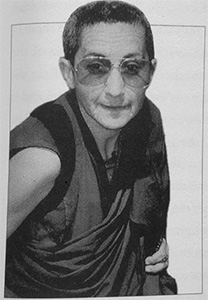
Bhikshuni Jampa Chokyi
We know we need guidance on the path to enlightenment, and it is a spiritual friend—a guru or a lama—who can provide this. Before exploring the various ways of understanding the guru, it is helpful to understand the Buddhist objects of refuge.
There are two types of refuge objects: the outer or causal and the inner or resultant Three Jewels. The various Buddhist traditions—Theravada, Mahayana, and Vajrayana—have slightly different ways of describing these. Regarding the outer refuge, the Theravada tradition considers the Buddha to be Shakyamuni, the historical Buddha; the Dharma to be the Three Baskets, of which the core teaching is the Four Noble Truths; and the Sangha to be the noble ones who have realized selflessness: those at the eighth level of the path from stream-enterer to arhat. For the practitioners of this tradition, the guru or teacher is a person who explains the teachings, give precepts, and so forth. In the Mahayana tradition, the Buddha Jewel refers to all the Buddhas, whose qualities and realizations are similar to those of Shakyamuni. The Dharma is expanded to include the meaning of the Mahayana sutras, and the Sangha contains the bodhisattvas as well. In the Vajrayana or Tantra, the guru (lama) becomes even more important and is included in the objects of refuge: “I take refuge in the Gurus, the Buddhas, the Dharma, and the Sangha.” Here, the guru is considered to be the embodiment of the Three Jewels, not a fourth object of refuge. The guru is the Buddha, the guru is the Dharma, and the guru is the Sangha.
From the point of view of the Sutrayana—the Theravada and general Mahayana—the lama is someone who gives teachings and guides our practice. There is a relationship between teacher and disciple, but leaving one teacher and relying on another is not a serious problem as long as the student does not have anger or contempt toward the teacher. However, when we receive Tantric initiation, the relationship between the lama and disciple is something very deep, very subtle. Once we have made such connection with a lama, breaking it is very serious.
The Tibetan Buddhist traditions emphasize that without strong guru devotion it is impossible to gain any spiritual realizations. There are many stories about the incredible hardships that great masters such as Naropa, Marpa, and Milarepa went through in order to follow their gurus’ advice. Naropa’s guru asked him to do some seemingly outrageous actions, such as jumping from a roof and stealing food. Marpa had to go through great pains to collect enough gold to journey to India and to make offerings to his guru, Naropa. Nowadays we may complain about having to pay for receiving teachings, but in previous times, in order to acknowledge the value of both the teacher and the teachings, disciples made lavish offerings to their gurus whenever they could. Milarepa spent six years building houses for his teacher Marpa, only to be ordered to destroy them and to start again.
A teaching in the Kagyu tradition says, “You should see everything that the guru does as perfect. If the guru kills, he is sending the consciousness of that being to a pure realm. If the guru steals, he is using material possessions to help others,” and so forth. This kind of teaching may be difficult for us to understand. Another more rational approach is to check a guru carefully. If he or she tells us to do something that is in accordance with the Dharma, we should follow the advice, otherwise we should not. This accords with the Buddha’s instruction: “You should not accept anything because I said so, but check it well first. Then, if you find that it is right and logical, you can accept it.” However, all those highly realized beings who attained enlightenment had to follow their guru’s instructions even when the guru did or told them to do outrageous things. However, as His Holiness the Dalai Lama points out, those disciples were highly realized beings who understood the subtle and hidden meanings of these instructions, while we have not yet attained their level of realization.
The Buddha also said that we should rely on the teachings, not on the teacher, and we may feel that there is a contradiction here. On the one hand, we are told that we won’t achieve any realization unless we totally devote ourselves to our guru, no matter what he says, no matter what he does. On the other hand, we are told to check the teacher’s advice very carefully and to consider the teachings more important than the teacher. How do we deal with this apparent contradiction? My opinion is that, regarding the guru who gives sutra teachings, we would be wiser to rely on the teachings than on the teacher; but after receiving Tantric initiations and teachings from a guru, we have to see him or her as Buddha and as more important than the meditational deities.
Some Westerners seem to have problems in their relationship with their teachers even without receiving Tantric teachings. Some of us come to Buddhism because we have many emotional problems in our life, not because we want to learn Buddhist philosophy and attain enlightenment. We just want someone to take care of us. Tibetans are more independent and stronger; they go to the Dharma because they want to learn the Dharma and not because they want to hang around a lama. Many Westerners, when they find a lama who is kind to them, totally devote themselves to him or her without checking their own minds any further. They only care about “what my lama says.” In those cases, although we may call the teacher an object of refuge, he or she has become another object of our emotional problems. We give up our family and friends just to follow the lama because we need to have a safe emotional relationship with someone. Sometimes we rely on the lama because we don’t want to think for ourselves. It is easier to think, “I’ll just do what my guru wants.” We may think this is devotion, but in fact it is just confusion. Devotion does not mean continuously following the teacher around and asking where to go, what to study, and even what to eat and what to wear. Real devotion is to practice pure Dharma in accordance with the Buddha’s teachings and the lama’s instructions.
We all have our inner wisdom, our inner guru. The role of the outer guru is to help us to bring forth our own Buddha mind. To some extent the guru can be considered as a parent, but only on a very high or subtle level, and certainly not on an emotional level. His job is not to take care of us like our father or our mother did.
Our teachers act as a mirror. When we seek advice, they show us exactly what is in our mind, like a mirror reflecting back what is there. They may give advice and help, but basically they are just there without projecting anything from their side. They perceive what we are projecting and show it to us. In this case, what our guru tells us to do is what we ourselves want to do, but we may not have the courage or wisdom to admit it to ourselves. At other times, the guru may tell us to do something, not because he actually wants us to do that, but because he wants us to learn how to use our own wisdom and become strong enough to make our own decisions. In this case, he is using skillful means to help us develop that inner wisdom. However, such skillful means may not be easy to understand unless we have gone through the experience ourselves.
His Holiness the Dalai Lama mentioned that when a fully qualified teacher and a fully qualified disciple, such as Tilopa, Naropa, Marpa, or Milarepa meet, enlightenment comes very easily. Instead of having unrealistic expectations of our relationship with our guru, we should ask ourselves, “Am I capable of following a teacher in the same way as those beings who attained high realizations?” To have such devotion is really wonderful, but for most of us ordinary people, it is difficult. We may have a perfect teacher, but if we are not fully qualified disciples, limitations exist. Therefore, in addition to checking the teacher’s qualities carefully before entrusting ourselves to him or her, it is necessary to attentively check our minds before following the guru’s advice. Otherwise, we may later regret what we did and develop a negative attitude toward the teacher and even toward the Buddha and the Dharma. This is definitely detrimental for our spiritual progress.
As we develop our awareness of who we are and what we need, we will be able to find the answers inside ourselves and will not need to rely so heavily on the advice of a lama. Also, the more we develop genuine meditative experience and get in touch with the subtle levels of our own mind, the less we need to rely emotionally on an external guru. The outer guru is definitely necessary at the beginning of our practice, but the more we meditate and learn to watch our mind, the more self-reliant we become. Through meditation we find that the guru is in our heart and everywhere.
However, that does not mean that we neglect the external guru. To reach the point where we don’t need any more help from the external guru is extremely difficult, and even high lamas go to their own gurus for advice. At the moment, we are full of delusions, and we should remember that the external guru is there to show us the actual state of our present mind so that we can make efforts to transform it. We must be able to keep a balance: on one hand, we should develop our own wisdom and not rely emotionally on a guru; on the other, we should keep in mind that the connection with a guru is extremely important. By taking refuge, praying to our gurus, and visualizing them as our meditational deity, we will receive their guidance and the answers we seek. We will know what to do with our lives.
Some people may feel that relying on more than one teacher may become a source of conflict. It is helpful to remember that many highly realized beings such as Atisha, Tsong Khapa, and so forth, followed many teachers and respected all of them equally. It is not a matter of having just one guru in the same way that one has only one boyfriend at a time! In addition, meditation facilitates our understanding of the nature of all our gurus in a non-contradictory way. The essence of all our gurus is the same, although they appear as different beings and the level of their realizations may also vary. When we gain some insight into the real nature of the mind, we will discover that the true essence of our mind and the nature of our guru are the same: clear light and emptiness. We are no longer able to define a boundary between them. At that point, there is no more problem because we know that by relying on one guru we are actually relying on all of them. However, if we do not meditate and only rely on the external guru, there may seem to be a conflict between the advice of different teachers. In such a case, we should know which of our teachers we consider as the principal one and follow his or her advice.
To advance in our Dharma practice we must practice meditation. Studying, teaching, and organizing events are worthwhile activities, but they bring limited benefit. In my own case, after spending many years doing retreats, living very close to my lamas, and doing various works for them, I had the opportunity to study more. I heard the teaching on the five paths and thirty-seven factors concordant with enlightenment from Geshe Sonam Rinchen; he made it very clear that unless we develop one-pointedness of mind and bodhicitta, we do not even enter the first path. That really gave me a shock. I realized that even after all those years spent in Dharma practice, I had not even entered the actual path of Dharma. It is only through meditation based on proper study and understanding of the teachings that we can generate realizations. Thus, my wish is to meditate as much as I am able and to use whatever other activities I engage in as means to purify my delusions and accumulate merit, so that I can realize all the stages of the path and be able to help others. At the present moment, even though I may think I am helping others, that is just talking in space. Until I have genuine realizations and develop wisdom, any help I give is limited.
Let me finish with a short dedication prayer written by His Holiness the Fifth Dalai Lama:
The outer lama is the various Bodies of Transformation.
The inner lama is the All Pure Heruka (the Body of Enjoyment).
The secret lama is our basic, most subtle mind.
Please bless me to meet these three lamas in this very lifetime.

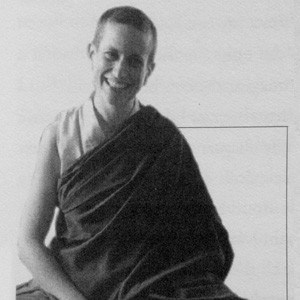
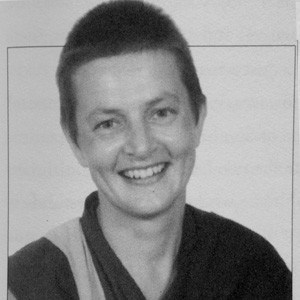
Venerable Jamyang Wangmo
Jamyang Wangmo (formerly Jampa Chokyi) was born in Spain in 1945. She obtained a degree in Law, became a sramanerika in 1973 and studied with Lama Yeshe. In 1987. She received the bhikshuni vow in Hong Kong. An artist, she also translates Dharma texts and prefers to live in retreat when possible. She was co-organizer of ‘Life as a Western Buddhist Nun’.