The Theravada sangha goes west
The story of Amaravati Monastery
 Ajahn Sundara
  Blossoms of the Dharma
  Dec 28, 1999
From Blossoms of the Dharma: Living as a Buddhist Nun, published in 1999. This book, no longer in print, gathered together some of the presentations given at the 1996 Life as a Buddhist Nun conference in Bodhgaya, India.
Ajahn Sundara
For many years I have been a member of Amaravati, a Theravada Buddhist monastery in England. The story of how our monastic community came into existence is an interesting one. My teacher, Ajahn Sumedho, is an American monk who is the most senior Western disciple of Ajahn Chah, the well-known Thai meditation master from the Thai Forest Tradition who passed away a few years ago. In 1975, Ajahn Sumedho visited London as the guest of the English Sangha Trust, a body founded to establish a Theravada monastic order in England. Inspired by Ajahn Sumedho, the trust members asked their chairman to accompany him back to Thailand and request Ajahn Chah to send some of his Western disciples to reside in England.
Ajahn Chah visited England to assess the suitability of the request. In 1977, with his blessings, Ajahn Sumedho and three Western monks fresh from the jungle of northeast Thailand found themselves in a vihara, in an urban setting, occupying a town house on a busy street in central London. They started teaching meditation to a few people, and soon more people came to practice with them and to participate in their daily life. Eventually the place became too small, and the English Sangha Trust decided to look for a property outside London.
Meanwhile the monks continued the tradition of going on almsround and used to walk through a beautiful park close to where they lived. One day a jogger who often crossed their path engaged them in conversation. He returned with them to the vihara, and after getting to know the monks made them an offer. He had bought a forest in the south of England with the wish to develop and preserve it through modern conservation principles. However, such conservation was beyond his means, and he felt that Buddhist monks, whose philosophy advocated a deep respect for all living things, were the ideal people to take care of it. Thus he offered them the use of that forest. It was an unbelievable gift: a beautiful forest of old English oaks and beeches on about 140 acres of land in one of the most attractive parts of the country.
By a fortunate coincidence, Chithurst House, a large Victorian house nearby, had just been put on the market by the rather eccentric old couple who owned it. The chairman of the Trust made a bid which the couple accepted, and later that year the sangha moved into what would become their forest monastery. They spent most of that first summer, with the small lay community who had joined them, clearing the place of forty years of stuff accumulated by its previous owners.
Most of the monks who originally came to Chithurst had trained in Thailand with Ajahn Chah. At the beginning of this century, Buddhism in Thailand had turned more into a social institution and lost touch with its roots. It had become the domain of priests and scholars. In reaction to this, some monks chose to return to a way of life close to the one led and advocated by the Buddha. This revival movement, known as the Forest Tradition, brought new breath into Buddhist monasticism in Thailand. The forest monks lived a simple and austere life according to the Vinaya in solitude in the forest and devoted themselves to the practice of meditation and the realization of the Buddha’s teaching. It is remarkable that a tradition so remote from our materialistic Western culture has been transplanted to the West, and within a relatively short time, has integrated itself into society. In the towns near our monasteries, the sight of monks or nuns on almsround is now familiar.
I arrived at Chithurst in September of that first year. I had just returned from abroad when a friend told me that the monks had moved out of London. I was very busy, but three days later I traveled to Chithurst, curious to find out what was happening at the monastery. I was then a lay person more interested in meditation than in Buddhism itself. Earlier that year I had done a retreat with Ajahn Sumedho, and at the end, when someone had asked me if I wanted to be a nun, I had replied that maybe, when I was seventy and there was nothing left to do. With that frame of mind, I arrived at Chithurst, talked with Ajahn Sumedho, and told him that life and the world were great. Sure the world was full of problems, but it was challenging and that’s what I loved about it. He just said, “Yes, but it depends where the world is.” Something in me stopped. I had read numerous times and been told that the world originated from the mind, but I was living my life as if the world were “outside.” At that moment the understanding lasted just a millisecond. I did not become conscious of the profound effect his insight had on me until three weeks later I realized that I was still at Chithurst! Many doubts had fallen away, and I felt an incredible confidence and inner freedom. I was aware that I had choice: the world was not “out there,” so it was up to me to live my life the way I wanted.
I loved the lifestyle of the retreat I had attended previously: eating one meal a day, getting up early in the morning, and meditating throughout the day. I also valued the silence, the reflections on Dhamma, and having time to think for myself rather than to read books or listen to others’ ideas. So I thought, “Why not carry on in a similar environment for a while?” I still did not think of becoming a nun, but I was confident that spending a few months in a monastic environment and keeping the eight precepts could only be beneficial. I wanted to understand my mind and how it was possible to make peace with it. I had a taste of this during a previous retreat and realized that even for a short time, not contending with myself or the world around me had wonderful effects on my life. At thirty-two, I felt that it was time to find out how I wanted to spend the next fifty years, for it seemed that life was going very fast and there was a real sense of urgency.
Thus I decided to stay at Chithurst. However, this new situation was quite a challenge. Three other women had come to live there also. We did not know each other and came from different backgrounds and different countries. I must confess that even though I had good women friends, I did not like women very much and in general got along much better with men. Also, living within the restraint of the eight precepts, I could not eat after noon or sleep as long as I liked. A great part of the day was spent in Chithurst House which was then a busy work site—cold, dark, and dusty. My temperament was to love beauty, comfort, and clean places! Cooking had never been my favorite pastime, yet I found myself cooking for twenty-five people almost every day in a marquee—a large tent that had been turned into a kitchen. It was full of wasps, and normally it took only one to get me really agitated. But somehow they did not bother me, and I was very happy in spite of all the new challenges, or more likely, because of them.
Shortly after arriving, we became anagarika, or eight-precept nuns. A special ceremony marked our “official” entry into the community. Wearing the traditional white robes of Thai maechees (nuns), and with our hair cropped—we started shaving our head a year later—we formally took the eight precepts in the presence of the monastic community and some friends and were given a new name in Pali. The community consisted then of six monks, four nuns, and a few laymen.
The forest at Chithurst was extremely beautiful and quiet. In the early years, even though we had periods of silent formal practice, most of our energy was spent working on the house that had to be rebuilt inside almost from scratch. In those days a pioneering energy gave the community great impetus and strength to go through difficulties and obstacles with faith. Our daily schedule was in many ways similar to that of Thai forest monasteries. We got up at 4:00 A.M. and walked in the dark from our cottage to the main house to attend morning puja. During the morning we worked in the kitchen, the garden, or the office. The monks continued the tradition of going on almsround while the rest of the community was busy building or working in the forest. Our main meal was at 10:30 A.M. Afterwards we had a rest period and worked all afternoon. After a hot drink and a short break, we gathered for evening puja. Once a week we had a quiet day, a kind of Buddhist Sabbath, which was followed by an all night meditation practice. This schedule has remained more or less the same up to the present, although now there is less physical work, and lay people help us to run the monastery so that we have more time to focus on “inner work.” Initially, just keeping pace with the schedule was a difficult discipline. Having been a dancer, however, I was used to strong physical training. Interestingly, I felt more energetic than before because my energy was not wasted in endless distractions. Ajahn Chah would tell people who were lethargic in meditation, “Sleep little, eat little, and talk little.” How true this is!
Entering into practice
When I came to the community, I did not know the Buddhist scriptures. I was mainly interested in living my life with integrity so that when it ended I would have no regrets. This motivation has given me great incentive throughout my monastic life. Before long I saw, even at a modest level, that it was possible for the mind to abandon negative habits, be truly peaceful, and respond to life from a place of freedom and compassion. This encouraged me to investigate and understand the mind at a deeper level. Training of heart, understanding of Dhamma, and working to realize liberation were clearly ongoing processes, a lifetime’s work that could not be done in just a few months!
Meditation was and still is the foundation of this life. It gave me the clarity with which to look within and see the mind as a mirror. The practice is focused on the teachings of the Four Noble Truths, which in the Theravada tradition is considered one of the most important teachings for realizing nibbana, the goal of the Buddhist teaching. Through awareness of our suffering and understanding of its cause—the first and second Noble Truths—the Buddha teaches that we can let go of the basic illusion that we are a self, an ego. As we keep watching inwardly—thoughts, feelings, the body and its sensations, perceptions, and mind (the five khandas)—we need not be limited or bound by our identification with our body or our mind. By observing again and again how impermanent, painful, and empty of self they are, we can let go of our attachment to and identification with them. Actually, it is more correct to say “there is letting go,” because we cannot find anyone that lets go. This letting go experience is called the third Noble Truth and must be realized. The development of the path is the fourth Noble Truth or Noble Eightfold Path. It is a detailed guide to practice, which is quiet inner work, nothing dramatic. Sustaining mindfulness and a clear vision of the experience in the present moment is important, practice focuses on all aspects that generate, strengthen, and sustain mindfulness. This brings about the wisdom that can break through the delusion of the mind. Outwardly, we use the monastic ethical standard to guide our verbal and physical actions. Slowly, we harmonize the energies of our mind and body by not recreating unskillful behaviors, which are the main sources of our inner conflicts. It is not enough to know that the Four Noble Truths exist. For them to become the Truths that the Buddha realized, we have to gain profound insight into the nature and reality of the mind.
I was amazed that in the midst of a real intense and painful situation, my heart could often remain joyful. Meditation taught me that the suffering I experienced was not a trap anymore but a source of learning. I now had the necessary tools to transform this human experience of greed, hatred, delusion, and selfishness. By looking directly into the mind at the nature of that experience—its impermanence, unsatisfactory nature, and selflessness—it was possible to let go of the undiscriminating habit that kept grasping it. Why do we hold on to suffering? Because at some level we do not understand what it is and how it affects the heart. If we knew, we would drop it straight away. As I observed again and again how little control the mind has over its suffering, it became obvious that pain is not “mine.” What a relief it was to discover that we do have a method to get out of our predicaments!
Prior to joining the community, I avoided the unpleasant sides of life and did not talk about anger, frustration, and selfishness. Harmony, love, philosophy, and art were so much more interesting to me. But, practicing Dhamma, I had to look at the ugly things in myself. People living with me became clear reflections of my mind, and without the social screens we usually put up to alleviate pain, there was no way to hide any more. I kept bumping into this self with its selfishness, anger, pettiness, fear, impatience and so forth. Previously, I thought I was kind, open-minded, and easygoing. But when I looked, I saw how critical and judgmental I was. What a surprise that was!
It was Buddhism’s practicality and relevance to everyday life, not its philosophy, that appealed to me. The practice and the material I was working with were tangible, and I was not interested in reading books. Monastic life was so much more alive than anything I had ever encountered. Often, nothing much seemed to be happening externally, but inwardly, I would be going through a powerful cathartic process. Without a deep commitment to the practice and to the Buddha, Dhamma, and Sangha as refuge, it would have been difficult to transverse those times.
The style of training in this tradition is very appealing to me. Initially, we do not need to study a lot. The monastic environment itself demands that we be alert and mindful. We rapidly learn how the law of cause and effect works at a grassroots level. We discover that if we are not careful, we receive the results of our actions immediately. Also, in community, although we no longer have the usual outlets for our creativity, we discover that this creative energy continues in the most mundane situations and activities. When we were novices, for example, cooking became the field of our artistic creations! My imagination would go wild as I prepared an elaborate meal in no time. But this was not the way to peace! When others cooked, I witnessed my critical mind: “These people can’t cook! They are hopeless! They can’t even cut carrots properly!” In that environment, all my buttons got pushed, and I could be so righteous. I had to train myself to repeat a mantra—”Let go, let go”—all morning while working in the kitchen. I had to concentrate, because in just one moment of heedlessness I would lash out at someone. Sometimes greed would fuel my energy. In that situation the absurd was so obvious that I could clearly see my attachments and how miserable they made me. We need a good sense of humor to recognize and let go of these things.
Every week we practice sitting and walking meditation through the night. Imagine what the mind can conjure up at the prospect of not sleeping all night! It plays every possible trick to justify going to sleep or it creates good, even inspiring reasons to justify the validity of staying up. Sometimes our pride keeps us awake because we have energy to check on others and criticize them, “Look at that one dozing off! How disgusting and shameless!” The judgment lasts until we find ourselves exhausted and join the sloth and torpor lot. Monastic training does not allow us to lie to ourselves for long time because we are in an uncomfortable environment, where people often drive us up the wall and our basic survival mechanisms are challenged. In this setting, the teaching is a constant encouragement to observe our reactions to life with gentleness and love. We discover that just changing our attitude enables us to develop qualities that strengthen and liberate the heart. We tap into an extraordinary reserve of energy when we live this life wholeheartedly. After a while, we experience the mind when it is not preoccupied with itself. It is free, even for a short time, of its inner turmoil; it becomes bright, filled with peace and love.
Women in the community
More women joined our little community at Chithurst, and by 1983 we were eight anagarikas (practitioners with eight precepts). We came from different European countries but shared a similar strong aspiration to practice the Dhamma within a monastic form. In Thailand, Ajahn Sumedho hardly had any contact with nuns. Having women in Chithurst and teaching them was a new experience for him. I don’t think he quite knew what to do with us at first, so we took responsibility for our own training. We were keen on the discipline, which we knew played an important role in transforming the mind. Ajahn Sumedho could see that we were serious about pursuing this way of life and began to consider how women in the West could further their training beyond the traditional form of Thai maechees. In Thailand, women who wish to live in a monastery shave their head, take the eight precepts, and support themselves materially. They are in a rather ambiguous situation: although they are nuns, they do not benefit from the advantages and support traditionally given to the ordained sangha. They primarily support the monks’ community, especially by cleaning the temple and preparing the monks’ daily meal. Currently, however, new models for Thai nuns are emerging that allow them to learn the Dhamma and to train and practice outside the traditional maechee role.
Seeing that European women were serious about practice and would benefit from training similar to that of the monks, Ajahn Sumedho asked permission from the Elders in Thailand to initiate the ten-precept ordination for women. He received their blessing to do so, and in 1983 the four of us who had joined the community in 1979 received the ten-precept ordination in the presence of the bhikkhu sangha and hundreds of people who came to witness this auspicious event. We received a set of brown robes—the robe material being offered by Thai lay supporters—and a beautiful ceramic almsbowl. The latter came as a surprise, as we did not know that we would use a proper almsbowl and were delighted at the thought of going on almsround.
The ten-precept ordination was a major step. It opened to women in the Thai Theravada tradition a way of life and a training quite similar to the one followed by the nuns during the Buddha’s lifetime. This monastic form, based on the ten precepts, made us totally dependent upon the generosity and kindness of others. Through the years this form has evolved in an organic way. There were no models, no precedent to follow. The bhikkhuni order established by the Buddha had died out in the Theravada tradition some fifteen hundred years ago. Thus no lineage had remained for women who wished to live and train following a way of life based on alms—mendicancy, which in the Forest Tradition implies the relinquishment of money and thus of independence on the physical level. On Ajahn Sumedho’s part, it was a true act of faith to establish this training for women as many “reasonable” questions could have prevented it from coming about: Would this traditional form be suitable for Western women? Would it be accepted by the society? Would women monastics in the West be supported as monks have been for the last twenty-five centuries?
For the first year after taking the ten precepts, we followed the traditional Theravada training of a samanera. However, unlike the expansive Vinaya for bhikkhunis, the ten precepts did not deal with many areas of our life. We realized that to live together as a group, we needed to have a common understanding of the precepts, the use of requisites, and many other practical aspects of our daily life. Therefore, we gathered materials from various sources with the help and guidance of a senior monk, Ajahn Sucitto. We selected rules most appropriate to our life from the samanera training and the bhikkhu and the bhikkhuni Vinayas and rewrote them in modern language. In this way, we prepared a Vinaya book and a recitation of the training rules, which we do fortnightly. We also formulated the procedure for clearing the transgressions of our precepts. In this way, we researched the nuns’ monastic life and found that the bhikkhuni Vinaya developed twenty-five centuries ago deals with issues and behavior relevant to our community. Using this discipline to train our body and our speech has proved very effective in helping the mind to relinquish its self-cherishing interests, delusion, greed, hatred, and the idea that we are a permanent self. The discipline also promotes harmony because we follow agreed-upon standards. Instead of spending hours discussing the best way to do this or that, we turn to the Vinaya for advice and benefit from the wealth of experience and wisdom of this discipline.
By 1983, our cottage at Chithurst had reached its full capacity, and several other women were waiting to ordain. Plans were made to find a new place, and a year later Amaravati Monastery was established in Hertforshire, England. In 1984, the nuns moved to Amaravati. To celebrate this auspicious event we decided to go there on foot, following an ancient practice of Buddhist renunciants called tudong in Thailand. This practice is usually undertaken by monks to face new challenges and test themselves after their initial period of training. In England, this has become a regular feature of our life, and every year monks and nuns go on tudong. We walk, carrying our bowl and a few belongings, around Britain, Ireland, or other European countries. Sometimes we go in a group of two or three, accompanied by an anagarika or a lay friend, and other times we travel on our own without money. We depend on whatever people offer us for our daily meal and material necessities. It is a journey in faith, we never quite know what the next day will bring and are instantly brought into the present moment. Although it may be difficult at times, many of us have found this experience to be rewarding and joyful. In addition, most of the people we meet on the way are friendly and are inspired to see monks and nuns still living on faith.
Our tudong to Amaravati took three weeks. Upon our arrival, we were welcomed by the sangha and the lay community who had come to join in this happy occasion. Our new dwelling place was located on top of a hill under a vast open sky. It had originally been a school and was a large complex of wooden buildings. Like Chithurst, it was in a very attractive part of the country. Large enough to accommodate many people, it offered an excellent situation for hearing and practicing the Dhamma and for a wide spectrum of activities. We now have a retreat center, a large library, summer camps for families and children, regular meditation workshops, seminars, and interfaith gatherings.
After receiving guidance and Vinaya training from Ajahn Sucitto for a few years, we nuns became more experienced and confident in using the ten precept form and took responsibility for the running of our own community. This was an important shift, for until then we had been emulating of the male community and had adapted a hierarchical model. When we became more autonomous, we learned to work together in tune with the needs of female monastics. We had to assume many responsibilities, a challenging process as none of us had much experience in this way of life. For the last few years, the senior nuns have overseen the training of the junior members and offered them guidance and support in their Dhamma practice. We have also managed the affairs of the community and shared the administrative duties and responsibilities of the monastery. We regularly receive invitations to teach and to lead retreats in England and abroad. By 1986, seventeen nuns and novices lived in the two nunneries of Chithurst and Amaravati. Recently, a third place—the first experiment of a totally autonomous nunnery—has been established in Devon.
It is still too early to anticipate how our community of nuns will evolve in the future. We have learned that this is always wonderfully uncertain. But the seed has been planted and through the deepening of our trust in the Dhamma, it will continue to be nurtured and will bring many fruits for the benefit and happiness of all beings.

Ajahn Sundara
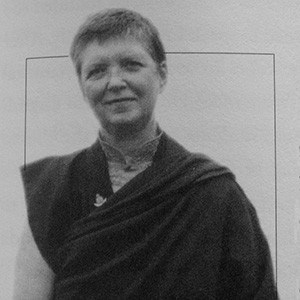
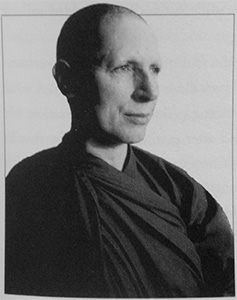
Born in France, Ajahn Sundara ordained in the Theravada tradition as an eight-precept nun at Chithurst Monastery in England in 1979. In 1983 she received the ten-precept ordination and went to live at Amaravati Buddhist Monastery in England. Subsequently, she resided at Wat Marp Jun in Thailand and recently returned to England to become the abbess of a new nunnery in Devon. (Photo courtesy of Amaravati Buddhist Monastery)