A new possibility
Introducing full ordination for women into the Tibetan Buddhist tradition
 Venerable Thubten Chodron
  Tibetan Tradition
  Mar 18, 2006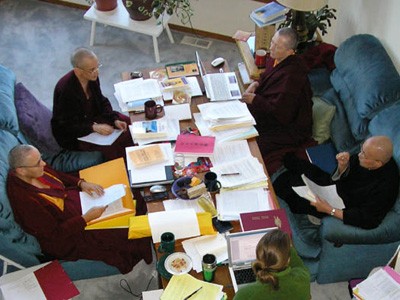
It was 1986, and my life as a nun was changing in a profound way. I had been a sramanerika (novice) in the Tibetan tradition since 1977 and was now in Taiwan, to receive the bhikshuni vow. The 30-day vinaya training was excellent and the example of so many educated and active Chinese bhikshunis inspiring. Still, it took some time before the meaning of holding the full monastic vow sank in.
Importance of the four-fold community
The existence of the “four-fold community”—groups of four or more fully ordained monks and nuns (bhikshus and bhikshunis) and male and female lay practitioners holding the five precepts (upasakas and upasikas)—establishes a place as a “central land” where the Buddhadharma flourishes. Historically, it has been the monastic community, with the aid of lay followers, that has been responsible for the continuation of both the scriptural and realized doctrine. The monastic sangha preserves the scriptural Dharma by learning and teaching it; it preserves the realized Dharma by putting those teachings into practice and actualizing them in their own being. While these activities are not limited to monastics—lay practitioners can and should engage in them—living a simple lifestyle without family or many possessions gives monastics more time and fewer distractions to do this. Monastics contribute in myriad ways to the well-being of society by living with excellent ethical conduct and consciously cultivating tolerance, love, compassion, and wisdom. They teach others how to do the same. A community of monastics practicing in this way radiates tremendous positive force in a world asphyxiated by the ignorance, greed, and hostility of consumerism and terrorism.
Despite the importance of the four-fold community, the bhikshuni sangha is currently absent in some Buddhist traditions. To understand this, let’s trace the development of the Bhikshuni Order and see how the ordination is given.
Nowadays three levels of ordination exist for nuns: sramanerika (novice), siksamana (probationary), and bhikshuni (full). These ordinations are received gradually in order to prepare and accustom one to keep the full precepts and to assume the privileges and responsibilities of a fully ordained sangha member. One becomes a bhikshuni by receiving the ordination from a sangha of the fully ordained, and it is important that this transmission be traced back to the Buddha in an unbroken lineage. Women receive bhikshuni ordination in front of two sanghas, a community of twelve bhikshunis and ten bhikshus. In lands where such a large number of monastics does not exist, communities of five monks and six bhikshunis can give the ordination.
Brief history of bhikshuni ordination
Six years after the Bhikshu Order was established in India in the sixth century B.C.E., the Buddha established the Bhikshuni Order. The bhikshuni lineage flourished in ancient India and in the third century B.C.E. spread to Sri Lanka. From there it went to China in the fifth century C.E. Due to warfare and political problems, the lineage died out in India and Sri Lanka in the eleventh century, although it spread throughout China, Korea, and Vietnam. Although there are sramanerikas (female novices) who are ordained by Tibetan monks, the Bhikshuni Order was not established in Tibet due to a sufficient number of bhikshunis to give the ordination not having crossed the Himalayan Mountains. Nevertheless, there are a few historical records of bhikshunis in Tibet receiving their ordination from monks.
The bhikshuni ordination was never extant in Thailand. Currently, in Thailand and Burma, women receive eight precepts and in Sri Lanka ten precepts. Although they live in celibacy and wear robes demarcating them as religious, their ordinations are not regarded as monastic ordinations, nor are they considered to be part of the sangha.
As Buddhism spread in ancient India, various vinaya schools developed. Of the eighteen initial schools, three are extant today: the Theravada, which is widespread in Sri Lanka and Southeast Asia; the Dharmaguptaka, which is followed in Taiwan, China, Korea, and Vietnam; and the Mulasarvastivada, which is practiced in Tibet. All of these vinaya schools have spread to Western countries in recent years. Considering that the vinaya was passed down orally for many centuries before being written down and that the various schools had little communication with each other due to geographical distance, it is amazing that the monastic precepts are so consistent throughout. The differences among them are minor. Over the centuries, each school has developed its own ways of enumerating, interpreting, and living the precepts that accord with the culture and climate of that place.
Current situation of bhikshuni ordination
In recent years, some women who hold eight- or ten-precept in countries where the bhikshuni sangha does not currently exist wish to receive that ordination. In 1996, ten Sri Lankan women received the bhikshuni ordination from a Korean sangha in India, and in 1998, over twenty Sri Lankan nuns received it in Bodhgaya, India, from Dharmaguptaka bhikshunis and Theravadin and Dharmaguptaka bhikshus. The bhikshuni ordination has subsequently been given several times in Sri Lanka, and while initially some Sri Lankan monks opposed this, some prominent monks supported it. Nowadays Theravadin bhikshunis, who number over 400, are accepted by Sri Lankan society.
Since the early 1980s, over fifty Western women and a handful of Himalayan women who practice in the Tibetan tradition have gone to Taiwan, Hong Kong, Korea, or in more recent years to the USA, France, or India to receive the bhikshuni ordination. A few Western women who practice in the Theravadin tradition and a handful of Thai women have received bhikkhuni ordination in Sri Lanka.
Among Tibetans, bhikshuni ordination is closely related to the possibility of having geshe-mas—female geshes. For over fifteen years, some Tibetans nuns have been diligently studying Buddhist philosophy and debating. They have now reached the vinaya class, the last before taking the geshe exam. Traditionally, only those who are fully ordained are allowed to do the complete vinaya studies required for the geshe degree. Thus, enabling the Tibetan nuns to become bhikshunis so that they can study the vinaya just as the monks do is crucial for producing the first generation of geshe-mas whose degrees are equal to those of the monks.
While the Department of Religion and Culture of the Tibetan Government-in-Exile has been researching the possibility of introducing bhikshuni ordination into the Tibetan tradition since the early 1980s, no conclusion has been reached thus far. In 2005, His Holiness the Dalai Lama repeatedly spoke about the bhikshuni ordination in public gatherings. In Dharamsala, His Holiness encouraged, “We need to bring this to a conclusion. We Tibetans alone can’t decide this. Rather, it should be decided in collaboration with Buddhists from all over the world. Speaking in general terms, were the Buddha to come to this 21st century world, I feel that most likely, seeing the actual situation in the world now, he might change the rules somewhat… In many countries of the world, not just within Buddhism, women have great faith in religion. Within the Buddhist countries in the Himalayan region, it is women who have greater faith in their religion. Hence nunneries become very important and accordingly, nuns’ studies should be of high quality. If, gradually, the lineage of bhikshuni ordination can be introduced, it would be good.”
Later, in Zurich, during a 2005 conference of Tibetan Buddhist Centers, His Holiness said, “Now I think the time has come; we should start a working group or committee” to meet with monks from other Buddhist traditions. Looking at the German bhikshuni, Ven. Jampa Tsedroen, he instructed, “I prefer that Western Buddhist nuns carry out this work… Go to different places for further research and discuss with senior monks (from various Buddhist countries). I think, first, senior bhikshunis need to correct the monks’ way of thinking.”
“This is the 21st century. Everywhere we are talking about equality… Basically Buddhism needs equality. There are some really minor things to remember as a Buddhist—a bhikshu always goes first, then a bhikshuni… The key thing is the restoration of the bhikshuni vow.” His Holiness also mentioned the introduction of the bhikshuni ordination at the inauguration of Dolma Ling Nunnery in 2005, and at the 2006 Kalachakra ordination in India.
Recent research on establishing bhikshuni ordination in the Tibetan tradition
Bhikshuni Jampa Tsedroen together with Ven. Tenzin Palmo, Ven. Pema Chodron, Ven. Karma Lekshe Tsomo, and Ven. Thubten Chodron formed a committee of Western bhikshunis that His Holiness suggested. Bhikshuni Heng Ching Shih, a professor from Taiwan, is their advisor. In March, 2006, we met at Sravasti Abbey in Washington State to research and translate vinaya passages showing that bhikshuni ordination is possible within the Mulasarvastivada system of Tibet. Our research has been submitted to the Department of Religion and Culture and will be presented at a conference of Tibetan vinaya masters in May of this year. Another conference of abbots, rinpoches, and high lamas is planned in August to discuss the bhikshuni ordination in the Tibetan tradition.
All vinaya traditions agree that dual ordination—ordination by a bhikshuni and a bhikshu sangha—is optimum and prescribed by the Buddha himself. In fact, sramanerika and siksamana ordination are to be given by bhikshunis, and nuns should do their confession and restoration of precepts (sojong) before the bhikshuni sangha. How are these to be accomplished if there are no bhikshunis ordained in the Tibetan Mulasarvastivada tradition at present?
Through our research, our committee has found Chinese texts establishing the unbroken lineage of Dharmagupta bkikshus going back to the Buddha and of bhikshunis going back to the first bhikshuni in China in 357 C.E. We have clarified the ordination procedures followed in East Asian countries and found them sound. We have also found vinaya passages indicating that a monks’ sangha alone can give the bhikshuni ordination. Therefore, we are proposing some options for Tibetan vinaya masters to consider. Without going into the intricacies of vinaya, (1) nuns could receive dual ordination by a Dharmaguptka bhikshuni sangha and a Mulasarvastivadin monks’ sangha, with the new bhikshunis receiving the Mulasarvastivadin precepts, or (2) nuns could be ordained as bhikshunis by a sangha consisting of Tibetan monks of the Mulsravastivadin tradition alone. In either case, after the new bhikshunis have been ordained twelve years, they will be qualified to serve as the bhikshuni sangha in a dual ordination procedure.
Since this is a sangha matter, Tibetan monks will decide if and how to do this. It cannot be decided by popular vote in society or by His Holiness the Dalai Lama as an individual. If bhikshuni ordination could receive international acceptance through an international conference of vinaya masters of various Buddhist traditions, as His Holiness suggests, it could open the door for women from other Buddhist traditions to receive the bhikshuni ordination as well.
The existence of full ordination for women is not a feminist issue. It concerns the preservation and spread of the Dharma. It is about individuals having the possibility to progress on the path to enlightenment by means of living in full precepts. It enables lay practitioners and society in general to reap the benefits of having educated and confident bhikshunis in their midst.
Personally, receiving the bhikshuni vow has had a huge impact on me. Previously I’d been primarily concerned with my own Dharma practice, thinking of whom to study with and where to do retreat so that my practice would advance. I was content to sail on the tremendous wave of virtuous energy created by millennia of monastic practitioners. Now as a bhikshuni, I am a full member of the sangha and must assume responsibility for the continuation of the monastic tradition and the existence of the Dharma in our world. Instead of simply relying on others to preserve the Dharma as I’d done in the past, I now have to contribute to this virtuous wave so that future generations may enjoy the precious Dharma and vinaya. I am grateful for the opportunity to have received this ordination and to the lineages of monastics who preserved it over the centuries. Through our efforts, may all sentient beings throughout infinite space benefit!
An audio recording on this topic is also available.

Venerable Thubten Chodron
Venerable Chodron emphasizes the practical application of Buddha’s teachings in our daily lives and is especially skilled at explaining them in ways easily understood and practiced by Westerners. She is well known for her warm, humorous, and lucid teachings. She was ordained as a Buddhist nun in 1977 by Kyabje Ling Rinpoche in Dharamsala, India, and in 1986 she received bhikshuni (full) ordination in Taiwan. Read her full bio.