|
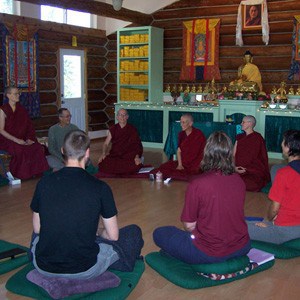
Exploring Monastic Life 2008
Conducted by Ven. Thubten Chodron©
Sravasti Abbey, Newport, Washington, USA
18 August - 2 September, 2008
18 August 2008
Introduction
Venerable Chodron gives a brief introduction into the schedule of the week-long, Exploring Monastic Life gathering that is held annually at Sravasti Abbey, Newport, Washington. Venerable provides guidelines for participants on how to follow the monastic way of life while engaging in activities at the Abbey. Following the introduction is a brief question and answer period.
[25 minutes] : Download mp3 file
20 August 2008
The Benefits of Precepts
Venerable Chodron describes the causes of the unsatisfactory conditions in which we live, and the Three Higher Trainings which lead to freedom from unsatisfactory conditions. She then explains the relationship between ethical conduct and keeping precepts. Venerable Chodron differentiates between the five lay precepts and the monastic precepts, and explores the benefits of monastic life over lay life, highlighting the difficulties of being ordained while living in a non-monastic environment. She also responds to questions and comments.
[96 minutes] : Download mp3 file
20 August 2008
Taking and Holding the Precepts
Venerable Chodron discusses taking and holding the precepts. She talks about each precept and gives examples to clarify their purpose. She discusses the ten advantages of taking precepts and the history of their origin. Delving into both how they help us as individuals and how they help the community, Venerable Chodron explains how they help us to overcome our afflictions and how they work to bring peace and happiness to the community
[25 minutes] : Download mp3 file
20 August 2008
The Fruits of the Homeless Life
Venerable Chodron discusses the portion of the Samanapala Sutra dealing with the fruits of the homeless life. She begins with an overview of what "homeless" refers to in a monastic context including issues such as socializing and visiting family and friends, and receiving gifts and donations. She then reviews the topics included in the text including appropriate bodily conduct and speech, meal consumption, and entertainment for a monastic. A short Q&A is included at the end.
[72 minutes] : Download mp3 file
23 August 2008
The Life of the Buddha
Ven. Chodron summarizes Buddha's life story to show us the direction we can go in our mind training. She speaks about the behavior of Buddha's monastic disciples in relation to inspiring faith in the lay community. She tries to get at the intentions behind some of the monastic precepts and suggests how we may carry those intentions into contemporary monastic life in our culture; specifically, she addresses internet usage, pollution, storage of goods, entertainment, chairs, beds, and meditation cushions, cosmetics, gossiping, arrogant disputation, errands, and deception.
Q & A
- Buddha's crown protrusion and hair.
- Remembering all the things to avoid.
- Deception and not saying everything about a situation.
[69 minutes] : Download mp3 file
24 August 2008
Livelihood For Monastics
Ven. Chodron speaks about avoidance of activities to clear the sense field and stop searching for happiness outside, but within the mind instead. She talks about the wrong means of livelihood that Buddha mentioned and the differences between Buddhism and prevalent cultural practices. She speaks of the danger of doing "magic." Then she explains the emphasis on correct view for dharma practice and gives examples of some of the 62 wrong views.
Q & A
- Not having a job
- Offering services to a monastery to help it function; bodhicitta in practical application.
[47 minutes] : Download mp3 file
28 August 2008
Mindfulness and Checking Awareness
This teaching begins with a question relating to patterns of emotion and thought posed by one of the program participants, and then a subsequent discussion. The discussion veers into the topic of authority and accepting decisions without having a say in them. Following this, Ven. Chodron continues to teach on the Sutra on the Fruits of the Homeless Life. She explains that those who perfect ethical conduct are free of danger because danger comes from negative karma and they also have the bliss of blamelessness. She talks about the restraint of the sense faculties.
Q & A:
Do the seeds accumulated over the past form a pattern?
[81 minutes] : Download mp3 file
29 August 2008
Contentment
Ven. Chodron continues to speak on the Sutra on the Fruits of the Homeless Life. She talks about the mind that always wants more and better and how monastic life is a training in contentment. She reflects on the misery of craving. She briefly mentions the five hindrances to concentration.
Q & A:
- Cultivating contentment and the danger of becoming lackadaisical
- Desire for pleasure of dharma practice
- Ambition for retreats/ teachings and taking a spot when there are limited seats
[47 minutes] : Download mp3 file
31 August 2008
Deciding to Become a Monastic and Careers
This teaching is a discussion between Ven. Chodron and the participants of EML, continuing from the group discussion. Participants share their experiences with careers. Many topics are subsequently raised, such as what it really means to be useful and help someone; the ideas of justice and fairness in the framework of karma; transforming the mind and applying the antidote with compassion; the motivation to ordain; and coming to the decision to ordain based on the lam rim meditations, as well as other topics. Some of the abbey's monastics share what motivated them to ordain.
Q & A :
- Lessening someone's negative karma
- Insanity and breaking precepts
- Word for Martin Luther King Jr.'s/ Gandhi's quality in dharma – ahimsa
- Why are there more Western senior women in robes than men?
- How do you distinguish whether you see monastic life as a career or not?
- Signs that you're ready to ordain
[99 minutes] : Download mp3 file
2 September 2008
Concentration
In this teaching – one of several in a series for Exploring Monastic Life retreat – Venerable Chodron continues telling the life story of the Buddha, starting at the point where he enters meditation and completes the perfection of concentration underneath the bodhi tree. Quoting closely from scripture, she explains four of the five hindrances (ill will and hatred; sloth and torpor; restlessness and worry; doubt) and the four jhana stages which purify them (subsiding of thinking and pondering; inner tranquility and openness; equanimity and mindfulness; mental clarification and development of supernatural powers.)
[53 minutes] : Download mp3 file
2 September 2008
Ven. Bhikkhu Bodhi on Monastic Life
Bhikkhu Bodhi speaks about Buddhist monastic life in America today in three sections; the Buddhist aspect, the monastic aspect, and the America today aspect. He speaks about faith and having a clear confidence in the Buddha when ordaining. He speaks about situating oneself within a certain Buddhist tradition that is affiliated with a specific Asian country. He talks about how becoming a monastic places one in a close relationship with the Three Jewels, in that one follows the Buddha's example and has the time and ideal external conditions to learn the Dharma and put it into practice. He warns about the possibility of boredom if one doesn't use one's time skillfully. He talks about living in community and being a member of the Buddhist Sangha. He mentions some of the special challenges of being a Buddhist monastic in a secularized Christian society. He calls attention to the special role of monastics to dispel the illusion of where happiness is to be found, challenging the mainstream consumerism.Q & A:
- Has our culture lost the sense of its origin as far as Christianity goes? This sets us up for a lot of bias.
- If you (Bhikkhu Bodhi) were seeking ordination today in the Theravada tradition, where would you go and who would you seek to study with?
- What does it mean to be guided by community principles but not to be engulfed by a group? Can you give advice on that?
- How do we convince our loved ones about leading a homeless life so it will not be too painful for them?
- How can somebody let go of attachment to their parents or children?
- How do we avoid going to the extremes of proselytizing or just hoping the world will notice?
- I'm having trouble with rebirth - can you say something about that? Without believing in rebirth would you have chosen a monastic lifestyle?
[100 minutes] : Download mp3 file
|