Inspiration to ordain
Inspiration to ordain
 Venerable Thubten Chodron
  A Nun's Life
  Mar 14, 2003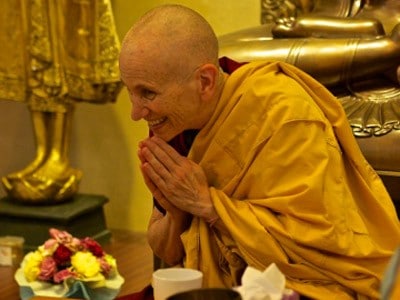
An interview with Venerable Chodron by Mahabodhi Society of USA.
Mahabodi: How old were you when you met Buddhism?
Venerable Thubten Chodron (VTC): I was 24. I was teaching elementary school in Los Angeles and going to graduate school.
Mahabodi: Could you talk about the reason that you became a nun?
VTC: I grew up during the Vietnam War, and as a young person I had many questions. I wondered why our government was fighting a war for the purpose of living in peace. I wondered what the purpose of life was. I couldn’t find answers for these kinds of questions from adults such as my parents, family, friends or teachers. Nobody could give answers that satisfied me.
When I went to the religious people in the community, their answers didn’t make any sense to me either. I couldn’t understand their idea of God and asked, “Why did God create the world? If He created it, why didn’t he do a better job?” I couldn’t figure it out, so when I went to college I abandoned religion altogether, even though those questions remained. Later on, when I was in graduate school and was teaching in L.A., I saw a flyer about a meditation course led by two Tibetan monks, so I decided to go. I was only going to go for part of the course, but I wound up staying for all three weeks, because it was so interesting. One of the things they said was, “You don’t have to believe everything we say.” I really liked that, because I was so tired of people telling me what the Truth was and what I should believe. Instead, Lama Yeshe and Zopa Rinpoche said, “We just teach you. You think about it and see if it makes sense to you. You decide for yourself.”
When I heard the teachings and started meditating on them, I saw that they described my life. Even though the Buddha lived 2,600 years ago, what he was talking about applied to me in modern America.
I went to this meditation course in the summer of 1975 and was supposed to go back to teaching that autumn. But Buddhism affected me so strongly that rather than go back to my work, I quit my job and went to Nepal. In 1975, it was very difficult to find Dharma teachers teaching in English in America. Everything is in Chinese, Japanese, or Vietnamese, and I didn’t know any of those languages. My teachers spoke English, but they lived in Nepal, so I went halfway around the world to receive teaching. That’s what I had to do.
Mahabodi: Why did you choose Tibetan Buddhism?
VTC: At the beginning, I didn’t know there were different Buddhist traditions. All I knew was that I went to these masters and they helped me, so I came back again and again. I never really knew until much later that there are different traditions. But I was satisfied with what these teachers said and how they guided us, so I didn’t feel the need to investigate other Buddhist traditions before deciding what to practice.
Mahabodi: What is the difference before and after you met Buddhism?
VTC: Huge differences! I was so confused before, because the world didn’t make sense. Buddhism gave me a worldview that could explain my life experience, why things are the way they are, and what I can do to work with my mind and emotions in a constructive way. So one of the changes was that I stopped being confused. Another change was when I was in college, together with the confusion (Who am I? What do I want to do? Nobody loves me—how most kids feel when they are making the transition to adulthood), I sometimes got depressed because I didn’t understand what the purpose of life was. Since I met Buddhism, depression hasn’t been a problem, because Buddhism establishes the purpose and meaning of life, and there is something positive that we can do. It makes a huge difference!
Buddhism also helped me so much with my anger. I became more tolerant of people, more accepting of others and of myself. I still have a long way to go, but there has been progress.
Mahabodi: What inspired you to become a nun?
VTC: What really impacted me in the Buddhist teachings was the whole idea that happiness and suffering come from our mind, not from outside. The Buddha also pointed out how selfishness, anger, and attachment are the causes of suffering, which I had never thought before. I always thought that attachment was wonderful. When I heard the Buddha’s teaching and looked at my experience, I think the Buddha was really right. Ignorance, anger, and attachment do cause suffering; that is true. The teachings about karma also made sense to me. When I was growing up, I wondered, “Why are things the way they are? Why was I born me?” I grew up in America and was aware of people who were poor in the world, and I kept thinking, “How come I have such a comfortable life? I didn’t feel right; it didn’t seem fair. How come it’s like this?” When I heard about karma, that explained to me how the present situation evolved; and when I heard about compassion and bodhicitta, it explained to me what I can do to change the situation, because I felt resources should be distributed more equally. Buddhism gave me an avenue of action, a path to follow.
Mahabodi: What Buddhist book has affected you the most?
VTC: I have to say Lama Tsongkhapa’s book Lamrim Chenmo, or Stages of the Path to Enlightenment has affected me the most. In it, he laid out the principal teachings of all the sutras and commentaries in a gradual path. When the Buddha taught, he wandered and gave different teachings to different people, according to their dispositions. We now have access to all the sutras, but we don’t know what to study first, what to study next, and how does it fit together. Lamrim Chenmo presents the teachings in a very methodical way. First you meditate on this, then you meditate on that, and so on. I appreciate its systematic approach.
Another thing that attracted me to Buddhism was that it gave ways to train our mind and open our heart. For example, people say, “Love thy neighbor as thyself,” but I didn’t see anybody who did, and I couldn’t either. You can’t just say to yourself, “I have to love everybody.” That doesn’t change how you feel. But what Lama Tsongkhapa did is he took the Buddhist teachings and arranged them in a way so that you can see how to go about changing your mind. He showed how to see other sentient beings in a more affectionate way and how to develop equanimity, love, and compassion towards them. He taught exactly how to meditate in order to develop those feelings. I really like that, because we need a method to practice to change how we think and feel. We can’t just say, “I should be patient. I should love them.” Telling ourselves how we should feel doesn’t change how we do feel. We need a method to look into our mind to understand that what we’re feeling is incorrect: When I’m angry, I’m not perceiving reality correctly. That’s why my anger is something to be abandoned, because it does not perceive things as they are. This kind of analytical way to look into the mind and change it has been very useful for me.
Mahabodi: What was the most memorable phrase you can remember from your teachers?
VTC: There are two that come to mind. One time Lama Yeshe asked me to lead a meditation course. I was a new nun at that time and didn’t feel like I knew very much or had much to share with other people. So I went to Lama and said, “I can’t do this. I don’t know enough.” Lama looked straight at me and replied, “You are selfish.” WOW! Was that a shock. So what that meant to me was that even though I’m not a bodhisattva, I should still help in whatever way I’m capable of, instead of refusing to try. That really made an impact on me.
I remembered very clearly another time when Lama was talking to all the sangha. He picked up his prayer beads and said, “Your mantra should be: I am the servant of others. I am the servant to others. I am the servant to others.” He clicked his beads and said, “This is what you should remember over and over again.”
Mahabodi: Did teaching elementary school help you in teaching Dharma?
VTC: I was always learning how to teach. When I studied education, it was during the time of Open Classroom. They were encouraging teachers to let students explore and learn according to their interest. So that may have influenced me in terms of having a lot of Dharma discussion groups. But I haven’t consciously taken anything I learned about teaching and used it in teaching Dharma.
Mahabodi: After you ordained, have you ever read the Bible again?
VTC: I never read the Bible again after I ordained, but Buddhism has helped me to understand teachings from Judaism and Christianity better than I did before I met the Dharma. But I never had much interest in the Bible so I haven’t read it. When I was young, I tried to read it, and I went to Sunday school, but it just made me have more questions. But I have to respect that those religious beliefs help other people. For example, I recently went to a Catholic-Buddhist nuns’ conference. The Catholic nuns are wonderful women, and some of them have been ordained for forty or fifty years. They are people with integrity and deep spirituality, which they gained from the Bible. It was interesting, though, that they wanted to learn from us Buddhists about how to tame the mind and how to work with emotions. They asked many questions along that line.
Mahabodi: How do you reflect on 9-11 and the Iraqi war as a Buddhist practitioner?
VTC: I can’t tell anybody what their political views should be, because that is not my role. Buddhists may have a variety of political views. Nevertheless, Buddhist teachings can help us understand what happened and enable us to respond appropriately. When we are harmed, the Buddha suggested that we ask ourselves, “What did I do to get myself in this situation?” instead of looking outward and blaming somebody else. My hope is that America will do some self-reflection about what we did in relationship to other countries that provoked so much hostility towards us. If we reflect on some of our economic and political policies, if we investigate some of the things the CIA has done, we might discover why other countries don’t trust us. In the present Iraqi war, it’s very clear that we don’t have the support of the international community. Why? This has to do with our previous behavior towards other countries.
It would be beneficial to reflect on our motivation. The Buddha said that we should try to have a genuine, pure motivation, and not a selfish one or a fake one that looks good but is actually corrupt. In the case of the Iraqi war, we’re saying that we want to liberate the Iraqis, but I don’t remember any Iraqis asking us to liberate them. It becomes very clear that U.S. is doing it, firstly, because it wants Iraq’s oil to support our very luxurious lifestyle; and secondly, we want a military base in the Middle East, so we can threaten other countries. In that way they will go along with our economic policies so that we can have more riches. With that kind of motivation no wonder other countries don’t trust us.
I think we have to, as individuals as well, look at our consumer lifestyle. We’re only a small percentage of the world population, yet we use an enormous percentage of the world’s resources. That’s not right. The Buddha taught us to cherish others. Only if we take care of other people and society in general can we really be happy. The world is so interconnected now, that only if we care for the people of other countries and meet their needs, instead of taking advantage of them, can we have happiness. These different Buddhist principles can be applied to the current situation.
How wonderful if we Americans would learn about and really help people of other countries according to their culture and their value system, instead of trying to make everybody capitalist like us. Because of the differences in values and in culture among peoples, I don’t think capitalism is necessarily the right way for everybody. How wonderful it would be if we respected other peoples’ cultures, instead of insisting that they should have our culture, where sex and violence is so prominent. Why are we exporting our fascination with sex and violence to other countries when it is harming our own country?
Respecting other cultures is very important. Regarding democracy, we can’t simply go into a country and tell everybody they are now going to be democratic. People have to learn what democracy means and decide they want it. In some cultures decisions are made in other ways and leaders are chosen in ways that correspond with their societal values. We have to respect that.
Mahabodi: Many religious people believe their religion is the best. What’s your view?
VTC: From the Buddhist viewpoint, we say that all religions have something good in them. Each sentient being has their own disposition and their own way of thinking, so it’s up to each person to find what religion makes sense to them according to their individual ways of thinking. All the religions teach ethical conduct; all teach restraint from harming others; they all teach generosity and being kind. The theological part—do you believe in God or Allah? Do you believe that our mind is the root of happiness and suffering?—is not so important in terms of living a wholesome life, getting along with others, and creating a peaceful world. In Buddhism, we’re very glad that there is multiplicity in religions, because that way everybody can choose what is suitable for them.
In Mahayana Buddhism they talked about the great bodhisattvas who appear in the world according to different sentient beings’ karma and way of thinking. Bodhisattvas don’t always appear as Buddhists. Perhaps Moses, Jesus, and Mohammed were bodhisattvas who appeared at that time in history in order to help those people. Maybe Mother Teresa was a bodhisattva.
I think many problems the world currently faces occur because religion is being used as a political force. This happens because people don’t really practice the teachings on ethical conduct and compassion taught in their own religion. I think that if Moses, Jesus, and Mohammed came here and saw what people are doing in their names, they would be horrified.
Mahabodi: What was the intention of your books?
VTC: I never intended to write a book. What happened was that when I was in Singapore, people kept asking similar Dharma questions over and over again. One lady gave me a computer though I didn’t ask for one. Then a man came and said, “We have a tradition of printing Dharma books for free distribution in Singapore. If you ever want to publish a book, I will help you print it.” These three things came together, and I started writing a series of questions and answers. This became my first book called I Wonder Why, which was published in Singapore. I later revised it and added more questions and answers, and it became Buddhism for Beginners, which Snow Lion published in the US.
When I was teaching young people in Singapore, they often asked, “Can you recommend a good book in English, that doesn’t have a lot of complicated Dharma vocabulary in Chinese, Tibetan, Pali, or Sanskrit, something that I can give to my mother or my friend to read.” I couldn’t think of anything, so due to their encouragement, I began to write one. That’s how Open Heart, Clear Mind and Taming the Mind came out.
Transforming the Heart is actually a book by my teacher Geshe Jampa Tegchok. He gave me some of his teachings and said, “If you want to, please make these into a book.” So I did. It was a delight to work on this manuscript because Geshe-la is an excellent teacher who explains the Dharma very clearly.
Blossoms of the Dharma came about because in 1996, I helped to organize a three-week educational program for Buddhist nuns in Bodhgaya. We had a bhikshuni master from Taiwan as well as Western nuns and a Tibetan geshe who gave talks and teachings. I edited the Vinaya teachings by Ven. Bhikshuni Master Wu Yin to make a book called Choosing Simplicity, a Commentary on the Bhikshuni Pratimoksha (the nuns’ vows). I edited the talks of the Western and Asian nuns into the book Blossoms of the Dharma. We need more information about monastic life and the nuns’ voices need to be heard. People want to know what women do and how they practice because until now, most books are about male practitioners.
Mahabodi: What is your vision for Sravasti Abbey?
VTC: Ordained people who have grown up in the West need a monastery in the West where they can train. Regarding Tibetan Buddhists, at present in the USA, there are a few groups of monks and nuns living here and there, but not a monastery where people can be supported and train as monastics. The situation of Western monastics in the Tibetan tradition is different from other monastics. Because the Tibetans themselves are refugees, they can’t support the Western monastics. In fact, they look to the Westerners to help support the Tibetan monasteries, because they have to build their monasteries in the refugee community in India and restore monasteries in Tibet. So Western monastics in the Tibetan tradition have very little support. There is no church or large institution that takes care of us, and the Tibetan community is unable to support us. Western monastics are trying to keep their vows, but that is difficult to do when some of them have to get a job in the city in order to have the money to eat and have a place to live. I ordained 26 years ago and vowed not to work at a regular job. Somehow I’ve managed, but there have been times when it was quite difficult for me financially. However, most of the time I lived in Asia. When I see monastics in the West who now have to put on lay clothes and grow their hair out in order to get a job, I feel very sad. How can someone live like a monastic if they have to do that just to survive? Therefore, a monastery is essential so that these people will have a place to live, train as monastics, and study and practice the Dharma.
There is great need in this country and other Western countries for Dharma teachers who can teach in English. Monastics who study and practice at Sravasti Abbey will be able to do this, which will greatly help the larger Buddhist community.
Another benefit of the Abbey is to provide a place where lay people can come and practice the Dharma while living in a community. Many lay people live very stressful lives with little time to learn the Dharma. They can come and stay in the Abbey, live with the monastics, offer service to the community, and study and practice the Dharma. Lay people need a place to go where they can get in touch with their inner Dharma practice and their own spiritual values. I would like to have activities for young people at the Abbey too, for example a youth camp in the summer.
Monastics at the Abbey will help put more teachings in English on the Web, and if there’s someone who can translate into Chinese and other languages, that would be great. Then there’ll be more books in Chinese. We can put together some short, informal (not technical language) books in English and Chinese for children, so they can read too.
So that’s my vision. I want the Abbey to be in a rural setting, where there is lots of land and where the beauty of nature helps relax the mind. But we want it to be close enough to a city so that people can come easily. A large piece of land is necessary, so that we don’t have a housing development or shopping mall next door 20 years from now. The most pressing need is the financial support to get the land and to build the buildings we need. Without the place we can’t do anything else. Once we have the land, we can start building on it. Then we will need furniture, and equipment, etc. We also hope people with varied skills will volunteer their time and talents, for example architects, construction workers, plumbers, electricians, fundraisers, computer specialists, office workers.
Mahabodi: How will you proceed in teaching Dharma to the young generation in the U.S.?
VTC: Short Dharma talks and meditations work well with youth. Also discussion groups and interactive exercises are useful. Young people learn when they can voice their own thoughts and do something, not just sit as passive listeners. For example, when I lived in Singapore I once led a discussion group with teens on the topic “What qualities do you look for in friends?” This is something that teenagers think about, something important to them. I asked, “What makes somebody a good friend? What qualities do you want to develop to be a good friend to others?” I asked everybody to voice their ideas one-by-one in small groups and then to discuss the topic with the others. It was very interesting: when we assembled all the things that people said, it became apparent that abandoning the ten negative actions, and doing the ten positive actions was the root of being a good friend. Why? The teens said, “I want a friend whom I can trust, somebody who doesn’t talk bad behind my back. I want a friend who is honest, who really cares about me.” The teens realized that the Buddha said something similar. They see that they can learn something from the Buddha’s teachings. In this way their interest in the Dharma grows.
Chinese version: 出家的鼓舞

Venerable Thubten Chodron
Venerable Chodron emphasizes the practical application of Buddha’s teachings in our daily lives and is especially skilled at explaining them in ways easily understood and practiced by Westerners. She is well known for her warm, humorous, and lucid teachings. She was ordained as a Buddhist nun in 1977 by Kyabje Ling Rinpoche in Dharamsala, India, and in 1986 she received bhikshuni (full) ordination in Taiwan. Read her full bio.