Working with emotions
 Venerable Thubten Chodron
  Working with Emotions
  Jun 18, 2011
People worldwide want to know how to work with their emotions—how to prevent being overwhelmed by painful ones and how to enrich the wholesome and loving ones. As a young person, I had no idea how to do this, and it was Buddhism’s perspective on this that first attracted me. So I will begin with my journey leading to the Buddha’s teachings, continue with the methods the Buddha recommended to work with emotions, and conclude with a few observations about the future of Buddhism.
I came to Buddhism rather unexpectedly, or so it may seem. As a child, I was curious about religion, and as a teenager, my mind teemed with spiritual questions: “Why am I alive? What is the purpose of life? What happens after death? Why do people fight and kill each other if they want to live in peace? What does it mean to love others?” Growing up in a reform Jewish family in a predominantly Christian suburb in the USA, I asked my teachers and the religious leaders around me. The answers that satisfied them nevertheless left me dry.
Studying history at university, I came to learn that almost every generation, for hundreds of years, wars were fought in Europe in the name of God. Disillusionment with organized religion overcame me, for wasn’t religion supposed to make people more peaceful and harmonious? In reaction, as a young person in the sixties, I took part in some of the social protests of the times, as well as turned to the various distractions offered to my generation.
I graduated Phi Beta Kappa from UCLA and, after working for a year, traveled in Europe, North Africa, the Middle East, and Asia. I wanted to learn about life through experiencing it instead of reading about it. After a year and a half, I had learned a lot, but still lacked understanding of the meaning of life. Nevertheless, feeling that the purpose of life must have to do with benefiting others, I returned to the USA, taught elementary school in Los Angeles, and pursued graduate studies in Education at USC.
One summer vacation, I saw a flyer about a meditation course taught by two Tibetan monks, Lama Thubten Yeshe and Zopa Rinpoche. One of the first things they said at the course was, "You don’t have to believe anything we say. You are intelligent people. Listen to the teachings; think about them logically; test them out in your own life experience. Use the teachings that help you in your life and leave those that don’t make sense on the back burner."
"Whew," I thought. "Now I’ll listen." If they had said they would tell us the Truth, I would have left. I liked Buddhism’s open-minded approach and began to listen and to practice the teachings. As I did, I was surprised to find that what the Buddha taught over twenty-five centuries ago in ancient India applied to my modern American life. I wanted to learn more.
During a retreat after the course, I realized that if I neglected this opportunity to learn the Dharma—the Buddha’s teachings—I would regret it at the end of my life, and dying with regret never appealed to me. Thus, instead of resuming my teaching post that autumn, I went to Kopan Monastery, Lama and Rinpoche’s monastery outside Kathmandu, Nepal. My parents were hardly thrilled about their daughter once again putting on a backpack to visit a third-world country. But for me, the spiritual urge was strong, and I had to follow it.
Once there I attended the teachings that the lamas gave in broken English to the variety of Western travelers passing through Nepal in the mid-seventies. In addition, I reflected on them, practiced them as best I could, and participated in the community life at Kopan. After some months, I decided I wanted to become a nun. Why? I wanted to focus my life on spiritual development and knew that to do this effectively, I needed to direct my energies. Living in vows provided that conducive lifestyle. In addition, as I reflected on the vows, I saw that I really didn’t want to do the things they proscribed. Thus the vows were a protection against acting upon my attachment, anger, and ignorance—emotions and attitudes that Buddhism sees as the origin of our suffering and unsatisfactory state. In addition, the vows helped me to clarify my ethical values and to live by them.
I requested Lama Yeshe for permission to ordain. He said yes, but asked me to wait. This waiting period, which lasted nearly a year and a half, was wise, for it helped me become clear about my motivation. I also had to face the questions and challenges posed by my family and friends, which strengthened my motivation. In the spring of 1977, in Dharamsala, India, I was ordained by Kyabje Ling Rinpoche, the senior tutor of His Holiness the Dalai Lama.
Our mind is the source of happiness and suffering
What attracted me to Buddhism? I was taken by its ideas, perspectives, views, and practices. In particular, the Buddha’s teachings on how to work with emotions—how to subdue disturbing emotions and enhance positive ones—provided both a logical framework and practical techniques with which I could work. What, then, is the Buddha’s perspective on emotions?
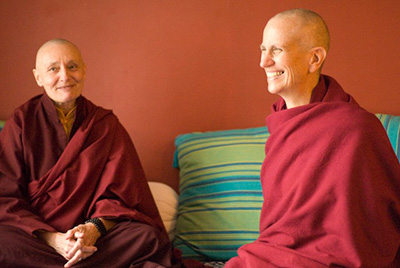
Each of us wants to be happy and to avoid suffering. Our mind—specifically its attitudes, views, and emotions—are the primary factors contributing to our experience of happiness and pain.
Each of us wants to be happy and to avoid suffering. From a Buddhist viewpoint, our mind—specifically its attitudes, views, and emotions—are the primary factors contributing to our experience of happiness and pain. This view flies in the face of our usual perception of things. For example, most of us instinctively feel that happiness is "out there" in an external person, place, or object. We think, "If I only lived in this house … had this career … married that person … moved to that place … bought this car, I’d be happy." We are taught to be good consumers—not just of possessions, but of people, ideas, spirituality, and everything else as well—in our search for happiness. However, no matter what we have or how much we have, we are perpetually dissatisfied.
Similarly, we feel that our problems have been thrust upon us from outside. "I have difficulties because my parents yelled at me, my boss is inconsistent, my children don’t listen to me, the government is corrupt, others are selfish." Thus we devise wonderful advice for others to follow and believe that if they only did what we suggested, not only would our problems cease, but also the world would be a better place. Unfortunately, when we tell other people how they should change so that we can be happy, they don’t appreciate our sagacious advice and instead tell us to mind our own business!
This innate world view that happiness and suffering come from external sources leads us to believe that if we could only make others and the world be what we wanted them to be, then we would be happy. Thus, we endeavor to rearrange the world and the people in it, gathering towards us those we consider happiness-producing and struggling to be free from those we think cause pain. Although we have tried to do this, no one has succeeded in making the external environment exactly what he or she wants it to be. Even in those occasional situations in which we are able to arrange external people and things to be what we want, they don’t remain that way for long. Or, they aren’t as good as we thought they would be and we are left feeling disappointed and disillusioned. In effect, the supposed path to happiness through external things and people is doomed from the start because no matter how powerful, wealthy, popular, or respected someone is, he or she is unable to control all external conditions.
This supposed path to happiness is also doomed because even if we could control external factors, we still would not be fulfilled and satisfied. Why? Because the source of true happiness lies in our mind and heart, not in possessions, others’ actions, praise, reputation, and so forth. But we must examine this for ourselves, so the Buddha asked us to observe our own experiences to see what causes happiness and what causes misery.
For example, we have all had the experience of waking up on the wrong side of the bed. Nothing in particular happened to cause us to be in a bad mood; we simply feel lousy. But, interestingly, just on those days we feel grumpy, we encounter so many uncooperative and rude people. Just on the day we want to be left alone, so many obnoxious people descend upon us! Suddenly, the way our spouse smiles appears sarcastic, and our colleague’s "Good morning" seems manipulative. Even our pet dog no longer seems to love us! When our boss remarks on our work, we take offense. When our friend reminds us to do something, we accuse him of being controlling. When someone turns in front of us on the road, it feels they are deliberately provoking us.
On the other hand, when we are in a good mood, even if our colleague gives us some negative criticism on a project, we can put it in perspective. When our professor asks us to redo a paper, we understand her reasons. When a friend tells us that he was offended by our words, we calmly explain ourselves and clear up the misunderstanding.
That our interpretations of events and responses to them change according to our mood says something important, doesn’t it? It indicates that we are not innocent people experiencing an objectively real external world. Rather, our moods, perspectives, and views play a role in our experiences. The environment and the people in it aren’t objective entities that exist from their own side as this or that. Instead, together with them, our mind co-creates our experiences. Thus, if we want to be happy and to avoid suffering, we need to subdue our unrealistic and non-beneficial emotions and perspectives and enhance our positive ones.
Working with emotions
Let’s look at some of the methods the Buddha prescribed to transform specific emotions. Reflection on impermanence and the unpleasant aspect of a person or thing counteracts attachment. Cultivating patience and love opposes anger, and wisdom demolishes ignorance. Thinking about a difficult topic or reflecting that all we know and have comes from others eliminates pride. Rejoicing prevents jealousy. Following the breath diminishes doubt. Contemplating our precious human life dispels depression, while meditating on compassion counteracts low self-esteem.
Reflection on impermanence and unpleasant aspects counteracts attachment
When our mind is under the influence of attachment, we cling to people, things, or circumstances, thinking that they have the power to bring us happiness. However, since these things are transient—their very nature is to change moment by moment—they are not safe objects to rely on for long-term happiness. When we remember that our possessions do not last forever and our money does not go on to the next life with us, then the false expectations we project upon them evaporate, and we are able to cultivate a healthy relationship with them. If we contemplate that we cannot always remain with our friends and relatives, we will appreciate them more while we are together and be more accepting of our eventual separation.
Contemplating the unpleasant aspect of things we are attached to also cuts false expectation and enables us to have a more balanced attitude towards them. For example, when we have a car, we will definitely have car trouble. Therefore, no benefit comes from getting too excited about having a new car, and no great catastrophe has occurred if we can’t get a car. If we have a relationship, we will undoubtedly have relationship problems. When we first fall in love, we believe that the other person will be everything we want. This skewed view sets us up for suffering when we realize that he or she isn’t. In fact, no one can be everything we want because we are not consistent in what we want! This simple process of being more realistic cuts attachment, enabling us to actually have more enjoyment.
Cultivating patience and love opposes anger
Having exaggerated certain negative aspects of a person, thing, idea, or place, we become angry and unable to bear it. We want either to harm what we think is causing our unhappiness or to escape from it. Patience is the ability to bear harm or suffering. With it, our mind is calm, and we have the mental clarity to figure out a reasonable solution to the difficulty. One way to cultivate patience is by seeing the disturbing circumstance as an opportunity to grow. In this way, instead of focusing on what we don’t like, we look inside and develop our resources and talents to be able to deal with it.
Seeing the situation from the other’s perspective also facilitates patience. We ask ourselves, "What are this person’s needs and concerns? How does she see the situation?" In addition, we can ask ourselves what our buttons are. Instead of blaming the other person for pushing our buttons, we can work to free ourselves from those buttons and sensitive points so that they cannot be pushed again.
Cultivating love—the wish for sentient beings, including ourselves, to have happiness and its causes—prevents as well as counteracts anger. We may wonder, "Why should we wish those who have harmed us to be happy? Shouldn’t they be punished for their wrongdoing?" People harm others because they are unhappy. If they were happy, they would not be doing whatever it is that we found objectionable, because people don’t hurt others when they are content. Instead of seeking punishment or retaliation for harms done to us, let’s wish others to be happy and thus free from whatever internal or external conditions precipitate their negative actions.
We cannot tell ourselves we must love someone; rather we must actively cultivate this emotion. For example, sitting quietly, we begin by thinking and then feeling, "May I be well and happy." We spread this thought and feeling to dear ones, then to strangers, and to people we find disagreeable, threatening, or disgusting, and say again and again to ourselves "May they be well and happy." Finally, we open our heart and wish happiness and its causes to all living beings everywhere.
Thinking about complex topics and recognizing our indebtedness to others eliminates pride
When we are proud, we cannot learn or develop new good qualities because we falsely believe we have attained all there is. When a Buddhist student becomes arrogant about his scholarship or practice, his teacher often instructs him to meditate on the twelve sources and eighteen elements. "What are those?" people ask. That’s the point—just hearing the names, let alone understanding their meaning, makes us realize we have a lot to learn and thus dispels arrogance.
When we are proud, we have a strong feeling of self, as if whatever qualities we are proud about are inherently ours. Reflecting that everything we know and have has come from others quickly dispels this arrogance. Any abilities due to genetics came from our ancestors; our knowledge came from our teachers. Even our artistic, musical, or athletic abilities would not have surfaced had it not been due to the kindness of parents and teachers who encouraged and taught us. Our socio-economic status is due to others who gave us money. Even if they gave it to us in the form of a paycheck, it was not ours to begin with. Our education came from others. Even our ability to tie our shoes came from those who taught us. Looking at our lives in this way, we are indebted to others’ kindness. We have much to be grateful for and nothing to be arrogant about.
Rejoicing dispels jealousy
The jealous mind cannot endure the happiness of others and wishes that happiness for ourselves. Although we want to be happy, jealousy itself is a painful emotion, and we are miserable when we are under its influence. Rejoicing, on the other hand, celebrates goodness. We always say, "May everyone be happy," so when someone is, we might as well rejoice in it, especially if we didn’t even have to make any effort to bring it about.
We may start by rejoicing in the happiness we already have, enabling us to realize that we are not completely bereft of joy even though we may not have what we want at the time. Then we focus on others’ goodness and happiness and rejoice in them. While this initially may seem uncomfortable due to the force of the jealousy, if we persist in recounting the goodness and happiness of others, our mind will, in time, become joyful. "Isn’t it wonderful that Susan excels in sports? How great that Peter was promoted and that Karen got a new car! Bill and Barbara have a caring relationship; I’m happy for them. Jane’s meditations are going well, and Sam has a lot of contact with his spiritual mentor. That’s great."
Thinking positive thoughts in this way automatically makes our mind happy. It shifts our perspective from focusing on what we don’t have to the richness in the world.
Following the breath diminishes doubt and anxiety
When our mind is turbulent, spinning in doubt or anxiously imagining worst-case scenarios, the Buddha recommended that we focus our attention on the breath. Sitting comfortably, we breathe normally and naturally. We place our attention either at the nostrils, feeling the touch of the breath on our upper lip and in the nostrils as it passes in and out, or at the belly, being aware of the rise and fall of our abdomen as we inhale and exhale. Should our attention shift to the doubts and anxious thoughts, we recognize this and then patiently but firmly bring our focus back to the breath. By doing this continuously, the runaway thoughts begin to calm down, and the mind becomes clear and calm.
Contemplating our precious human life dispels depression
Often we take our opportunities and fortune for granted and focus on what we lack instead. This is tantamount to ignoring all the delicious food in a large buffet and complaining, "There is no spaghetti." Instead of becoming depressed because we are ill, we can remember that we are also fortunate to have others who help us when we don’t feel well. Even if they don’t help us as much as we would like, they still are there for us, and we would be hard put if they weren’t. Something is always going well in our lives, and it’s important to remember those things that are.
In addition, we have human intelligence and the opportunity to encounter a spiritual path. This opportunity in itself is cause for great rejoicing. No matter if we are sick, lonely, imprisoned, or going through hard times financially, we still can take refuge in the Three Jewels—the Buddhas, Dharma, and Sangha. We can practice our spiritual tradition no matter where we are, who we’re with, or what the state of our physical body, for genuine spiritual practice does not depend on certain external implements or actions but involves redirecting our mind towards constructive emotions and realistic attitudes. Thus for as long as we are alive, we can be happy about what is going right in our lives and at the opportunities we have for spiritual practice. Even when it comes time to die, we can rejoice at a life well-spent and dedicate all the goodness we created for the benefit of all sentient beings.
Meditating on compassion and on our Buddha nature counteracts guilt and low self-esteem
When we suffer from guilt and low self-esteem, we put all attention on ourselves. There is little space in our mind for thoughts of others, and everything related to ourselves is overblown. Guilt is an inverted feeling of self-importance: "I’m the worst one in the world, unforgivable," or "I’m so powerful that I can make all these things go wrong." This is totally unrealistic!
Compassion is the wish for sentient beings, including ourselves, to be free of suffering and its causes. Meditating on it works in two ways. First, we think, "I am a sentient being, worthy of happiness and freedom from pain, just like everyone else. I have the Buddha nature—the underlying purity of mind—just as all living beings do. Therefore, I can wish myself to be happy and to be free of suffering, and I know that these are achievable goals because the basic nature of my mind and heart are pure. The clouds that cover them can be dispelled." Thinking in this way helps overcome depression.
In addition, spreading our love and compassion out to others alleviates the pain of the self-preoccupation lying behind guilt and low self-esteem. By taking the focus off of ourselves, compassion enables us to realize that everyone is in the same position. Thinking of others and reaching out to them pulls us out of the isolation of guilt and low self-esteem.
Wisdom demolishes ignorance
From a Buddhist perspective the ignorance misapprehending the nature of reality is the root of all other disturbing attitudes and negative emotions. To dispel it, we cultivate wisdom, which is of three types: the wisdoms of learning, thinking, and meditating. First we must learn from qualified teachers, either by listening to talks or reading books. Then we think about what we have learned, examining it thoroughly to test it logically and to make sure we have understood it properly. Finally, we integrate the meanings of the teachings into our lives through meditation and continuous practice.
For example, we listen to teachings on profound reality, the emptiness of inherent existence. We read about and study these concepts, and then discuss them with our friends as well as think about them ourselves. When our understanding is correct and refined, we then familiarize ourselves with emptiness in meditation, first by investigating the nature of reality and then by focusing single-pointedly on it. When we arise from meditation, we try to hold this newfound meaning in mind as we go about our daily life’s activities, so that this wisdom will be integrated into our mind and life.
Since all the other disturbing attitudes and negative emotions are rooted in the ignorance misapprehending reality, developing this wisdom is a general antidote to all of these. However, since cultivating the correct view is difficult, takes time, and requires effort, we practice the antidotes explained above, which are unique to each particular emotion. By pacifying these emotions even a little, our mind becomes clearer and more tranquil, which makes the development of wisdom easier. For this reason, we learn not only the specific methods to counteract each disturbing attitude, but also wisdom as the antidote to all of them.
Our responsibility
Subduing and transforming our mind is a process we alone must do. While we can pay someone to clean our house or fix our car, hiring someone to get rid of our negative emotions doesn’t work. I can’t ask you to sleep late so that I’ll feel refreshed or to eat so my hunger will go away. Just as we must sleep and eat ourselves to experience their benefits, we must practice ourselves in order to let go of our harmful emotions and to nourish our constructive ones.
The Buddha’s teachings explain many techniques for subduing our disturbing emotions and for cultivating positive ones. Just learning these techniques does not transform us. Reading a book with instructions on how to type does not give us the ability to sit down at a computer and type perfectly. We need to practice and train ourselves. In the same way, we must reflect on the techniques taught by the Buddha and then practice them consistently over a long period of time. The Tibetan word for meditation, gom, has the same root as the word meaning "to familiarize." Familiarization takes place with effort and over time. Similarly, we say we "practice the Dharma," meaning we train ourselves in certain attitudes and emotions over and over again. In short, there is no shortcut for transforming our mind.
However, since the disturbing attitudes and negative emotions are not the very nature of our mind and because they are based on misconceptions, they can be eliminated through cultivating realistic views and constructive emotions. Our mind and heart are a stable base for this transformation, and if we cultivate wisdom and compassion over time, they will increase infinitely. It is our responsibility, for our own as well as for others’ happiness, that we engage in the practice to do so.
Future prospects for Buddhism
Over a period of many centuries Buddhism spread throughout Asia. Now, with modern transportation and communication facilities, it is quickly coming to Western nations. Nevertheless, it faces many challenges both in Asia and in the West.
In Asia, Buddhism is widely accepted, but not widely practiced among its adherents. In some places people have neglected to learn the meaning of the ceremonies and rituals. In others the religious hierarchy could be re-invigorated by broadening educational opportunities for nuns and laypeople. Buddhist institutions need to be more engaged in helping society.
In the West, Buddhism risks becoming another consumer good, tailored in order to suit the tastes of the public. The Buddha’s teachings have always been a challenge to society and to our egos. We must be careful not to dilute their essential power in the name of spreading them to more people. In addition, we must abandon our hidden wishes for an "instant fix" and be prepared and happy to practice for a long time. His Holiness the Dalai Lama says that one of the biggest hindrances for Westerners is the expectation to gain realizations quickly and easily. This attitude makes some people give up practice when their fanciful ideas are not actualized.
While Buddhism has much to offer in Asia and the rest of the world, the extent to which it is able to do so depends on the quality of its practitioners and teachers. Thus we must try to improve our own learning and practice as well as support others who are doing so. As individuals and as Buddhist institutions, we must take personal responsibility, create and maintain harmony, and look out for the common good.

Venerable Thubten Chodron
Venerable Chodron emphasizes the practical application of Buddha’s teachings in our daily lives and is especially skilled at explaining them in ways easily understood and practiced by Westerners. She is well known for her warm, humorous, and lucid teachings. She was ordained as a Buddhist nun in 1977 by Kyabje Ling Rinpoche in Dharamsala, India, and in 1986 she received bhikshuni (full) ordination in Taiwan. Read her full bio.