|
Death and Caring for the Dying
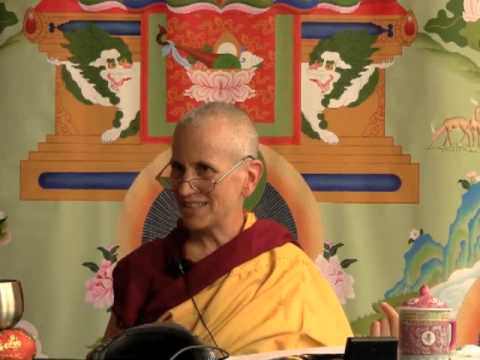
by Venerable Thubten Chodron©
Sravasti Abbey, Newport, Washington, USA
29-31 May, 2010
29 May 2010
Session 1: Advantages of Contemplating & Disadvantages of Ignoring Death
Ven. Chodron says that living and dying are going on at the same time. She speaks about the disadvantages of ignoring death and the benefits of contemplating it. She talks about two different types of fear: panicky fear and awareness-of-possible-danger fear. She speaks of the way in which our self-grasping egoistic fear of losing what we're familiar with makes us create beliefs about what happens after death.
Q & A:
- What is compassion? Compassion
for ourselves & compassion for others
- Dealing with change, a source of pain
- Physical, psychological & spiritual changes that occur as one approaches death; phases in the dying process
- Our tendency to want to "fix" things
[70 minutes] : Download mp3 file
29 May 2010
Session 2: Nine Point Death Meditation
Venerable Chodron continues teaching on death and caring for the dying focusing on the classic nine-point death meditation. This meditation leads us to gain a firm conviction that life is precious because consciousness continues on after death, will be directed by the actions we perform in this life, and for this reason it is important to practice Dharma and engage in virtuous activities now.
Q & A:
- Can you talk about extreme measures to extend life? Are medical procedures interfering with the natural flow of death?
- What do you recommend regarding giving pain medication during dying process?
- Is the nature of karma such that it only ripens in our next life, or can it ripen now?
- It is a common practice in hospice, when someone is close to death, to have family bring in favorite music, perfumes, etc, which forces dying person re-engage their senses – is this beneficial or not?
- What about a child who has drowned, and half an hour they bring them back – they spend their life tube fed, without the ability to think – is this due to their karma? Is it worthwhile to save the child's life?
- What about organ donation?
[77 minutes] : Download mp3 file
30 May 2010
Session 3: Death & Peace of Mind and the Five Forces in One's Life
Ven. Chodron begins this teaching with a short explanation of the Amitabha Buddha chanting practice that is done at the Abbey. She poses questions of how we will deal with our death and those around us at the time of our death and have peace of mind. She suggests that we look at ourselves and those we have problems with as sentient beings under the influence of afflictions and karma, uncontrollably taking rebirth. She then talks about how to practice the five forces (motivation, white seed, destruction, prayers of aspiration, and familiarity) during life.
Q & A:
- When we die we experience other things that are projections of our minds – with the Amitabha or other pure land practices, aren't we trying to create causes for projecting in the bardo state to a pure land?
- Isn't Amitabha's Pure Land itself just a transitory state?
[61 minutes] : Download mp3 file
30 May 2010
Session 4: Attachment to the Body and the Five Forces at the Time of Death
Ven. Chodron speaks about attachment to the body and what will happen to it after we die. She prompts us to question what exactly about the body is I or mine. She recounts a story of a monk in Dharamsala who died when she was there. She explains how to practice the five forces (white seed, prayers of aspiration, destruction, motivation, and familiarization) at the time of death.
Q & A:
- If consciousness separates from the body at death, can that happen before the body ceases to be alive? What happens to the consciousness when a person's on life support and virtually brain dead?
- What to do if we're with somebody who is dying and that person is not prepared to die.
- Do you think that when you're going to sleep at night it's a good idea to implement these practices?
[62 minutes] : Download mp3 file
31 May 2010
Session 5: Reducing Attachment to the Body & Helping the Dying
Ven. Chodron starts this audio by describing the inner mandala offering as a means to reduce attachment to the body. In this visualization we visualize transforming our body into the universe (the external mandala) which is then offered. The body part symbolism is as follows:
Mount Meru – one's torso & abdomen
Four continents – one's hands & feet
Eight subcontinents – one's upper and lower arms & legs
Golden ground – one's skin
Sun & moon – one's eyes
Umbrella & parasol – one's ears
Seven circles of golden mountains – one's intestines
Oceans & seas – one's blood & lymph
Beautiful sky offerings – one's internal organs
Venerable Chodron teaches on how to help dying people. She reminds of the techniques for reducing attachment to the body, of the importance of expressing love to the dying person and helping them to share kindness with others. She explains how to skillfully guide a person through the dying process in regards to practical aspects and spiritual practice. She offers advice on letting go of personal agenda, talking in the language of the dying person and offering our presence and empowering a dying person.
[61 minutes] : Download mp3 file
|