Report on “Nuns in the West I”
Report on “Nuns in the West I”
 Venerable Thubten Chodron
  Interfaith Dialogue
  May 26, 2003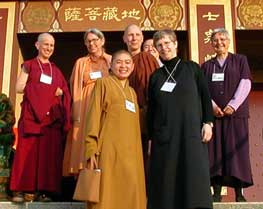
Imagine Chinese Buddhists going to the airport to pick up Catholic nuns, looking for figures swathed in long black habits and starched veils, and being puzzled when women in skirts appeared instead. Imagine Catholic nuns at dinner at a Chinese temple gingerly picking at the unfamiliar, strange looking food before them. This was the first evening of the Catholic-Buddhist nuns’ conference organized by the Catholic organization, Monastic Interreligious Dialogue, and sponsored by the Hsi Lai Temple in California, May 23-26, 2003. Despite (or maybe because of) our humorous beginning, we soon became spiritual sisters, with remarkable trust and exchange between us.
The 30 participants were split equally between Catholic and Buddhist, with a Hindu nun and an Orthodox nun as well. We marveled at and learned from our diversity: among the Catholics were nuns from the Order of St. Benedict and sisters from several different orders that focused on active service to society. Among the Buddhists were nuns from the Korean, Chinese, Theravadin, and Tibetan traditions, and priests following Japanese Zen.
It was just us nuns—no reporters, no observers, no formal agenda. We wanted to be able to discuss freely, without presenting papers or making statements. Of course the press and men were interested. “What in the world do a group of religious women talk about behind closed doors?” they wondered.
Our days were long, beginning with morning prayers with the monastic community at Hsi Lai Temple, continuing with several morning and afternoon sessions, and concluding with an evening circle. Our sessions began with Buddhist chants and Christian inspirational songs in which all joined. The first day each of us spoke, giving a snapshot of her life and spiritual quest. We spoke not of theology but of practice and experience. From this emerged various common concerns that we discussed in depth on the second day.
One theme was balance: How do we balance our inward spiritual life of prayer with our active outer life of social service? How do we balance tradition and customs with being pioneers who adapt to ever-changing societies? How do we balance community life with the need for solitude?
A second theme focused on community: What types of communities do we live in? What are elements of healthy communities? How does community life enhance our spiritual development? How is living in spiritual communities a form of social engagement? What is community leadership?
A third theme was spiritual cultivation: What does meditation consist of? What is contemplation? What does cultivation mean in our respective traditions? Are there stages or different activities? How do we remain engaged when we traverse times of spiritual impasse? How does spiritual cultivation and emotional maturity relate to each other? What is the role of a teacher, and how does a teacher discern what is necessary for a disciple at any particular time?
We discussed these themes in small groups. I was touched by the genuine interest the Catholic sisters had in how we Buddhist nuns trained and meditated. I was also moved by the integrity and confidence of the Catholic nuns, many of whom had been ordained for four or five decades.
The depth of our dialogue and trust was illustrated the last evening when Sr. Meg Funk, the main Catholic organizer, related an incident with Venerable Yifa, the main Buddhist organizer. In an elevator one day, Venerable Yifa, renowned for her feistiness, looked Sr. Meg in the eye and said, “Meg, you’re so intelligent. Do you really believe in God?” When the group heard this, we all burst out laughing, but the following day a few of us took up the question. Our discussion was interrupted by the arrival of the van to the airport, leaving us eager to meet again with our spiritual siblings.
View photos and more information about “Nuns in the West.”
Read a report and interviews from “Nuns in the West I.”

Venerable Thubten Chodron
Venerable Chodron emphasizes the practical application of Buddha’s teachings in our daily lives and is especially skilled at explaining them in ways easily understood and practiced by Westerners. She is well known for her warm, humorous, and lucid teachings. She was ordained as a Buddhist nun in 1977 by Kyabje Ling Rinpoche in Dharamsala, India, and in 1986 she received bhikshuni (full) ordination in Taiwan. Read her full bio.