The value of a disciplined way of life
The value of a disciplined way of life
 His Holiness the Dalai Lama
  Interfaith Dialogue
  Sep 17, 1994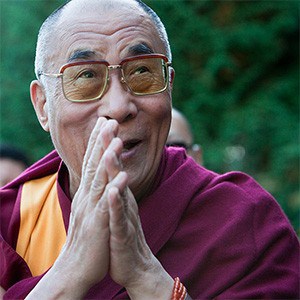
His Holiness the Dalai Lama talks to a group of Christian and Buddhist monks and lay associates at the Monastery of Christ the King (Cockfoster, London), which belongs to the Benedictine Congregation of Monte Oliveto. The talk was given on September 17, 1994, at the conclusion of the John Main seminar, during which His Holiness had for the first time commented extensively on the Christian gospels. Earlier that morning His Holiness meditated with the Benedictine monks. The seminar is recorded in the video series The Good Heart from Medio Media in London. This article is reproduced here with the permission of Shambhala Sun Magazine.
Although I have had the opportunity and privilege to participate in many interfaith dialogues and interfaith services, this current dialogue has had a totally different significance. I am particularly curious to know the opinion of my fellow Buddhist monks here about the fact that I have read and commented on the Christian gospel.
You know, obviously, personally, I am Buddhist. Therefore, my own faith does not include the belief in a “Creator.” But at the same time, I really want to help those who say they are Christian practitioners to strengthen their faith and their sincere practice. I really try to help them…
There is a story: once Nagarjuna wanted to debate with a great scholar, a non-Buddhist in the ancient Indian tradition. His disciple, Aryadeva, offered to go in his place so that his teacher need not go. Nagarjuna said, “First I must test you to see if you are qualified to take my place.” Nagarjuna and Aryadeva began to debate, with Nagarjuna taking the position of the ancient Indian school against which Aryadeva would debate. Nagarjuna’s defense of the non-Buddhist school of thought was so convincing and firm that there was a point in the debate that Aryadeva began to doubt his teacher’s allegiance.
This might apply similarly to a Buddhist monk who tries to understand about the “Creator.” [laughter] These few days of dialogue and discussions have reinforced my long held belief that in spite of the fundamental metaphysical and philosophical differences in the religious traditions of the world, there is enough strong, common ground that unites the various religious traditions, thus enabling us to make a common contribution towards the betterment of humanity. My experience over the last few days has strengthened this belief, so I feel very grateful for the opportunity to have led this year’s John Main Seminar.
Here today in this monastery I would like to speak on the value of the monastic way of life. The monastic life is the way of life based on explicitly following certain precepts and vows. I will discuss how that could be a foundation for one’s spiritual practice and growth.
Although my fellow Buddhist monastics here are familiar with this idea, let me say that in the Buddhist tradition, when we speak of our spiritual path or enlightenment, the practice is explained within the framework of what are known as the three higher trainings. These are the higher training in wisdom, the higher training in concentration or meditation, and the higher training in morality. Of these three, the higher training in morality and ethics is the foundation on which the remaining two trainings are based.
It is in the context of the higher training in morality that we speak about our moral precepts and ethical disciplines. Generally speaking, in the Buddhist tradition there are two types of precepts: the lay person’s ethical precepts and the monastic precepts. In Buddhism the area of ethical discipline is known as pratimoksa, which literally means “individual liberation.” In that practice there are primarily seven or eight sets of precepts, of which five are monastic. They include novitiate vows up to the full ordination for men and women. The two remaining sets of precepts are those of the lay practitioners.
When speaking about monastic precepts, we are referring to an ethically disciplined way of life based on the foundational precept of celibacy. To reflect on the importance and value of a monastic way of life, it is important to understand the wider religious and spiritual context within which such a way of life is adopted. For example, in the case of Buddhism, there is the belief that every living being possesses the potential for perfection, the Buddha nature, and this is inherent in all of us. This seed of Buddhahood is naturally present in each being. In the language of Christianity, used by my brother and sister Christian practitioners, the expression is slightly different. One says that all human beings share the divine nature, God’s “image and likeness.” Thus in both religions, there is the idea of a natural purity in all of us which is the foundation for our spiritual growth. To perfect that nature of goodness in all of us, it is not sufficient to enhance and develop it. At the same time we also need to decrease and overcome the negative impulses and tendencies that are within us. We need a two-pronged approach: enhancing the positive qualities and decreasing the negative impulses.
I believe that one of the principal ideas underlying the monastic way of life is the idea of contentment. This principle of contentment is associated with simplicity and modesty. The emphasis on and practice of simplicity and modesty are common to both the Christian and the Buddhist monastic orders. For example, in the case of Buddhism, this is found in the list of twelve qualities to be cultivated by a member of the monastic order and the four tendencies of a superior being. (These have to do with being content with simple food, clothing, shelter, and having a strong interest in pacifying the mental defilements and practicing meditation to generate excellent qualities.) These instructions enable the individual practitioner to live a way of life in which he or she is content with modest needs in terms of food, shelter, clothing, and so on. This helps that person develop not only a sense of contentment, but also a strength of character so that he or she does not become soft and weak and succumb to temptations for a luxurious way of life.
The stronger the character that you have, the stronger your will and your capacity to endure hardship. With these you will have greater power of enthusiasm and perseverance. Once you have that kind of powerful enthusiasm and sense of endurance and forbearance, they will lay a firm foundation for further spiritual progress such as attaining single-pointedness of mind and penetrating insight.
In the case of my brother and sister Christian practitioners, especially those in the monastic order, I think you need more intense effort and perseverance because you will have only one life; whereas the Buddhist monastic members can be a little lazy because if they do not make it in this life, there is another life! [laughter]
One of the principal benefits of having such a strong force of endurance and forbearance is that it lays the foundation for future spiritual development. For example, if you look at the list of conditions that are recommended for someone who is aspiring to attain tranquil abiding, or samatha, we find that some of the principal conditions recommended are a sense of contentment and modesty and an ethically sound and disciplined way of life.
A monastic way of life is a life of self-discipline. It is important that we do not think of this discipline as being imposed from outside upon us by an irresistible power. Discipline must come from within. It should be based on clear awareness of its value as well as a certain degree of introspection and mindfulness. Once you have such an attitude towards discipline, it will be self-adopted rather than imposed. Being freely chosen, discipline will really help you develop two very important qualities of the mind: alertness and mindfulness. As you develop these two basic factors of awakening, you will have the most powerful tools to attain single-pointedness of the mind.
When we examine the value of the Buddhist monastic order, it is important to see that celibacy is the foundation. We must understand why celibacy has to be the foundation of a monastic way of life. In one sense, the way of life of a celibate monastic almost resembles going against the biological nature of our body. If you look at the nature of sexuality and sexual desire, it is very much part of our biological impulses. This drive is associated with the evolutionary process of reproduction. In some sense, yes, a monastic way of life is against the biological nature of the body.
What is the goal or purpose of adopting such a way of life? For a Buddhist practitioner, and particularly for a Buddhist monk or nun, the ultimate goal is the attainment of nirvana or liberation. This is liberation of the mind. If you understand nirvana and liberation properly, you know that by seeking liberation we are trying to go beyond the bonds of human nature, to transcend the limitations of human existence. Since the goal is beyond the bounds of human existence, then, of course, the method to be adopted will also involve going against biological limitations. The celibate way of life acts as perhaps the most powerful antidote to overcome the impulses and acts of attachment and clinging desire. According to Buddhism, attachment and clinging desire lie at the root of our cyclic existence. Since the goal is to cut the knot of that cycle and go beyond it, the means will also involve going against the currents of the biological nature.
The Buddhist presentation of the evolution of samsara is depicted in the form of a cycle, the twelve links of interdependent origination, which clearly demonstrate how attachment and clinging act as the roots of cyclic existence. For example, a person may have fundamental ignorance, the first link, and may have created karma, the second link, and may have experienced the third link, consciousness, where the karmic seed has been implanted. However, if that karmic seed is not activated by clinging desire and attachment, samsaric rebirth cannot come into being. This shows how desire and attachment lie at the root of our cyclic existence.
In the Christian context I offer my own personal opinion and understanding, and my friend here, Father Laurence, may have a more profound account to give. But in any case, I will try to look at the role and importance of celibacy in the Christian monastic context. Since there is no idea of nirvana as the Buddhist presents it, I think celibacy has to be understood in relation to the fundamental, important principle of being modest and contented. This is understood in relation to fulfilling one’s call or destiny, allowing oneself the time and opportunity for spiritual practice, and committing and dedicating oneself completely to one’s calling.
It is important to lead a modest way of life so that there are no personal involvements and obligations which would divert one’s attention from the pursuit of that calling. This is essential. If you compare a monastic’s life with a family life, the latter clearly has greater involvements. One has more obligations and responsibilities in a family life. In contrast, at least ideally, a monk or nun’s life reflects the ideal of simplicity and freedom from obligations. Our principle should be this: as far as our own interests and needs in life are concerned, there should be as little obligation and as little involvement as possible; but insofar as others’ interests are concerned, the monks and nuns should have as much involvement as possible and as many commitments as possible.
I was told that in the Benedictine monastic order there are three precepts which are emphasized. These are: first, the vow of obedience; second, the “conversion of life,” implying that there ought to be an ever-growing evolution within one’s spiritual life; and third, the precept of stability. Let me again look at these three vows, wearing Buddhist spectacles. I think the first vow, the vow of obedience, has a close parallel to the Buddhist monks’ and nuns’ obedience to the Pratimoksa Sutra, which is the Buddhist scripture laying down the rules and precepts for a monastic way of life. This sutra in the Buddhist tradition has to be recited every fortnight during the confession ceremonies. In some sense, this recitation affirms our obedience to the Buddha’s monastic precepts. Just as the members of the monastic order reaffirm their obedience to the scriptures every fortnight (and this is often expressed by living in accord with certain rules of obedience within the monastic community itself), the internal discipline of the monastery is supposed to reflect the spirit and the precepts set down by the Buddha.
This two-fold obedience, I think, is similar to that of the Christian practice. Not only does one have the personal monastic precepts, but there is also a vow of obedience to the discipline of the monastery. By obeying the internal discipline of the monastery and the dictates of the abbot and the senior members of the monastery, you are in fact paying homage and obedience to the precepts and rules set down by the Buddha himself. This is very similar to the idea found in the Gospel when Jesus says, “Those who listen to me, do not listen to me but listen to Him, the Father who sent me.”
The second precept of the Benedictine order, conversion of life, is really the key to the monastic life. It emphasizes the importance of bringing about inner spiritual transformation. Even if someone leads a totally secluded life with no contact whatsoever with the outside world, if no internal transformation takes place, then the life is pretty useless. In Tibet we have an expression that sums up the urgency and importance of this conversion of life in the monastic order. One Tibetan master said, “If I have a month or two more to live, I will be able to prepare for my next life. If I have a year or more to live, I will be able to take care of my ultimate aspiration.” This demonstrates the urgency on the part of the practitioner to work constantly on bringing about internal transformation. A process of growth must take place within the practitioner.
I think stability, the third vow, points toward the importance of maintaining a stable way of life, not only physically but also mentally. In that way one’s mind is not infected by all sorts of curiosities, distractions and so on.
When I look at these three vows, I personally see the middle one as being the most important: the conversion of life, which is the need to have ever-increasing spiritual growth within oneself. To help create the right condition for that you need the first vow, which is the vow of obedience. The third vow enables the person to overcome obstacles along the way, to protect himself or herself from being affected by hindrances. The first vow creates the favorable conditions, the third helps you to overcome the obstacles and hindrances, but the second is the main vow.
Having said all this, I do not mean to imply that even in the Buddhist context there is no hope for liberation or nirvana without joining the monastic order. That is not the case. For someone who can embark upon a spiritual path, attainment of nirvana can even be possible while maintaining the life of a householder. Similarly, one might join the monastic order and lead a secluded life, but if there is no internal transformation, there is no nirvana or liberation for that person. It is for this reason that when the Buddha gave teachings on morality he spoke about not only monastic precepts but also precepts for lay persons. I think this is also true in the case of Christianity; all human beings equally share the divine nature so all of us have the potential to perfect that and thus experience union with the divine being. With that, my brief presentation is over. If I have made any false interpretations, I would like to apologize. [laughter]
Father Laurence Freeman: Your Holiness, the early Christian monks came from the Egyptian desert. Disciples or seekers of the truth would go to the desert to seek out the wisest teacher, and they would simply say, “Father, give us a word.” We asked you to do that for us today, and you have given us a very rich and wise word. Thank you.
His Holiness suggests that we take five minutes of silence together now.

His Holiness the Dalai Lama
His Holiness the 14th Dalai Lama, Tenzin Gyatso, is the spiritual leader of Tibet. He was born on July 6, 1935, to a farming family, in a small hamlet located in Taktser, Amdo, northeastern Tibet. At the very young age of two, he was recognized as the reincarnation of the previous 13th Dalai Lama, Thubten Gyatso. The Dalai Lamas are believed to be manifestations of Avalokiteshvara or Chenrezig, the Bodhisattva of Compassion and the patron saint of Tibet. Bodhisattvas are believed to be enlightened beings who have postponed their own nirvana and chosen to take rebirth in order to serve humanity. His Holiness the Dalai Lama is a man of peace. In 1989 he was awarded the Nobel Peace Prize for his non-violent struggle for the liberation of Tibet. He has consistently advocated policies of non-violence, even in the face of extreme aggression. He also became the first Nobel Laureate to be recognized for his concern for global environmental problems. His Holiness has traveled to more than 67 countries spanning 6 continents. He has received over 150 awards, honorary doctorates, prizes, etc., in recognition of his message of peace, non-violence, inter-religious understanding, universal responsibility and compassion. He has also authored or co-authored more than 110 books. His Holiness has held dialogues with heads of different religions and participated in many events promoting inter-religious harmony and understanding. Since the mid-1980’s, His Holiness has begun a dialogue with modern scientists, mainly in the fields of psychology, neurobiology, quantum physics and cosmology. This has led to a historic collaboration between Buddhist monks and world-renowned scientists in trying to help individuals achieve peace of mind. (Source: dalailama.com. Photo by Jamyang Dorjee)