What I learned about Judaism from the Dalai Lama
What I learned about Judaism from the Dalai Lama
 Rodger Kamenetz
  Interfaith Dialogue
  Jun 18, 2011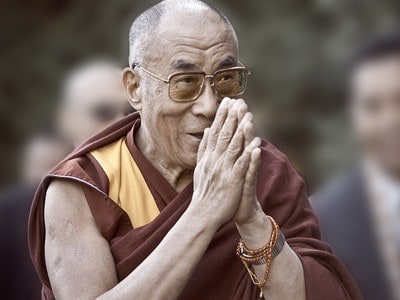
Rodger Kamenetz describes his experience in the Jewish-Buddhist dialogue that took place in Dharamsala, India in October, 1990, and his encounter with the Dalai Lama when he again visited Dharamsala in the spring of 1996. It is reproduced here with permission from Reform Judaism.
In 1990, I accompanied a group of eight rabbis and Jewish scholars to India for an audience with the Dalai Lama of Tibet. He had asked us to unlock the mystery of Jewish survival in exile for two millennia. I never imagined he also held a secret that could help Jews.
Since his exile from Tibet in 1959, the His Holiness the fourteenth Dalai Lama, temporal and spiritual leader of six million Tibetan Buddhists, has often reflected on the Jewish people and our history:
Through so many centuries, so many hardships, you never lost your culture and your faith. As a result, when other external conditions became ripe, you were ready to build your nation. There are many things to learn from our Jewish brothers and sisters.
In a painting at the main temple in Dharamsala, India, where the Dalai Lama lives in exile, is a painting of the Buddha seated before a pool of clear water. It was explained to us that the pool of water was actually a pool of nectar. A pool of nectar, clear but sweet. That became my overriding image of the Jewish encounter with the Dalai Lama. Somehow, he made us see Judaism more clearly and sweetly than often we ourselves see it. In our dialogue with the Dalai Lama, we saw Jewish tradition come to life. His eagerness to learn was infectious. I watched his face as Rabbi Irving Greenberg explained how in our prayers and customs, every Jew is to be reminded of the exile:
At the end of every wedding, we break a glass. Why? To remind people they cannot be completely happy. We are still in exile, we have not yet been restored. When you build a new home, you leave one little place unfinished. Why? As beautiful as the home is, we are not at home.
The Dalai Lama nodded thoughtfully:
Yes. Always remind. The points you have mentioned really strike at the heart of how to sustain one’s culture and tradition. This is what I call the Jewish secret–to keep your tradition. In every important aspect of human life, something is there to remind you: We have to return, to take responsibility.
He had grasped a prime Jewish secret of survival–memory.
Memory came alive for me in another way in Dharamsala. I felt reconnected with lost fragments of my own tradition. The monastic’s robe was like our own talit. The emphasis on ceaseless debate, common to both religions, connected the Buddhist School of Dialectics to the ancient rabbinical academies. One dawn I awoke to the chanting of a young nun. Later I learned she was reciting an entire book from memory, just as the first-century tannaim had recited Mishnah before it was first written down. As Rabbi Greenberg described the rabbinic sages at Yavneh after the Roman destruction of the Temple in Jerusalem to the old lamas and abbots, I looked at their wrinkled faces and knew that for them Dharamsala was Yavneh, and the time of supreme crisis was now. We Jews know instinctively the agony of losing one’s homeland, being forced into exile, and surviving adversity.
“Always remind” was key advice, but we gave other secrets as well. In a Friday night service attended by several learned lamas, we shared the power of Shabbat, our weekly holy day. Dr. Blu Greenberg, feminist author and scholar, lit the candles and prayed. She thoughtfully substituted matzah, our bread of affliction, for ordinary bread, in solidarity with our Shabbat guests who may never return from exile. In her session with the Dalai Lama, Blu, a grandmother, emphasized the central importance in Judaism of home and family–a difficult lesson for a religion led by celibate monastics. Blu’s very presence, and that of Joy Levitt, a rabbi who explained the central role of the synagogue, added a vital element to the dialogue. The Tibetan “side” of the dialogue was all male.
The Dalai Lama wanted to know more about the “inner life” of Jews. He wanted to know what method Judaism provides for transforming the human being, for overcoming disturbing emotions such as anger. For Tibetans, this is not an abstract question. The Dalai Lama is leading his people through its most difficult period in history, one in which violence is a very predictable response. How he handles anger is both a personal and political challenge. Although the Chinese communists have driven him and his family into exile, tortured and killed his people for nearly forty years, he refers to them as the “so-called enemy.”
I found the Dalai Lama, who describes himself as “a simple Buddhist monk,” to be a mensch, a profoundly kind and a gracious man. From his behavior I learned that humility could be powerful, receptivity dominating, and kindness challenging. I learned the power of what the Buddhists call “a quiet mind.” In our first session, he suffered a miserable cold, but for three hours of conversation his interest and extraordinary power of concentration never flagged. He also took time to greet each of us personally. I felt a strange sensation when he looked deep into my eyes. The Tibetans believe he can see into your past lives.
I felt personally challenged by Buddhist meditation, which seemed to make its practitioners calmer, wiser, more capable of dealing with difficult emotions. These were qualities I had not found in myself. In our dialogue, the Tibetans wanted to know the path and the goal of our belief system and how it helps us overcome painful feelings. Until then I had never thought to ask such questions of Judaism. For me, being Jewish was wrapped up in our collective history, my family, my identity. I had never before considered Jewishness as a spiritual path.
Rabbi Jonathan Omer-Man, a teacher of Jewish meditation, addressed this problem when he told the Dalai Lama,
The work of transformation, for us, is a holy path. But more and more people who seek transformation don’t go to a rabbi. They go to a psychiatrist who will teach them not enlightenment but self-satisfaction.
Rabbi Omer-Man’s presentation on Jewish meditation and Rabbi Zalman Schachter’s on Kabbalah, the Jewish mystical teachings, came in response to the Dalai Lama’s inquiries about our Jewish “inner life.” I was surprised to learn that Judaism has powerful techniques of inner transformation. But these ways are deep and hidden, inaccessible to most of us. Historically, they were practiced only by a tiny elite; consequently, Jews who are spiritual seekers often go elsewhere when looking for a path.
I had this in mind when we addressed the sensitive issue of Jewish converts to Buddhism. In North America, Jews are disproportionately represented in Western Buddhist groups. In Dharamsala, we met a number of Buddhist monks and nuns who had Jewish roots. My own preconceptions about such people–apostates, flakes, cultists–soon melted away. We invited all of Jewish Dharamsala to a Shabbat morning service and spent hours with them reading and discussing Torah. The Jewish Buddhists of Dharamsala are extraordinary–witty, even radiant in some cases, certainly not brainwashed zombies. Some still consider themselves Jews, others do not, but all said they had found something valuable in Buddhism that they had not been able to find in Judaism.
This made a number of us uncomfortable. Professor Nathan Katz later expressed to the Dalai Lama our sense of pain, having lost such spiritually engaged Jews to Buddhism. After a long pause, the Buddhist leader said he has never sought to convert others, as all religions offer spiritual satisfaction. He advises newcomers to stay with their own religion, pointing out that some Tibetans are also investigating other religions. In learning about Jewish mystical teachings, the Tibetan leader said he developed more respect for Judaism because “I found much sophistication there.” He was particularly impressed by kabbalistic concepts of God that emphasized human responsibility and discovered that the techniques of Jewish meditation and prayer were strikingly similar to Buddhist meditation. Such esoteric teachings and practices, he advised, should be made more widely available. He gave a parallel from Buddhist history. Like Kabbalah, Buddhist mysticism or tantrayana, as traditionally taught in India, had been given selectively to very few students. Public teaching never happened. But with too much secrecy, there is a danger that the tradition will disappear. Therefore in Tibet, the esoteric teachings were more widely taught.
The Dalai Lama did not think it good to pressure someone to follow a specific religion:
Although your motivation may be sincere, the result may not be positive if you limit the right to choose and explore. If we try to isolate ourselves from modernity, this is self-destruction. You have to face reality. If you have sufficient reason to practice a religion, there is no need to fear (losing people). But if you have no sufficient reason, no value–then there is no need to hold onto it.
He had offered us extraordinary advice, and a challenge. Could our leaders make Judaism more satisfying and beneficial to Jews?
Professor Katz responded by criticizing some Jews’ tendency to define being Jewish mainly in terms of struggling against “enemies who threaten you either with persecution or assimilation. If we transmit to people only that you should be on guard all the time, we are going to lose them.”
Through my encounter with Buddhists, I began asking different questions of Judaism. How does it make my life better? How can I learn to bring blessings into my life? How can I live up to the Jewish ideal of making everyday life sacred? I realized how I had undervalued what was precious in my own tradition, especially prayer and study. I was also entirely ignorant of Jewish meditation, or the importance of kavana–intention–in Jewish prayer and daily life. My contact with the Tibetan Buddhists deepened my experience of Judaism.
I am continuing my quest for inner transformation, not in far-off India, but in my own home and synagogue. I have been intensively studying Jewish and Buddhist spiritual texts. Seeing Judaism reflected in a Buddhist pool of nectar, I have come to realize that the religion of my birth is not just an ethnicity or an identity; it is a way of life and a spiritual path with its own deep claims on my thoughts and feelings. If I could summarize the change, I would say it has been a move from the exotic to the esoteric, from the outside to the inside–not so much changing my Jewish practices as deepening them. My wife, two daughters, and I have for many years celebrated the eve of the Shabbat in our home by lighting candles and saying blessings over bread and wine, but now I am more mindful of our kavanah, our intentions. When reciting the blessings, for example, I try to keep myself attuned to the peaceful feeling of Shabbat in body, mind, and soul.
Our prayers and ceremonies are vehicles to deepen that feeling. I have learned to bring imagery and richness of imagination to my prayer through meditation. Jews can learn from other meditative traditions. Meditation, chanting, awareness of the breath–things we usually associate with Eastern religions are not foreign to Judaism. Most Jews are unaware of the vast storehouse of spirituality that can be found in Jewish prayer, in our mystical tradition, and in our Torah. The organizer of our trip to Dharamsala, Dr. Marc Lieberman, put it well:
I am rediscovering now in Judaism the voice of clarity and wisdom, the voice that speaks to my heart because I have a much clearer experience of listening to my heart through meditation.
For some, the journey to deeper spirituality in Judaism has involved a detour into Buddhist meditation. If we open the doors of our own meditative tradition wider and clarify how Jewish prayer and study can benefit us in our lives today, perhaps that detour will not be necessary for the next generation. When my daughter Anya was bat mitzvahed, I was proud of the rigor of her accomplishment, but even prouder of the spirit she brought to her prayers. She understood what she was saying. She worshipped with kavanah. I think her generation already understands implicitly that their task is to take Jewish spirituality to heart and deepen it. Clinging to an external Jewish identity without growing a Jewish soul no longer has meaning to me. The Dalai Lama spoke from “a personal curiosity” when he asked us about our inner life as Jews. It was a characteristically Buddhist question, and one that has transformed me as a Jew.
Six years later, after the publication of The Jew in the Lotus, my book about the Jewish-Buddhist encounter in Dharamsala, I went back to Dharamsala, the place where my life changed drastically due to the dialogue between Jews and the Dalai Lama. During that time, I was able to have a private appointment with the Dalai Lama. Our meeting was extraordinarily intimate, even though my wife, three translators, Laurel Chiten and her film crew of six were in the room. He walked in, smiling, bowed slightly as I bowed to him, and sat down. My friend Dr. Marc Lieberman, the father of the Jewish-Buddhist dialogue, introduced me, reminding His Holiness of the encounter with the Jews and explaining that I had written a book about it. Then it was up to me, “Your Holiness, people ask me why I had to go all the way to Dharamsala to look more deeply into my Jewish tradition. Why did I have to meet with a Buddhist master to see Judaism more deeply?” I paused and then added, “May I tell you a Hasidic story?” He nodded, and I told him the story of Reb Yehiel, who dreams every night of a bridge in Vienna where gold is hidden. Finally he journeys to Vienna, and finds the bridge. A guard asks him what he is doing and when Reb Yehiel explains, the guard laughs. “Oh you Jews are such dreamers. I’ll tell you what dreams are worth. Every night I dream of a Jew named Reb Yehiel, and behind his stove, under the floor, there’s buried gold.” As I was telling the story, I was captivated by the Dalai Lama’s face. He reflects every nuance of your words. He chuckled all along the way and then burst into laughter when I got to the punch line. “So Reb Yehiel returned home, looked behind his stove and found gold.”
I said the story explained why someone might have to journey far away to find a teacher who will show him what is already close at hand. I added, “For me and for many Jews, you have become such a teacher. By making us look more deeply into Judaism, you have become our rabbi.” Laughing, the Dalai Lama reached for his head and said, “So you will give me a small hat?” I promised to leave a yarmulke for him, and then was silent. I had learned something from transcribing the previous dialogue: always leave him time to respond. During the silence, he is thinking. If you fill it up with your own chatter, you will never get the benefit of that thought. So I contravened forty-six years of my own noisy cultural conditioning and let the silence hang.
Soon he replied:
All major religions can help each other. Each tradition has some specialty or uniqueness that can be very useful for other traditions. Sometimes the communication is not necessarily through words, it can also be through close feelings. If you found some little contribution from my part to our Jewish brothers and sisters, I am very happy.
I told him his questions about the Jewish inner life had been particularly helpful. Buddhists practice meditation and he had asked to know the Jewish method for overcoming afflictive states of mind. This had spurred Jews to look inward. The Dalai Lama generously replied that he felt all traditions, including his own are sometimes too focused on “external rituals or ceremonies. Then they neglect the real end of spirituality–transformation within ourselves.” He added with a smile, “If you make a short visit to a monastery, everything looks beautiful. But if you listen to the story of what is happening, just as with normal human beings, there is quarreling. That is a clear indication that we are neglecting genuine transformation, real spiritual development inside.” Thinking about the fights that so often go on within our own synagogues and between denominations within the Jewish community, I had to agree.
I had the chance to present him with a copy of The Jew in the Lotus, an author’s dream come true. I was a little afraid he might be offended by the title which plays on “the jewel in the lotus”—om mani padme hum—the Tibetan’s favorite mantra. I had found that Jews often did not understand the pun and some Western Buddhists were too pious to laugh. But the Dalai Lama seemed to think it was hilarious. He touched the book to his forehead in the Tibetan gesture of acceptance.
Before we parted, I mentioned that at the next full moon, we Jews would be celebrating Passover. According to the Talmud, there comes a time during the ritual when we recall liberation not just of the Hebrews from Egypt, but of every nation from captivity and slavery. Certainly in my household we pray each year that Tibet will soon be free. He was touched by this. The Tibetans see Jews as a people with a secret for surviving in exile and remaining spiritually intact. Right now, the Tibetans face a ruthless occupation by the Chinese communists. Their culture and religion face extinction. I told him, “Each year during the seder ritual we say ‘Next year in Jerusalem,’ to symbolize our hopes for spiritual wholeness and communal prosperity in the future. At my seder this year, my family will join ‘Next year in Lhasa’ to ‘Next year in Jerusalem.'”

Rodger Kamenetz
A poet and writer, Rodger Kamenetz lives in New Orleans and teaches English and Jewish Studies at Louisiana State University in Baton Rouge. He is the author of The Missing Jew: New and Selected Poems (Time Being Books), Terra Infirma (University of Arkansas), The Jew in the Lotus (HarperCollins), and Stalking Elijah (Harper). His essays and poems have appeared in the New Republic, Grand Street, Tikkun, and New York Times Magazine. (Photo © Owen Murphy)