Menu:


Other Articles/Audio
 

Teachings on Shantideva's "Guide to the Bodhisattva's Way of Life"
Khensur Wangdak Rinpoche
Sravasti Abbey, Washington, USA
20-26 November 2007


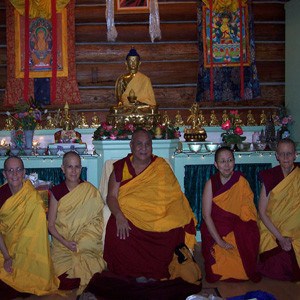
Khensur Rinpoche was born in 1934 in Kham, eastern Tibet. He pursued the traditional studies of a monk and joined the great Drepung University near Lhasa until the 1959 exodus from Tibet. As a refugee in India, he continued to study intensively, preserving the ancient traditions of Tibetan Buddhism at re-established universities finally earning the highest academic honors. He was then invited to Namgyal Monastic University, the seat of His Holiness the Fourteenth Dalai Lama until 1995 when the Dalai Lama appointed Rinpoche as abbot and senior teacher at Namgyal monastery in Ithaca, New York. He now teaches at Chenresig Tibetan Buddhist Center in Connecticut.

Khensur Rinpoche has made several visits to the Abbey. In 2007 he gave these wonderful teachings on Shantideva's "A Guide to the Bodhisattva's Way of Life."


20 November 2007 [1:53:00] Download mp3 file

The teaching will follow Gyaltsab Je's commentary on the "Guide to the Bodhisattva Way of Life." Rinpoche introduces the author of the text, Shantideva, in a rather uncommon way, by presenting his 7 great amazing activities:

- He was in direct communication with Manjushri from a very young age.

- He synthesized the teachings and presented them as the "Guide to the Bodhisattva Way of Life" in exceptional circumstances.

- He subdued 500 great individuals possessing physic powers out of compassion and in order to lead them to enlightenment by using debate and reasoning.

- He freed from famine 1000 people by rather miraculous means.

- He carried a wooden sword in honor of Manjushri which let to an amazing encounter with a king.

- He brought down a mandala of Shiva which had been set up by others through psychic powers and thus freeing the local people from the tyranny of some Hindu practitioners.

- He radiated out light rays from his brow and placed all those nearby in great bliss. In the second part, Rinpoche gives an overview of the ten chapters of a "Guide to the Bodhisattva Way of Life."

Q&A: - How can one be assured of enlightenment, and thus have enthusiasm for it?


21 November 2007 [2:10:00] Download mp3 file

Rinpoche addresses the issue of the selflessness of persons, speaking about three ways in which it is understood across the various philosophical schools: the absence of a unitary, permanent, independent person; the lack of a self-sufficient substantially existent person; and finally, the lack of a truly existent person. Rinpoche explains that the higher training in wisdom alone is not enough for removing the afflictive obscurations, one must have bodhicitta in order to abandon the cognitive obscurations and thus become a Buddha. Gyaltsab Je's commentary on "Guide to the Bodhisattva Way of Life" consists of four topics: explaining the meaning of the title; the homage of the translator; the meaning of the main subject matter; and the meaning of the conclusion. Rinpoche covers the first two topics (which correspond to verses 1-3 in chapter 1 of the text) and while doing so he talks in more detail about the meaning of the word "Sugata" - "one gone to bliss" and the implication of the two truths into the structure of the path.

Q&A:

- It would seem that at the time of enlightenment a Buddha would remove both types of obscurations simultaneously, is that correct?

- Is the distinction in the terminology of bodhicitta as conventional and ultimate because conventional bodhicitta is not enough?

22 November 2007 [2:28:00] Download mp3 file

We begin with verse 4 in Chapter 1 the topic of the main subject matter of the text. The text starts by mentioning the preciousness of a human life. Rinpoche goes through the eight freedoms and ten endowments and through its preciousness in terms of its causes and its rarity. The wisest way of seizing this opportunity is by practicing bodhicitta and the text goes on to explain the extensive benefits of developing bodhicitta. Rinpoche talks extensively about the need for purification and of bodhicitta as being the greatest force for purifying unwholesome karma. We stop at verse 14.

Q&A: - What is the purpose of meditation of the conventional nature of the mind and do the four Tibetan schools see this differently and if so why?

23 November 2007 [2:31:00] Download mp3 file

Rinpoche gives an overview of the goals, paths, and practice of the practitioners of the three capacities (lower, middling, and high) and explains that the awakening mind is the gateway enabling one to enter the Mahayana. Bodhicitta is a resultant mind, and so Rinpoche introduces the two methods for developing the awakening mind that come down through Atisha and Shantideva respectively: the seven point instruction of cause and effect, and equalizing and exchanging self for others. Rinpoche gives different classifications of bodhicitta and talks about the different types (aspiring and engaged bodhicitta; king-like, shepherd-like, ship captain-like bodhicitta; bodhicitta of aspirational path, bodhicitta of pure extraordinary thought, the fully ripened bodhicitta, and bodhicitta free from the two obscurations.) Then Rinpoche teaches on the advantages of the aspiring bodhicitta. We follow thus verses 15-25.

Q&A:

- How to meditate on both bodhicitta and emptiness?

- Since the engaged bodhicitta is distinguished by its reliance on the six paramitas, and because the root cause of bodhicitta is great compassion, why isn't great compassion included in the six paramitas?

26 November 2007 [2:18:00] Download mp3 file

In the context of cultivating the awakening mind through the seven point instruction of cause and effect, the difficult point for one to develop is the recognition that all sentient beings have been one's mothers. Rinpoche teaches that this recognition is in fact a result of causes, the causes being a thorough examination of the way in which things come into being. Is the I produced by self, by others, by both, or causelessly? In the second part of the teaching Rinpoche follows verses 26 to 36 and talks about the benefits of engaged bodhicitta. This completes chapter 1 of the "Guide to the Bodhisattva Way of Life."

Q&A:

- Why does engaged bodhicitta come on the path of preparation and not earlier on the path of accumulation?

- Could Rinpoche comment more on the fact that aspirational bodhicitta doesn't have the support of the six perfections but engaged bodhicitta does?

- Who is a bodhisattva? - Where does the mind that collects the karma reside?


Back to Top


What's New  |  Home  |  About Ven. Thubten Chodron  |  Activities  |  Audio Library  |  Video Library
Publications | For Those New to Buddhism | Health
Daily Life Dharma  |  Dealing With Emotions  |  Death & Dying  |  Prison Dharma  |  Youth & the Dharma
Travels  |  Dharma Guidance on Current Events  |  FAQ  |  Gradual Path to Enlightenment (Lamrim)  
Lamrim Articles/Transcripts  |  Thought Transformation & Other Commentaries  |  Prayers & Practices
Meditation  |  Retreat  |  Monastic Life  |  Science & Buddhism  |  Interreligious Dialogue  
Other Articles/Audio  | Other Resources  |  Sravasti Abbey  |  Links  |  About Us  |  Email Webmaster


All rights reserved. No part of this article may be reproduced by any means for commercial purposes or mass circulation without prior written permission from the webmaster who will communicate your request to Ven. Thubten Chodron. You're welcome to download for your own personal reading.
Please also contact the webmaster if you find any mistakes or broken links.