

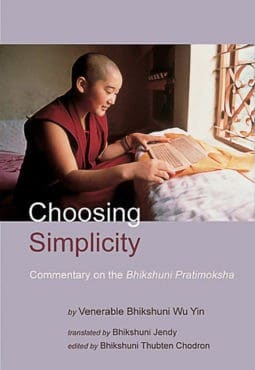
Choosing Simplicity
A Commentary on the “Bhikshuni Pratimoksha”A guide to the precepts and lifestyle of fully ordained Buddhist nuns for all those who wish to conduct their day-to-day lives more mindfully. This text is best read by fully ordained Buddhist monastics.
Order from
This text is best read by fully ordained Buddhist monastics.
About the book
Over twenty-five hundred years ago, the Buddha’s stepmother, Mahaprajapati and five hundred women from the Shakya clan went through incredible difficulties to request bhikshuni ordination from the Buddha. In giving them permission to enter the order, the Buddha affirmed women’s ability to practice the Dharma, to liberate themselves from cyclic existence, and to become enlightened. For over twenty-five centuries, women have practiced the Dharma and achieved the beneficial results. Now we are reaping the benefit of their practice and of the Dharma that they preserved and passed down. It is our privilege and responsibility to learn and practice the Dharma not only to attain spiritual realizations, but also to benefit others by preserving and passing on these precious teachings to future generations.
Choosing Simplicity presents the nuns’ monastic life as a living tradition. It describes the meaning and purpose of being a Buddhist nun and explains the precepts according to the themes or topics with which they deal. Venerable Bhikshuni Master Wu Yin, president of Gaya Foundation and founder of Luminary Temple in Taiwan gave the teachings contained in this book to Western nuns at the 1996 program Life as a Western Buddhist Nun, in Bodhgaya, India.
Choosing Simplicity is of interest to monastics and lay followers, women and men. By knowing about the lifestyle of monastics, people’s faith in the Dharma will increase, and they will see that monastics can help and inspire them along the path. Those considering taking ordination will gain a better understanding of monastic life and be able to make well-informed and thoughtful decisions about ordination. Those who are novices will learn the full precepts and be able to train in them before actually receiving them, while those who are fully ordained will understand what to practice and what to abandon on the path, thus enabling them to keep their precepts purely and progress on the path.
The story behind the book
Venerable Thubten Chodron reads an excerpt
The story behind Choosing Simplicity
Behind each page of a book lies a story. This story is not necessarily expressed in the content of the book; rather, it is the story of the lives of the people involved in writing and producing it. In the case of Choosing Simplicity, the story encompasses the lives of many people and the way those lives intersected at certain times in history. Read more …
Related materials
Reviews
Post your review on Amazon
It is of great importance that Buddhist monasticism become firmly established in the West. This excellent book makes a major contribution to this becoming a reality.
Until now there has been no comprehensive translation nor commentary on the precepts for Buddhist nuns available in English … Includes fascinating accounts of the history behind the vows and the reasons for keeping them.
The book not only helps nurture an understanding of the meaning and value of Buddhist monasticism but also offers essential commentary in simple language for Buddhists in the West who choose a monastic lifestyle.
Far from being just a dry list of rules, the material comes alive, thanks to Master Wu Yin’s approach, as she discusses them based on her years of experience in living and working with them in her monastery in Taiwan. She presents the Bhikshuni Pratimoksa rules, developed by the Buddha himself, as a living body of material that is still relevant in modern life.
By examining how the ordination vows act as guidelines to promote individual peace and personal simplicity, “Choosing Simplicity: A Commentary on the Bhikshuni Pratimoksha” by Venerable Bhikshuni Wu Yin … is a glance at a feminine lifestyle that utterly challenges the attainment-based culture that women, and particularly American women, have been so thoroughly sold on. So what stress-beating experiences could reading a manual on the female Buddhist relationships to food, clothing, shelter, and possessions possibly offer? All I can tell you is that such an immersion is like taking a trip to sanity for a while; people of all faiths and cultures can benefit from even such random samples of monastic experience. Just completing a chapter I felt more mindful than when I started. And as weeks passed the precepts crept through my consciousness as I went about my days.
By providing an insider’s perspective on the challenges of being a Buddhist monastic and a woman, the book makes a valuable contribution to the fields of religious history, anthropology, ethics, and women’s history.
Choosing simplicity in our affluent society means choosing sanity. Christians as well as Buddhists are discovering how monastic values can enrich their lives as lay people. For monastics and lay people alike, “Choosing Simplicity” will be a book worth reading.
More than a handbook to a Buddhist monastic life, this text offers guidelines to all who wish to conduct their day-to-day lives more mindfully. “Choosing Simplicity” can mean saving time and energy for the important things.