

A garland of advice
For prospective monastics
 Venerable Karma Lekshe Tsomo
  Preparing for Ordination
  Jun 1, 1996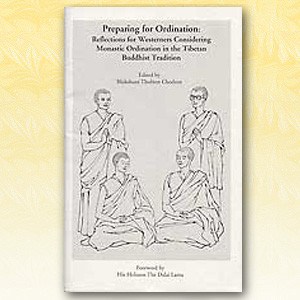
A series of articles published as Preparing for Ordination, a booklet prepared by Venerable Thubten Chodron and available for free distribution.
Dear Friend,
Thank you for your letter. I am very happy to hear of your interest in taking ordination as a Buddhist nun. The issue of ordination is a complex and fascinating one. The experience of each individual who ordains is unique and depends on many factors. First, I suggest you read the sections of the book Sakyadhita: Daughters of the Buddha that deal with ordination and monasteries in the West. This may answer some of your questions and will no doubt raise further ones. According to Buddhist tradition, the sign that the Dharma is established in a place is the presence of a monastic sangha. It is my sincere wish that a strong sangha be established in the West, so I am very happy to share my experience with you.
I have been happily ordained for 19 years: 13 years in India and 6 years in Hawai’i. However, I have had many friends over the years who have ordained but are no longer in robes. Their experience highlights issues that need to be considered seriously by anyone thinking of requesting ordination.
The wish to ordain is extremely virtuous, surely the result of positive actions and prayers. The monastic lifestyle is wonderful for Dharma practice, but being a Western monastic is not always easy. Buddhism is new in the West and as yet there is very little support for Western monastics on any level. Whether in India or the West, the problems of life cannot be solved simply by receiving ordination.
One of the first things to consider is one’s motivation for ordaining. If it is to live a peaceful life, to escape the problems of the world, to avoid human relationships, to withdraw from emotional problems, or to get material support, receiving ordination will not guarantee any of these. The highest motivation is to practice the Buddha’s teachings wholeheartedly for the sake of liberating oneself and others from cyclic existence. Laypeople can practice the Buddha’s teachings wholeheartedly too, but what distinguishes an ordained practitioner is the depth of commitment. Receiving lay, novice, or full ordination is a lifelong commitment to maintain various levels of precepts. To make any of these commitments requires a thorough understanding of Buddhist teachings and a strong resolve to practice them.
Prerequisite to taking any of these ordinations is taking refuge in the Buddha, Dharma, and Sangha, which signifies becoming a Buddhist. Therefore, it is important to reflect on one’s affinity with this spiritual tradition before making a commitment. It is also important to reflect on one’s determination to keep the precepts before taking them. The novice and full ordinations represent increasingly serious commitments to Dharma practice. These ordinations involve more responsibilities and greater visibility: wearing robes, shaving the head, keeping additional precepts, and maintaining the expected behavior of a Buddhist monastic.
Taking on these commitments is a gradual process of ever-increasing dedication to the Buddhist path. Although I had been a Buddhist since childhood and wanted to be a nun for many years, I began by taking refuge in a formal ceremony with my teacher. Then I took the two lay precepts I felt sure I could keep. Each year I added one more precept until I had five. After keeping the five lay precepts for several years and becoming comfortable with them, it still took several more years of simplifying my life before I became a nun. When I met Ven. Nyanaponika, the renowned German monk, in Sri Lanka and told him of my aspiration to become a nun, he advised me, “Make sure you are not running away from anything.” This turned out to be very sound advice. It caused me to reflect on my motivation and consider seriously whether I was ready for monastic life.
It is possible to take eight precepts for life, including celibacy, and continue living in the world. Such a person may wear lay clothes, work a regular job, and wear an ordinary hairstyle, but privately maintain precepts similar to a monastic. To quietly maintain a celibate lifestyle is extremely virtuous, but can also be very difficult. Since nothing external distinguishes one from a layperson, it is easy to get drawn into worldly affairs and lose one’s monastic resolve.
Becoming a monastic is very different, since the robes and shaved head announce one’s dedication to the spiritual life and one’s disassociation from worldly affairs such as sex, alcohol, and entertainment. Being visible in this way has its advantages and disadvantages. It protects one from worldly involvement, gives others a readily identifiable spiritual resource, and is a constant reminder of one’s spiritual aspirations. At the same time, people have expectations of what a spiritual person should be and expect monastics to live up to them. Unless one’s motivation is strong, such expectations may begin to feel constricting.
For me, ordination has often entailed a struggle for sustenance. One of the first things to consider is how to support oneself. There are very few monasteries that support Western monastics, and Dharma centers often provide Western monastics only room and board. Therefore, some Tibetan lamas say it is possible for monastics to work at a job. Unless you are independently wealthy or find some means of support, it may be necessary to work, but I do not feel that it is necessary or appropriate for monastics to wear lay clothes and long hair. I have worked at hospitals and universities for years with robes and a shaved head. The robes attract attention, which can be uncomfortable. Contemplating the value of precepts helps develop self-confidence, while contemplating compassion for living beings helps put others at ease. In time, people get used to the robes and often come to seek spiritual advice. The robes seem to inspire trust and serve to remind people of their own spiritual dimension. Some people say it is better to wear lay clothes and be integrated in society, but I do not wish to be integrated in society, since my goals and interests are very different from the mainstream.
I recommend that people interested in ordination begin by receiving the lay precepts and practice with them until they feel comfortable. Meanwhile, through reading and talking with people who are or have been in robes, you can research the matter of being a monastic in Western society, understanding the benefits as well as the challenges. You also need to consider carefully the matter of financial support, since you can expect little support from any direction.
Becoming a monastic is a lifelong commitment and entails trying to live according to very strict rules of discipline that were set forth at the time of the Buddha. It is good to be clear about this code of discipline as well as the social and cultural expectations involved before ordaining. Although it is possible to change one’s mind and return to lay life, it is generally a disappointing experience, both for the person and the people around. At present, there are very few ideal places for Western monastics, so it is difficult to learn correct deportment. Courses offering training for prospective and new monastics are badly needed.
Another thing to consider is the gender issue. Whether in Western or Asian societies, monks and nuns are often treated differently. Monks, especially Asian monks, are given respect and material support, while nuns, especially Western nuns, are sometimes neglected. Experiences of gender and racial discrimination like this can be quite discouraging. Attitudes are changing rapidly, and women can make a very positive contribution by demonstrating their capabilities. The most effective approach in Asian societies seems to be humility, sincerity, and perseverance.
What enabled me to live happily as a nun over the years was learning to transform my attitude toward difficult situations. When I had no money, I would reflect on renunciation. When I encountered obstacles, I would reflect on karma ripening. When I was sick, I would reflect on the Four Noble Truths. When I felt inadequate, I would reflect on Buddha nature, the potential for all beings to manifest enlightenment. Praise helped me develop humility, while humiliations helped me develop inner strength.
My teacher reminded me to reflect on the rarity of ordination, constantly rejoicing in my good fortune. Generating bodhicitta, the attitude wishing to achieve enlightenment for the sake of all living beings, is one of the most valuable Buddhist teachings for maintaining a steady practice and handling difficulties in monastic life when they arise. With sincerity and a pure motivation, all difficulties can be overcome and can even be beneficial to our practice. If you have any further questions, please feel free to write to me again.
Happiness in the Dharma,
Karma Lekshe Tsomo

Venerable Karma Lekshe Tsomo
Bhikshuni Karma Lekshe Tsomo grew up in Hawaii and received her M.A. in Asian Studies from the University of Hawaii in 1971. She studied for five years at the Library of Tibetan Works and Archives and several years at the Institute of Buddhist Dialectics, both in Dharamsala, India. In 1977, she received sramanerika ordination and in 1982 bhikshuni ordination. She is a founding member of Sakyadhita, the founder of Jamyang Choling Nunnery in Dharamsala, and is currently completing her Ph.D. at the University of Hawaii.