Foreword
Foreword
 His Holiness the Dalai Lama
  Preparing for Ordination
  Jun 1, 1996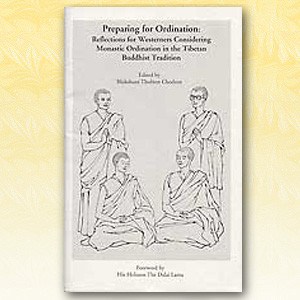
A series of articles published as Preparing for Ordination, a booklet prepared by Venerable Thubten Chodron and available for free distribution.
Many of the Buddha’s discourses and treatises by subsequent scholars clearly state that the single innermost treasure of the Buddha’s doctrine is the Vinaya, the teaching on moral conduct of ordained monks and nuns. Therefore, it is said that wherever there is a monk or nun observing the vows of full ordination, the Buddha’s doctrine exists there. Indeed, the Buddha is present in that place. However, merely taking the vows is not sufficient by itself. It is also extremely important to maintain pure moral discipline by correctly observing those activities that are to be cultivated and those that are to be given up. Therefore, it is very helpful to reflect over and again how moral discipline is the root of all excellence and to consider the benefits of guarding such discipline and the shortcomings of not doing so. Numerous scriptures explain these issues and several of them are available in English translation.
These days, interest in Buddhism is spreading beyond its traditional boundaries in Asia. More and more people from non-Buddhist backgrounds are expressing a wish to become ordained as Buddhist monks and nuns. Sometimes they face unexpected problems. These may occur because they did not properly understand what ordination entailed or because they lack the social and spiritual support that is taken for granted in traditional Buddhist societies. With a heartfelt wish to ease some of these problems, Venerable Thubten Chodron and other like-minded friends have prepared this booklet of advice, based on their own experience, for people, particularly Westerners, who are considering ordination as Buddhist monks and nuns.
This is a work of true spiritual friendship. Ordination is not something to be taken lightly. In the Tibetan Buddhist tradition, it is intended to be a lifelong commitment. The Buddhist tradition itself will not be strengthened merely by increasing the numbers of people who become ordained. That will depend rather on the quality of our monks and nuns. Therefore, those who sincerely seek ordination deserve proper guidance, encouragement and support.
Having taken ordination we must constantly remember that the primary reason for holding vows as a nun or a monk is to be able to dedicate ourselves to the practice of the Dharma and the welfare of sentient beings. Part of Buddhist practice involves training our minds through meditation. But if our training in calming our minds, developing qualities like love, compassion, generosity and patience, is to be effective, we must put them into practice in our day to day life. Even if only a few individuals try to create mental peace and happiness within themselves and act responsibly and kindheartedly towards others, they will have a positive influence in their community. If we can do that we will fulfill the Buddha’s fundamental instruction not only to avoid harming others, but actually to do them some good.

His Holiness the Dalai Lama
His Holiness the 14th Dalai Lama, Tenzin Gyatso, is the spiritual leader of Tibet. He was born on July 6, 1935, to a farming family, in a small hamlet located in Taktser, Amdo, northeastern Tibet. At the very young age of two, he was recognized as the reincarnation of the previous 13th Dalai Lama, Thubten Gyatso. The Dalai Lamas are believed to be manifestations of Avalokiteshvara or Chenrezig, the Bodhisattva of Compassion and the patron saint of Tibet. Bodhisattvas are believed to be enlightened beings who have postponed their own nirvana and chosen to take rebirth in order to serve humanity. His Holiness the Dalai Lama is a man of peace. In 1989 he was awarded the Nobel Peace Prize for his non-violent struggle for the liberation of Tibet. He has consistently advocated policies of non-violence, even in the face of extreme aggression. He also became the first Nobel Laureate to be recognized for his concern for global environmental problems. His Holiness has traveled to more than 67 countries spanning 6 continents. He has received over 150 awards, honorary doctorates, prizes, etc., in recognition of his message of peace, non-violence, inter-religious understanding, universal responsibility and compassion. He has also authored or co-authored more than 110 books. His Holiness has held dialogues with heads of different religions and participated in many events promoting inter-religious harmony and understanding. Since the mid-1980’s, His Holiness has begun a dialogue with modern scientists, mainly in the fields of psychology, neurobiology, quantum physics and cosmology. This has led to a historic collaboration between Buddhist monks and world-renowned scientists in trying to help individuals achieve peace of mind. (Source: dalailama.com. Photo by Jamyang Dorjee)