

Introduction
Introduction
 Venerable Thubten Chodron
  Preparing for Ordination
  Jun 1, 1996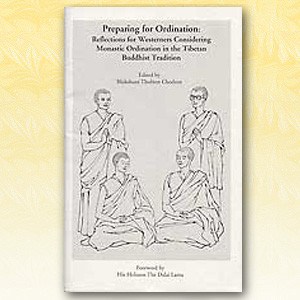
A series of articles published as Preparing for Ordination, a booklet prepared by Venerable Thubten Chodron and available for free distribution.
This booklet has been percolating for many years now, as senior Western monastics have become more concerned with the preparation and training of the Western sangha. During Life as a Western Buddhist Nun, a three-week educational program on the vinaya held in Bodhgaya, India, in February, 1996, this concern jelled, and many of the senior nuns at the program decided to produce a booklet for those Westerners who are considering monastic ordination. At the nuns’ audience with His Holiness the Dalai Lama following Life as a Western Buddhist Nun, we proposed that Western monastics become more involved in the screening and preparation of applicants for ordination. His Holiness responded enthusiastically, and this booklet is the first step in that direction. Volunteering to edit and prepare the booklet, I collected articles from other monks and nuns and from one layman. The booklet is financed by donations made to Life as a Western Buddhist Nun, and is given for free distribution to those who are interested.
This booklet is a compilation of the thoughts of several Western monastics in the Tibetan Buddhist tradition and of some Asian spiritual masters. Over the years, Western monks and nuns have learned about monastic life through our experience as well as by studying with our kind and wise spiritual masters. We feel a responsibility to share what we have learned so that others can benefit from our experience and can avoid some of the mistakes we have made. We are not setting down a policy that everyone must observe. Within Buddhism, the various traditions have different ways of interpreting and keeping the precepts. Even within one tradition, the monastic discipline may be lived differently from one monastery to another or from one teacher to another. We are not looking for unflinching uniformity. Although Buddha’s disciples have a common refuge, they have differing inclinations and dispositions.
However, because Buddhism is new in the West, people’s knowledge is limited, and our Tibetan teachers are not always familiar with the nuances of our cultures or with our particular Western mentality and values. Because we are working cross-culturally, care must be taken in bringing Buddhism in general and monasticism in particular to the West. At times Tibetan teachers and Western disciples have misconceptions, incorrect assumptions, or simply lack of knowledge about each other. If not clarified and resolved, these can lead to many difficulties and much confusion when Westerners ordain. We hope that this booklet will help prevent such problems and will enable people to build firm foundations so that their lives as monastics may be joyful, meaningful, and productive.
In Buddhist teachings, the ideal is explained so that we will know in what direction to develop and for what to aim. It is the same in this booklet. The ideal, the strict interpretation, is often given. Knowing that and trying to go in that direction in our practice, we may sometimes have to deviate from the strict view due to the circumstances in which we find ourselves. When such situations arise, we will be better equipped to make wise decisions if we know the ideal than if, in ignorance, we reinterpret the attitudes and conduct expected of monastics without being aware of the traditional views.
The monastic lifestyle has existed continuously from the Buddha’s time until the present, and through it countless people have progressed along the path to liberation and enlightenment. It is very important for individual practitioners, the Buddhist community, and society as a whole that the monastic lifestyle be continued in a pure fashion. For this to happen, people must be well-prepared before ordination and well-trained after it. In that way, the Dharma and the vinaya will grow in our minds and through that, we will be able to benefit others. It is with this in mind, that this booklet was humbly assembled.
More and more Sanskrit words, written without diacritics, are coming into common English usage. Since this booklet is written for Buddhist practitioners who may not be academic scholars, Sanskrit words in this booklet follow that trend. A glossary of terms is available at the end of the booklet. Also, the word “Sangha” is capitalized when it refers to one of the Three Jewels of refuge, and not capitalized when it refers to the monastic community. As one of the Three Jewels of refuge, Sangha refers to any person, monastic or lay, who has attained the path of seeing. The monastic community, or sangha, is a conventional representative of that ultimate Sangha.
This booklet was made possible through the kindness of many people. I am especially grateful to the Buddha and to the lineages of monastics who have preserved the vinaya and the Pratimoksa ordination for over 2,500 years, thus enabling the Dharma and the vinaya to touch the hearts of so many people throughout history in Asia and now in the West. Many thanks to all of the contributors as well as to the sponsors of this publication. I also thank Bhikshuni Lekshe Tsomo for her valuable editorial suggestions, Daria Fand for designing the cover, the nuns of Life as a Western Buddhist Nun for their inspiration, Bets Greer for her technical assistance, and Dharma Friendship Foundation in Seattle for its support while I worked on this booklet.
We welcome your feedback on this booklet and welcome articles to be included in future editions.

Venerable Thubten Chodron
Venerable Chodron emphasizes the practical application of Buddha’s teachings in our daily lives and is especially skilled at explaining them in ways easily understood and practiced by Westerners. She is well known for her warm, humorous, and lucid teachings. She was ordained as a Buddhist nun in 1977 by Kyabje Ling Rinpoche in Dharamsala, India, and in 1986 she received bhikshuni (full) ordination in Taiwan. Read her full bio.