

A letter to a friend considering ordination
A letter to a friend considering ordination
 Venerable Thubten Chodron
  Preparing for Ordination
  Jun 1, 1996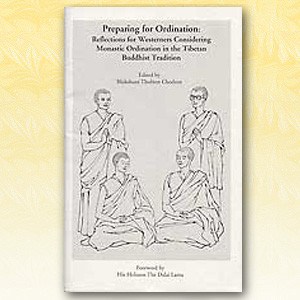
A series of articles published as Preparing for Ordination, a booklet prepared by Venerable Thubten Chodron and available for free distribution.
Dear Dharma friend,
I received your letter. You want to be a monastic! You sound both happy and nervous about this. It is very worthwhile to be a monastic, and the more prepared your mind is for ordination, the easier the transition from lay to ordained life will be. Therefore, I will write some questions for you to reflect on in the hopes that they will help you to think deeply and thus eliminate potential obstacles in your mind. When I requested my spiritual master for permission to be ordained, he said, “Yes, but wait a while.” He made me wait nearly a year and half. I was impatient to ordain and did not want to wait, but looking back on it now, it was very good that I did. During that time I repeatedly contemplated the topics outlined in these questions. This helped me considerably, so now I would like to share them with you. When you contemplate these questions, it is important to be as honest as you can and use them as a tool to discover your own thoughts and feelings. Sometimes your truthful answer may not be what you would like it to be or what you think your spiritual teacher would want it to be. However, there are no right or wrong answers here. The better you know yourself, with all your strengths and weaknesses, the better you will be able to prepare for ordination.
- Why do you want to become a monastic? What is your deepest motivation, your deepest reason for wanting to take ordination? What does ordination mean to you? Are there difficult relation-ships, situations, or emotions that you are trying to be free from? Is ordination a way of avoiding those or a way of facing them?
- Where does being ordained fit into your Dharma practice? How will it help you? What things about being ordained will be difficult for you?
- One of our precepts is to follow the Dharma advice of our abbot (abbess) or teacher. Is there a teacher with whom you have a strong connection? It is important to train under the guidance of a qualified and skillful teacher, not just to move around going wherever your fancy takes you. Are you willing to discuss your plans with your teacher and follow his or her Dharma instructions, or do you like to do what you want to do?
- As sangha members, we are part of a larger spiritual community. We sit in order of our ordination and respect those ordained before us. We also should listen to the advice and suggestions of the senior monks and nuns because they have more experience as monastics. Is there a part of you that has difficulty with respecting and listening to those who are senior? How can you work with that attitude so you can value their guidance and reap the benefit from their experience and concern?
- Which of the Buddhist traditions will be your principal practice? Theravada? Chinese? Tibetan? It is important to know which direction you will take in your practice; otherwise you could end up doing a mixture of things and not get anywhere.
- In order to be able to keep our ordination, we need living conditions conducive to spiritual practice. Where will you live after taking ordination?
- There is no large organization that supports and looks after Western monastics. We are responsible for our own finances, health insurance, and so forth. Worrying about these things can distract us from practice, so it is better to have these firmly in place before ordination. Will you have an income or financial support? Do you have health insurance?
- Do you have any social obligations to clear up before ordination (debts, divorce, caring for aged parents or children)? Do you have any serious health problems that will influence your ability to practice, to live in community, or to keep the ordination?
- We have years and lifetimes of conditioning behind us. It is important to look at this closely and resolve it. Thus, the next sets of questions deal with societal values and goals that previously have been inculcated in us. Do you wish to be successful in a career? Imagine meeting your old friends after several years. They have good careers, success, a comfortable life, and reputation. How will you feel? Will you feel like a useful member of society even though you have not produced anything tangible that is valued by society?
- Ordination entails developing our ability to handle our own emotions without seeking emotional support from a partner. It also involves managing our sexual energy. How do you feel about marriage and family life? Would you like a life-long companion to share your life with? Is it difficult for you to control your emotional or sexual attraction for others? Even if marriage and family do not seem so interesting now, how will you feel when you are older? Often women in their middle or late thirties and men in their late forties undergo a crisis, thinking, “If I want to get married and have children, I have to do so now. Otherwise, my age will make having a family difficult.” Imagine yourself at that age and investigate how you might feel.
- How will you feel when you are old if you have no children, grandchildren, home, security, and so forth? What could your old age be like as a nun or monk? as a lay person?
- Two of our precepts are to abandon the signs of a lay person and to take on the signs of a monastic. This entails shaving our head, wearing robes, and keeping our precepts wherever we are and whomever we are with. Are you easily influenced by what other people think of you—be they strangers or family and friends? How will you feel if people on the street stare at you because you wear robes? How will you feel if your family and friends say that you are escaping from reality or wasting your life by being a monastic? How will you feel if your parents are upset because you are not living a “normal” life?
- Have you told your family and close friends that you are considering becoming a monastic? Are you comfortable with the way they reacted, or do you feel guilty, hurt or angry? It is very important to work out these emotions. Also, it is important to give your parents love. They often fear that their child is rejecting them, or that they will never see their child again if he or she takes ordination. We have to be sensitive to their needs, to reassure them that we love them, and yet not feel pulled by their emotions or wishes. What meditations can you do to help you overcome the attachment or anger you may have towards your family?
- Are you prepared to live in a community? This involves giving up doing what you want to do when you want to do it. You have to follow the discipline of the community. You have to live and work with people whom you may not normally choose as your friends. How do you feel about having your ego confronted like this?
- Which is your strongest disturbing attitude: attachment, anger, ignorance, jealousy, pride, doubt? If it goes unaddressed, it will cause problems in your practice and make you doubt your ordination. Know which one is the strongest and start applying the antidotes in your meditation now.
- To actually receive the ordination during the ordination ceremony, you must have developed to some extent the determination to be free from cyclic existence and to attain liberation. To be able to keep the ordination after receiving it, you have to constantly cultivate this motivation. Do you regularly meditate on the disadvantages of cyclic existence and its causes, or is there a part of your mind that is resistant to thinking about that? The eight worldly concerns are some of the chief obstacles to developing the determination to be free. We are attached to 1) money and material possessions, 2) praise and approval, 3) reputation and image, and 4) pleasure from the five sensual objects. We have aversion to 5) not receiving or losing our money and possessions, 6) blame or disapproval from others, 7) bad reputation or image, and 8) unpleasant sensations from our five senses. Which of these are the strongest for you? Are you familiar with the antidotes for them? Do you apply those antidotes? Do you feel that giving up those eight mental states would make you unhappy?
- How do you feel about going through the hardships of ordained life? How can you strengthen your spiritual goals and make them more heartfelt and central to your life? Ordained life, like lay life, is not always easy. There will be problems, ups and downs. When the down times come, people are tempted to blame their ordination, thinking “My ordination is the problem. If I were not a monastic, I would not have this problem.” What are the benefits of ordination? Do you have deep conviction in them? It is important to have a clear understanding of these things beforehand, and to be courageous in facing physical, emotional, and spiritual difficulties in your life.
- Is there a part of your mind that is seeking respect from others because you are ordained? Do you expect others to treat you well? to give you things? to show you respect? Or are you willing to be the servant of others, thus cultivating the altruistic intention?
- What are your needs and concerns after ordination? What resources do you have—internal and external—to help you meet those? What things do you feel confident about? What things do you feel shaky about?
These are some things to think deeply about. Each point has several questions, and it could be helpful to write down your responses. Put them aside for a few weeks. Then reread them and make adjustments. Reflecting on these questions again and again over time will help remove unclarity in your mind and possible obstacles in your ordination. They will help you go through the emotional high of wanting to be a monastic and to understand your mind better.
I wish you all the best on the path to enlightenment and pray that your wisdom, compassion, and skill grow so that you may spread happiness to many beings.
Yours in the Dharma,
Thubten Chodron

Venerable Thubten Chodron
Venerable Chodron emphasizes the practical application of Buddha’s teachings in our daily lives and is especially skilled at explaining them in ways easily understood and practiced by Westerners. She is well known for her warm, humorous, and lucid teachings. She was ordained as a Buddhist nun in 1977 by Kyabje Ling Rinpoche in Dharamsala, India, and in 1986 she received bhikshuni (full) ordination in Taiwan. Read her full bio.