

H. H. the Dalai Lama answers questions
H. H. the Dalai Lama answers questions
 His Holiness the Dalai Lama
  Preparing for Ordination
  Jun 1, 1996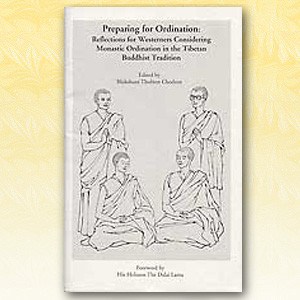
A series of articles published as Preparing for Ordination, a booklet prepared by Venerable Thubten Chodron and available for free distribution.
Question: When the Buddha first ordained monastics, there were no precepts. The precepts were gradually made afterwards, when some monks and nuns misbehaved. Thus there must have been a deeper meaning or purpose that the Buddha had in mind for monasticism, beyond the keeping of precepts. Please talk about the deeper essence or meaning of being a monastic.
His Holiness the Dalai Lama (HHDL): First, on the individual level, there is a purpose in being a monk or nun. The Buddha himself was an example of this. He was the prince of a small kingdom, and he renounced this. Why? If he remains in the kingdom with all of the householders’ activities, those very circumstances compel one to become involved in attachment or in harsh attitudes. That is an obstacle for practice. With family life, even though you yourself may feel content, you have to take care of your family, so you have to engage in more worldly activities. The advantage of being a monk or nun is that you do not have to be entrapped in too many worldly engagements or activities. If, after becoming a monk or a nun, as a practitioner you can think and develop genuine compassion and concern for all sentient beings—or at least the sentient beings surrounding you—then that kind of feeling is very good for the accumulation of virtues. On the other hand, with your own family, your concern and wish is to repay your family members. Perhaps there are some exceptional cases, but generally speaking, that burden is a real burden, and that pain is a real pain. With that, there is no hope of accumulating virtue because your activities are based on attachment. Therefore, becoming a monk or nun, without family, is very good for the practice of the Buddhadharma because the basic aim of Dharma practice is nirvana, not just day-to-day happiness. As monastics, we seek nirvana, permanent cessation of samsaric suffering, so we want to pacify the seed or the factors that bind us in the samsaric world. The chief of these is attachment. Therefore the main purpose of being a monastic is to reduce attachment: we work on no longer being attached to family, no longer being attached to sexual pleasure, no longer being attached to other worldly facilities. That is the main purpose. This is the purpose on the individual level.
Question: Please speak about the advantage of taking higher ordination as a bhikshu or bhikshuni. Why did you chose to become a bhikshu rather than to remain as a sramanera? What is the best way to prepare to take ordination as a bhikshu or bhikshuni?
HHDL: Generally, in our tradition, with higher ordination, all your virtuous activities become more effective, more powerful, more forceful. Similarly, the negative activities are more powerful (he chuckles), but we usually tend to look more on the positive side. The teachings of the bodhisattva vehicle and tantric vehicle, for example Kalachakra, express great appreciation for the bhikshu vow. We feel it is a great opportunity to take higher ordination. A bhikshu or bhikshuni has more precepts. If you look at them point by point, sometimes you may feel there are too many precepts. But when you look at the purpose—to reduce attachment and negative emotions—then it makes sense. In order to reduce our negative emotions, the Vinaya puts more emphasis on your actions. So Vinaya contains very detailed and precise precepts about physical and verbal actions. The higher vows—the bodhisattva vow and the tantric vow—put more emphasis on the motivation. If you look at how the bhikshu and bhikshuni precepts work, you will get a better understanding of their purpose.
Generally speaking, those Buddhist practitioners who are really determined to follow this practice according to the Buddha’s guidance of course become sramanera(ika), then bhikshu(ni). Then they take the bodhisattva vow and finally the tantric vow. I feel the real preparation for taking bhikshu or bhikshuni ordination is not the study of the Vinaya, but more meditation about the nature of samsara. For example, there is a precept of celibacy. If you just think, “Sex is not good. Buddha prohibited it, so I can’t do it,” then it is very difficult to control your desire. On the other hand, if you think of the basic aim, the basic purpose—nirvana—then you will understand the reason for the precept and it will be easier to follow it. When you do more analytical meditation on the Four Noble Truths, you will gain conviction that the first two truths are to be abandoned and the last two to be actualized. Having examined whether these negative emotions—the cause of suffering—can be eliminated, you will become confident that they can. You can see clearly there is an alternative. Now the whole practice becomes meaningful. Otherwise, keeping precepts is like a punishment. When you do analytical meditation, you will realize there is a systematic way to reduce the negative emotions, and you will want to do that because your aim is nirvana, the complete elimination of negative emotions. Contemplating this is the main preparation. Study the Four Noble Truths, and do more analytical meditation on these topics. Once you develop genuine interest in nirvana and feel it is possible to attain, you will feel, “That’s my purpose, that’s my destination.” The next question is, “How can I reduce negative emotions step by step on the emotional level and on the practical level?” Thus, you progressively becomes an upasaka, a full upasaka, an upasaka with celibacy, a sramanera, and a bhikshu. For women, one is first upasika, then sramanerika, shiksamana, and bhikshuni. Gradually taking the various levels of precepts is climbing the steps to liberation.
Question: Is there a different way of practicing the Vinaya for someone who is in the Vajrayana tradition? How do we integrate our study and practice of Vinaya with our study and practice of the tantra?
HHDL: According to our tradition, we are monastics and are celibate, and we practice the Tantrayana simultaneously. But the way of practice is through visualization. For example, we visualize the consort, but we never touch. We never implement this in actual practice. Unless we have reached a stage where we have completely developed the power to control all our energy and have gained the correct understanding of sunya (emptiness, reality), unless we truly possess all the faculties through which those negative emotions can be transformed into positive energy, we never implement practice with an actual consort. Although we practice all the higher practices, as far as implementation is concerned, we follow Vinaya. We never follow according to Tantrayana. We can’t drink blood!! (everyone laughs). In terms of actual practice, we have to follow the stricter discipline of Vinaya. In ancient India, one of the reasons for the degeneration of the Buddhadharma was the wrong implementation of certain tantric explanations.
Question: It is difficult to follow the Vinaya literally in all situations nowadays. Can adaptations be made to how we live it?
HHDL: Obviously, we must make every effort to follow the Vinaya teachings and precepts. Then in certain cases, if there is sufficient reason to make certain adaptations, it is possible. But we should not make these adaptations too easily. First we should give preference to following the Vinaya precepts as they are. In cases where there are enough sound reasons that necessitate an adaptation, then it is permissible.
Question: What is the source of joy in the mind? How do we maintain a sense of joy? How do we deal with doubt and insecurity that may arise?
HHDL: As a practitioner, once you gain some inner experience as a result of your spiritual practice, that gives you some deep satisfaction, happiness, or enjoyment. It also gives you some kind of confidence. I think that is the main thing. This comes through meditation. The most effective method for your mind is analytical meditation. But without proper knowledge and understanding it is difficult to meditate. There is no base for knowing how to meditate. To be able to do analytical meditation effectively, you should have knowledge of the whole structure of Buddhism. So study is important; it makes a difference in your meditation. But sometimes in our Tibetan monasteries there is too much emphasis on the intellectual side, and the practice side is neglected. As a result some people are great scholars, but as soon as their lecture finishes, then ugliness appears. Why? Intellectually, they are a great scholar, but the Dharma is not integrated with their life.
Once you personally experience some deeper value as a result of our practice, then no matter what other people do, what other people say, your happiness will not be affected. Because through your own experience you will be convinced, “Yes, there is some good thing there.” The Buddha made it very clear. Right at the beginning he said it was extremely important for each individual to make his or her decisions and make effort in the practice.

His Holiness the Dalai Lama
His Holiness the 14th Dalai Lama, Tenzin Gyatso, is the spiritual leader of Tibet. He was born on July 6, 1935, to a farming family, in a small hamlet located in Taktser, Amdo, northeastern Tibet. At the very young age of two, he was recognized as the reincarnation of the previous 13th Dalai Lama, Thubten Gyatso. The Dalai Lamas are believed to be manifestations of Avalokiteshvara or Chenrezig, the Bodhisattva of Compassion and the patron saint of Tibet. Bodhisattvas are believed to be enlightened beings who have postponed their own nirvana and chosen to take rebirth in order to serve humanity. His Holiness the Dalai Lama is a man of peace. In 1989 he was awarded the Nobel Peace Prize for his non-violent struggle for the liberation of Tibet. He has consistently advocated policies of non-violence, even in the face of extreme aggression. He also became the first Nobel Laureate to be recognized for his concern for global environmental problems. His Holiness has traveled to more than 67 countries spanning 6 continents. He has received over 150 awards, honorary doctorates, prizes, etc., in recognition of his message of peace, non-violence, inter-religious understanding, universal responsibility and compassion. He has also authored or co-authored more than 110 books. His Holiness has held dialogues with heads of different religions and participated in many events promoting inter-religious harmony and understanding. Since the mid-1980’s, His Holiness has begun a dialogue with modern scientists, mainly in the fields of psychology, neurobiology, quantum physics and cosmology. This has led to a historic collaboration between Buddhist monks and world-renowned scientists in trying to help individuals achieve peace of mind. (Source: dalailama.com. Photo by Jamyang Dorjee)
