

Waiting for the right time
Waiting for the right time
-
 Upasaka Guy Rom
 -
 Preparing for Ordination
-
Jun 1, 1996
 Upasaka Guy Rom
  Preparing for Ordination
  Jun 1, 1996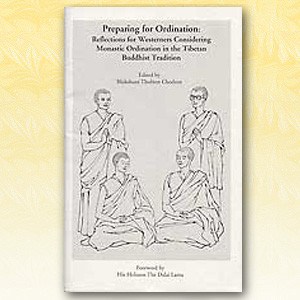
A series of articles published as Preparing for Ordination, a booklet prepared by Venerable Thubten Chodron and available for free distribution.
I would like to share my experience while encountering the Dharma. What I say may seem obvious to many Dharma practitioners, but if it clarifies something for just one person, then that is enough.
When I first met the Dharma, my mind was racing. I had a strong instinct for the teachings, and I was fascinated and excited by them. I had a strong desire to become a monk as soon as possible, to practice intensely, and to become a Buddha quickly. Luckily, my teacher would not allow me fall into my own trap. Becoming a monk at that time in my life would have been disastrous for me. This was because, unbeknownst to me at the time, my understanding of the Dharma was intellectual. My desire to be ordained was simply a desire of the ego; there was little Dharma motivation from the heart. Consequently, taking ordination would have made me feel pressured, instead of bringing peace and happiness, which are the real purpose of practicing the Dharma and keeping the precepts. I would have been in constant internal conflict as I tried to live up to my ideal of a perfect monastic, instead of accepting myself and working with what I am at present.
After some time, I realized my faulty motivation. I came to my senses, or more accurately, I left my senses and discovered a tiny drop of Dharma in my heart. As I practiced more, self-acceptance began to arise in my heart. I stopped pressuring myself with my idealistic, intellectual understanding of the Dharma and the expectations it produced. Dharma is beautiful, and we have to have a long-term view in order to find it within ourselves. It will take a long time to practice and develop Dharma qualities. As His Holiness the Dalai Lama says, “The longer the practitioner is willing to practice, the quicker he or she will achieve the goal.” Joyous effort means being peaceful and happy with the practice and willing to spend a long time at it. When we have this, then we are truly practicing. Dharma now means to me becoming a better human being, caring for others, trying to develop a kind heart. It does not mean being intellectual, uptight, and pushing myself.
I hope to be ordained when I am confident to keep the precepts purely in a peaceful, happy state of mind. Then being ordained will benefit my practice and that in turn will benefit many other people as well. In the meantime, I will try to live according to the precepts while wearing lay clothes and having long hair, and practice being a monastic before actually becoming one.
Upasaka Guy Rom
Guy Rom was born in Israel and became interested in Buddhism while visiting India and Nepal in the early 1990s. His principal teacher is Lati Rinpoche, and he has studied and practiced in Dharamsala as well as South India for several years.
Guy Rom
c/o Dalia Hochman
64 Hadar St.
Omer 84965, Israel
[email protected]