|
Reflections
On My First Vajrasattva Retreat
by Karen Tan ©
"Do you have the
program?" I asked the bespectacled volunteer at the reception
counter of Bright Hill Buddhist temple. He shook his head. I looked
absently at the words on the poster, trying to make sense of the
little blurb describing the event.
"The Vajrasattva Retreat will teach
us to relieve the burden of our negativities and purify the imprints
of negative actions in order to develop our Buddha potential."
OK.
I have no idea what
that means.
What is Vajrasattva? It doesn't say. All it
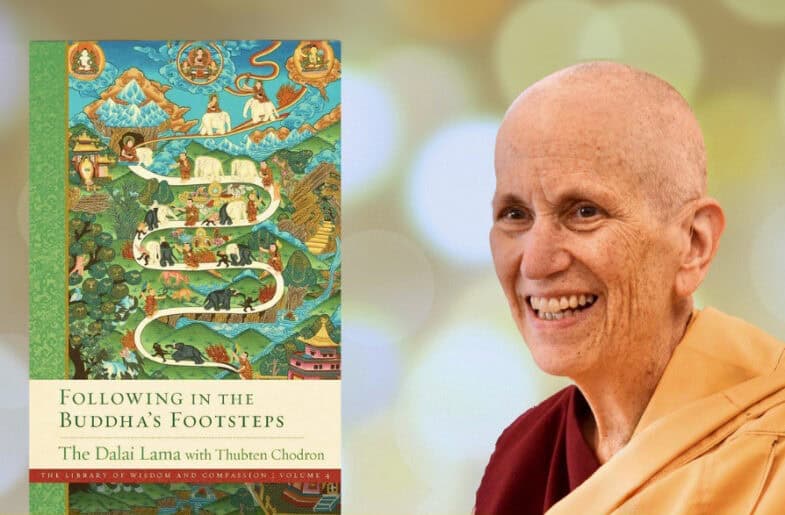
states is that the retreat will be helmed by Thubten Chodron, an
American Tibetan Buddhist nun. I don't know much about her although
I have read some of her books. Well, at least it will be conducted
in English. Anyway, KC was going to be at work in the US over the
weekend and I always wanted to try a retreat on my own. Before I
change my mind, I sign myself up. Go with an open mind, I told myself.
On Saturday morning, I woke up at 6 a.m., took
Reilly for an extra long walk and fed him, ran in for a quick shower
and changed into my "holy" clothes. By that, I don't mean
my usual gym get up. The advisory email recommended all participants
be comfortable and modestly dressed in loosely fitted tops with
sleeves, and long pants. A shawl or jacket was also suggested in
case the air conditioning got too chilly in the Hall of No Form.
Not a fan of the cold, I brought both.
The program was simple enough. A two-day program
from 9am to 5pm of gentle meditation, talks, Q&A, breaks and
more meditation, punctuated only by noble silence.
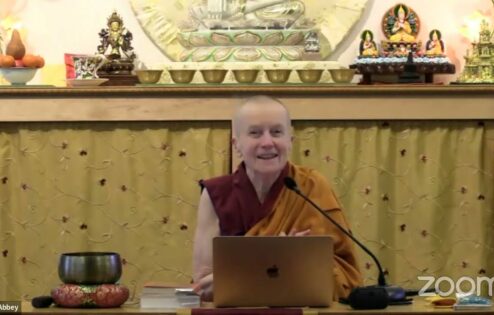
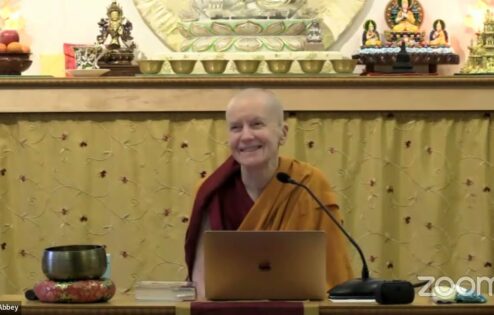
An introduction by Venerable Chodron set the
stage for the day. She drew on the problems of modern life- how
we have become so desensitized from the harried pace of fortune
hunting, how the onslaught of modern technology has enabled us to
reduce human communication and relationships to a hand-held device.
Inevitably, when speed and insensitivity collide, it gives rise
to an infinite series of negative actions and the subsequent need
for purification. As religiously puritanical and ritualistic as
it sounds, purification is to help relieve the mental and physical
symptoms manifested in us, in our lives; not just far-out concepts
of karmic repercussions, but everyday cases of suicide, depression
and aimlessness.
So far, so good. I think I am getting all this.
But what has Vajrasattva Buddha got to do with
all this? The God factor is not tenable in Buddhism, so this big
blissful-looking androgynous deity seated in some impossibly complex
yoga position is not coming down to save us from ourselves. I must
admit I was not impressed at first. Somehow Tibetan Buddhism is
a bit too close to home. I grew up with the general belief in the
religious cultural mish-mash of minor gods and deities, each with
wish-fulfilling powers, happy to grant wishes to whomever grovels
and hones their brown-nosing skills. How is a cartoon-like figure
going to help me? Does my visualization have to look like a Pixar
animated movie?
I am baffled but I follow along. If there is
anything I learned from horse riding is that you never learn until
you fall off. By falling, I cultivated humility and patience. Just
because I think I'm in control doesn't mean I am. After ten weeks
of riding, the most important lesson I derived is to ask the horse
to teach me to ride by being willing to listen, watching his every
breath and move. Right now is like the first time I got flung off
the horse. I'm not sure how I feel but I am willing to see where
this takes me.
Meditation hurts.
My back weeps in pain every time we sit for
more than 20 minutes. My legs feel like twisted scrap metal every
time we stand up. And there is bowing, lots of it. Bow to the Buddha,
bow to the teacher every time she comes in or leaves, bow during
chanting. By "bowing" I mean starting at full standing
position, then forward fold, kneel, forehead, elbows and hands on
the floor, push back up, repeat. My knees are bruised, creaking
knees begging for new joints. This is worse than any gym workout.
So much cheaper too.
Strangely, my mind is largely unperturbed. I
know my body hurts, but not enough for me to walk off in a huff.
I know I am watching my mind at close range, but I can only think
of one other reason why I am still there.
Venerable Chodron.
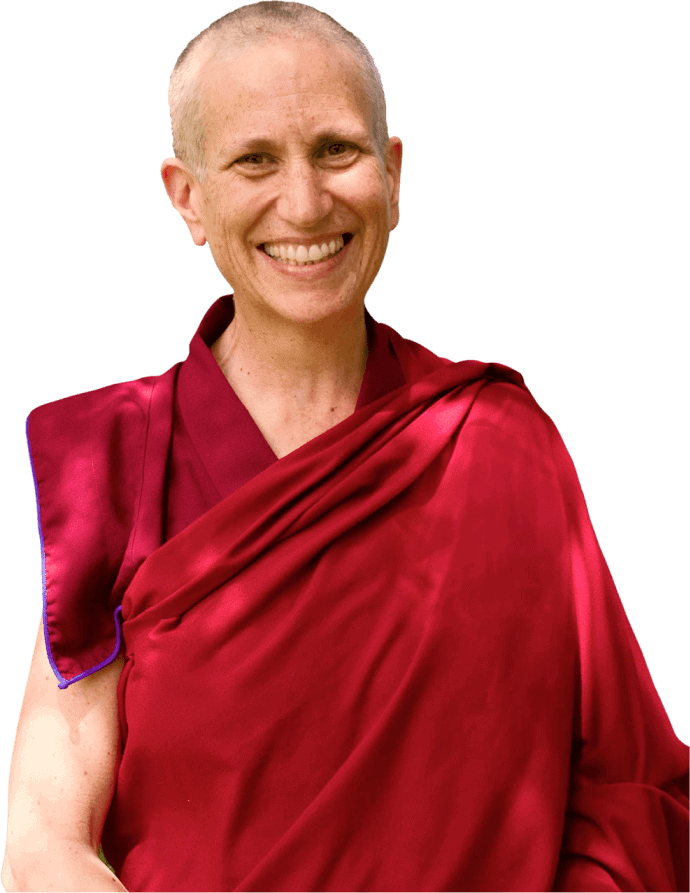
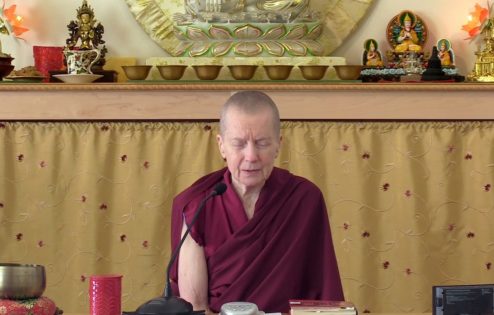
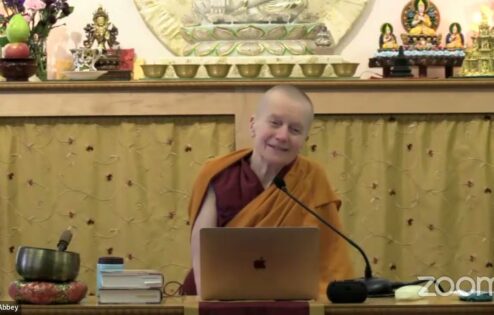
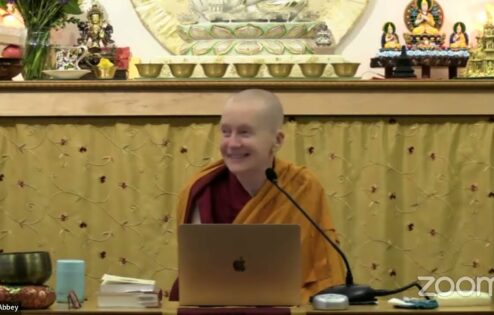
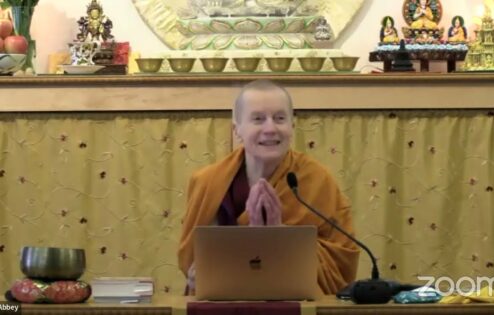
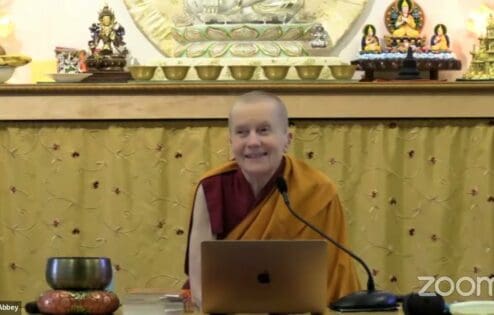
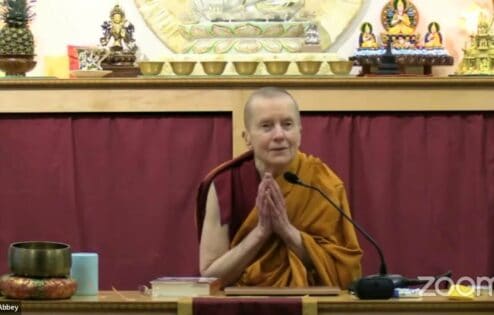
For a woman of 61, she is lithe and rather spritely.
In spite of her rather slight frame, she walks with a bit of a hunch,
I suspect honed from the years of physically demonstrating humility
among teachers and students alike. Her presence is like a drop of
dew on a leaf at dawn - inspiring, fresh but not attention seeking.
Her voice, racked with a cough she caught on a trip to Borobudur
prior to arriving in Singapore, is a melodic octave of a gentle
whisper even when she is animatedly driving home a point. She is
testament to the fact that you don't have to be loud or brutal to
be heard. If our collective consciousness had a voice, it would
sound like hers. Something rings innately primordial in me every
time she speaks.
The difference between someone who is born into
a religion and some one who discovers it for oneself is in the way
it is explained. Facts and generous quotes from doctrine tend to
be the manner in which the earlier explains. Juxtapose this against
someone who discovers it for oneself. The clarity that experience
lends to fact plays a far bigger role in the way it is taught. Every
once in a while, a truly special teacher like Ajahn Chah (1912 -
1992) comes along. Born to a Buddhist family in Thailand, he discovered
the true meaning of the Buddha Dharma through his own practice,
seeing it with new eyes. The combination of the two makes a teacher
who makes you see.
The West has produced many good Buddhist monastics
who have returned to the East to teach the locals their own culture
and religion from a new perspective. Take bowing. We have lost our
ability to bow, because we have lost our natural inclination to
show respect. While we set our sights on the West, aping what we
feel is a better way of being, jaded Westerners came to the East
in search of the meaning of life. Now we have come full circle,
learning to bow from a shaven-headed white woman.
I raised my hand in embarrassment when Venerable
Chonyi asked who amongst us has never chanted in Chinese. Mahayana
Buddhism to me is mostly out of reach, far too Chinese and, frankly,
for the older, Mandarin-speaking community. For someone who had
to sweat blood to get through high school Mandarin as a second language,
spending a good part of it being punished for not being able to
read or speak it well, Mahayana as a culture is to me an extension
of that reality.
When Venerable Chonyi began to chant in Mandarin,
I was all ready to cringe. For a language that relies so much on
intonation, one can really mangle the words. Believe me, I know.
Yet when she started to sing, not chant, the words didn't matter.
I have never heard a Chinese chant sung before, let alone in the
crystal clear soprano of someone who could very possibly sing Ave
Maria. We were invited to join in, but I was just content to listen,
allowing the divine sound to resonate the depths and breath inside,
unknown, unchartered before this. As emotions well up and tears
begin to sting my eyes, I hear a woman sob behind me.
I am not alone.
Visualization is a funny thing.
When someone asks you to visualize a figure
four inches above your head, the natural inclination is to see yourself
as a mirror image with something on top of your head. Somewhere
along the way, I realized that I had to feel myself-rather than
see myself-being filled with white light.
The four pillars of Vajrasattva purification
meditation are the power of reliance on the Triple Gem, the power
of regret, the power of remedial action of purifying body, speech
and mind, and finally the power of determination. By this time,
I understand and accept the four cornerstones, but I don't get how
and why I have to visualize this deity shrouded in white. Isn't
the regular Buddha good enough?
"Mata yata niyam putam - Ayusa ekaputtamanurakke
- Evampi sabbebhutesu - Manasam bhavaye aparimanam" is a stanza
from the Karaniya Metta Sutta, a chant I gravitate towards. It means
just as a mother who protects her only child with her life, we should
cultivate boundless loving-kindness towards all sentient beings
in the same manner. If I were asked to visualize this stanza, I
would probably see Venerable Chodron.
I say this because it is the essence of the
journey she took us on this retreat. For me, it was a quiet hand
on my shoulder guiding, even when I fell behind, was petulant or
resistant. She made me see that the many Buddhas are in fact not
separate entities and identities, but expressions of wonderful virtuous
qualities. Qualities to emulate. Qualities to aspire towards. Qualities
to cultivate. Qualities that will help us build up our mental and
spiritual immune system as we gear up to end this cyclic existence.
Qualities that will aid us in seeing beyond ourselves and work towards
gaining enlightenment for the sake of all sentient beings rather
than making it a goal in itself. She showed me that all these abstract
ideas are condensed into the physical manifestation of Vajrasattva,
the altruistic intention of bodhicitta.
The path of purification begins with contemplating
Vajrasattva and all that he represents, leading us up the path first
by finding our true north with the Triple Gem. Having found our
anchor, we then take responsibility for the things we have done
wittingly or not. With remorse arises the opportunity for a step-by-step
DIY redemption to lift the weight of our wrongdoings, and finally
a solemn pledge never to do it again. As psychiatrists sometimes
do with patients in the treatment of trauma, white light is visualized
here as well to facilitate the healing of heart and mind.
By the end of the first day, I developed a massive
headache from concentrating too hard, trying to adjust the TV channel
in my mind. I felt throbbing heat at the top of my head, coursing
through my whole body. By day two, through trial and error, I managed
to get the scene just right. In my mind, Vajrasattva has a pearly
body of light that is gradually infused by the nectar of the wisdom
and compassion of the Buddhas. The viscosity of the glowing golden
liquid is rich but runny, flowing smoothly from the crown of my
head and into my cavernous body. As prescribed, I see black ink,
blood and pus, scorpions coming out of my lower extremities as I
purify myself of the negativities of the body, caused by illness,
wrongdoing, and other maleficent influences.
I must admit, that was my favourite visualization
mainly because I have many acts to purify. Although it happened
many years ago, I haven't been able to overcome the horror and sadness
of having to destroy the wasp nest in my garden when it got too
big, and the traps I used to set for the geckos when I used to be
afraid of them. In contemplating the wasps, I must say that there
is a place for all experiences. Without the death of the wasps and
my deep-seated regret for making the choice to call the exterminators,
Reilly would not be alive today. An emaciated stray I found wandering
on the perimeters of the forest across my house, Reilly turned out
to be an insecure but aggressive dog that was inclined to biting
people. Hence, I was advised time and time again to put him down,
having severely injured no less than five people including KC, his
mother and myself. But the wasps had taught me that killing is not
an option. For that, I am eternally grateful. At this retreat, I
finally let that weight go. It was a product of a different time,
a different person.
For some inexplicable reason, starting from
dawn of day two, I had the runs. I was not feeling as hot, but warm,
not needing the shawl or the sweater. Through out the day, I make
emergency dashes to the toilet, some times barely in time. Yet each
time, I come out feeling cleaner, better, stronger, more awake.
Normally being around people with full-blown flu would affect me.
This time not only was I strangely unaffected physically, I felt
unusual compassion for the three classmates seated next to me who
were coughing hard throughout the whole retreat.
Can this meditation have a physical effect,
I asked Venerable Chonyi after the retreat. Yes, she says, sometimes
it does. It is purification after all.
Ah . . . I see.
We all think our problems are so unique when
in reality they all boil down to the same subjects of anger, pain,
desperation and being stuck. I guess this is conditioning of the
human identity, to see ourselves as separate special beings when
in fact we are all connected, and pretty much the same whether we
like to admit it or not.
This cannot be more evident than in the Question
and Answer sessions where people write down their questions to have
them answered by Venerable Chodron. After a while, it seemed like
the angles and context varied a little, but fundamentally the heart
of the matter was the same: I would like change, but in the circumstances
and people other than myself. Therein lies the root of our suffering.
As fate would have it, I wrote in three times
asking the same question and never got it answered. Once my mind
settled down from its anxiety, I began to notice the recurring pattern
in the questions and answers that were given. From others' experiences
and observations, I began to piece the answers to my question.
There is no better way to teach than through
real life scenarios of people sitting among us. Dilemmas we face
each day, at different stages of our lives, with varying stages
of maturity and understanding. I learned to see others and I not
as competitors to the finish line but as a community in close proximity
sharing best practices.
At the end of the day, the basic objective of
the whole teaching circuit is to effect change. However, the catch
is that the motivation to change can only come from within. No one
can make us change, but they can show us what it can look like if
we do and how to go about it. Yet ultimately whatever we decide,
we walk alone.
I am ready.
'Please keep Noble Silence', the sign read,
among many reminders over the course of the day.
For someone who is an only child, spending most
part of the day with a dog, doing household chores while the husband
is at work, silence is my constant gentle companion. I am blessed
with being able to live a simple but good life, in a house by a
nature reserve that I deeply appreciate. From the fresh air, graceful
trees and the countless species of forest creatures big and small
that share our living space, I have a life that few enjoy in urban
Singapore.
I thought keeping Noble Silence would be a breeze.
Outwardly, I have little problem not talking. I am not a technophile.
My mobile phone, a relic of the early twenty-first century, is working
but falling apart. I care deeply for all but am not attached to
friends and family. Quiet is fine by me.
Yet Noble Silence is not just keeping your mouth
shut. It is about observing our every thought, word and act. In
silence, I see the movies in my mind, drifting off into some bubble
of my own creation. Even in meditation, I catch myself trailing
after a random feeling or thought. As I go along, I see my state
of mind flinch every time a negative thought emerges. It is a fault-finding
mind, one that is critical and makes snap judgments about people
and situations. I begin to see the frown inside my head, the flash
of white frustration, the rush of blood red anger.
The upside of seeing is that you can catch it
before it escalates. When I internally erupt at some sensory trigger,
I catch it, and watch it fade away. It comes as fast as it leaves.
It becomes a game that I get sharper at but more compassionate with
time. This is just the way the mind is.
It would be nice to say I have managed to quell
the mind of its geyser of random thoughts. But I haven't. What I
do have now is the basic understanding of how the mind works and
the means to contain it. Like with Reilly, I continue to gather
the knowledge and skills to help him from harming others and himself.
In the same vein, I will keep at this practice of silencing and
training my mind, in a bid to put it to better use than splintering
it into a million aimless directions.
With quiet courage, I soldier on.
Now I am home, writing my thoughts on my two-day
Vajrasattva retreat.
When the cult of personality becomes emotionally
overwhelming, the inherent message often gets lost in all that drama.
Not this time. In retrospect, Venerable Chodron did not make a huge,
grandstand impression on me. I am not enamoured as I can sometimes
be in intense spiritual encounters like this. For this, I am grateful.
As I get on with age, I find the things that
are most naturally unassuming usually endure, its essence lingers
long after the embers of euphoria have faded. I still hear her voice,
nurturing ever so often with a gentle nudge to keep on the path.
I think my willingness to hear her out, to allow myself to be guided,
has very much to do with her emphasis and living demonstration on
dependent arising. The symbiotic relationship between her and the
participants is of teacher and student and vice versa, this dynamic
bond spontaneously blending, interchanging. Never before have I
encountered a teacher expressing appreciation to us for taking time
to participate so that she can teach, therefore improving and spreading
the Dharma as she goes along. I am forever humbled.
Through this retreat, I have learned a bit more
about Vajrayana Buddhism, opening a whole new world that I can now
relate to in a less mystical, mythical way. I am learning to slow
down, allowing compassion to choose words for me when I speak to
others, and the wisdom to know the difference. I sense myself evolving-softer,
open, less sure.
Perhaps it is apt that I took refuge in the
Triple Gem under her guidance. As with the retreat, I didn't know
what to expect, but was surprised by the touching rite of passage.
Having previously taken refuge in the Theravadin tradition, I was
given the name Samadhi meaning Perfect Concentration. In this refuge,
I was also given a name, Thubten Drenpa, meaning Mindfulness.
The universe probably knows I need both mindfulness
and concentration for true insight to emerge.
Now I have both to work on.
I would like to dedicate this experience and
the subsequent opportunity to write about it to Venerables Thubten
Chodron and Thubten Chonyi. May you both be blessed with good health
and great fortitude to carry on the light you shine at and into
peoples' lives to effect change.
I dedicate this to my classmates at the retreat,
all the volunteers, and people I have and have not met who have
contributed in any little way to making the retreat possible. May
all of you be well and happy and may I have the opportunity to return
the kindness in this life and the lives to come.
I dedicate this to my mother Tan Guek Cheng,
mother-in-law Ling Soo Hung, Soh Keng Chu (KC) my husband, our lovely
dogs Reilly and Sweet Potato we rescued from the forest across our
house, extended family of relatives and friends, and all sentient
beings seen and unseen. May you benefit from my practice and hopefully
in turn be a mirror upon your own lives.
I dedicate this to my departed father Tan Keng
Khian who infused me with the thirst for spiritual knowledge and
sowed the seeds of compassion in me even before I realized it. May
you inspire others to do the same in the lives to come.
I dedicate this to my late father-in-law Soh
Cheng Poh, our ancestors and those who have come before me, our
dogs Zen and Pebbles and the many beings whom have passed through
the universe. May you be free from suffering, worries, fear and
pain, and be blessed with the ability to practice the Dharma wherever
you are. Without you, I would never be.
Finally, I dedicate this diary to myself, as
a lasting reminder of all that I have learned. May I use this knowledge
wisely with compassion and may I be of benefit, either directly
or indirectly, to the all that I come in touch with. I shall strive
not to hanker after useless pursuits, but to use this life to bring
light, happiness and peace to all.
May all Sentient Beings be Well and Happy.
|