A second pilgrimage in China
 Venerable Thubten Chodron
  Travels
  Dec 18, 1994
Fortuitous circumstances plus a free frequent flyer ticket enabled me to visit China again in the autumn of 1994. Last autumn I went there on pilgrimage with a group of Singaporeans, and we traveled with a tour guide. During that time, I met three young Chinese men with whom I’d been corresponding for several months (the older Singaporeans nicknamed them “the boys”). They studied and practiced Tibetan Buddhism, and since finding teachers was so difficult for them, they flooded me with intelligent and thoughtful questions, and we had many interesting discussions. So this year the four of us, plus a young Chinese woman who is interested in Tibetan Buddhism, did a two-week pilgrimage and two-week retreat (no tour guide or tour bus!). It was a truly remarkable experience in so many ways that it’s hard to describe.
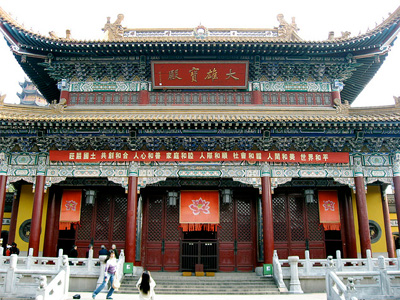
Jinshan Temple in Zhenjiang. (Photo by Yuxuan Wang)
I stayed with the family of one of the boys while we visited Shanghai’s temples for a couple of days. And then our pilgrimage began—first to Jinshan, a large Ch’an (Zen) temple in Zhenjiang, which was swamped by tourists, a circumstance we encountered often in city temples. There were many young monks, but the noisy environment with tourists isn’t conducive to practice. Most temples have a meditation hall, used only for meditation; a Buddha Hall where prayers are recited, and sometimes another hall for the recitation of the Buddha’s name, a practice which resembles mantra recitation. When visiting the meditation hall, we spoke with an 80-year-old monk with bright eyes and a rousing voice who encouraged us, “Chinese have Buddha nature. Westerners do too. Practice to become a Buddha. When distractions arise, try to find the thoughts. Where do they come from? Where do they go? Then return to the hua to.” Hua to are short phrases intended for meditation. Since the intermingling of Ch’an, which emphasizes meditating on emptiness, and Pure Land, which emphasizes reciting the Buddha’s name, began many centuries ago, the hua to “Who is reciting the Buddha’s name?” has become popular.
This was the practice done at Kao Ming Temple, near Yangzhou, our next stop. Before 1949, this was the most famous and strict Ch’an Monastery in the country, where hundreds of people did retreat all year round. It had been totally demolished during the Cultural Revolution. With the support of foreign benefactors and the Chinese government, it was now being rebuilt and was noisy with construction equipment. From the scorched earth of the Cultural Revolution, green sprouts of Buddhism are growing again, as if by miracle. Even more astounding is the number of young people who are ordaining. Where does their faith come from? What draws them to enter the monastery? However, as time went on and we visited more temples, I began to see behind the superficial appearance of renaissance to some severe problems, all of which are interrelated.
-
First, the quality of the monastics is low. That is, most college-educated youth prefer to work at joint-venture companies where they can make a lot of money. Many of the youth joining the temples are from the countryside, from poor and/or uneducated families.
-
Second, although some of the educated youth, my friends for example, are interested in Buddhism, it’s hard for them to find teachers. A few elderly monks and nuns heroically survived the years of persecution under the Communists. They teach as long as their health and age permit, but ordained people of my age, who should be the new generation of teachers, are virtually non-existent.
-
Third, people focus primarily on the physical reconstruction of Buddhism at the moment—temples, pagodas, statues—and this requires putting time and effort into raising money and building. There is little emphasis on education and practice, except in a few places which I’ll speak of later. There are Buddhist colleges with two, three, or four-year programs in many major cities and pilgrimage sites—their curriculum includes political education—but relatively few of the newly-ordained attend these.
-
Fourth, because the older monastics are concerned with administration and most of the younger ones do not know Buddhist doctrine well, some traditional ancestor-worship practices done in temples before the persecution are now being re-instituted. For example, people burn paper money, paper bars of gold, paper houses, and so forth to send to their deceased relatives. This is not a Buddhist practice, but it is tolerated and even encouraged at most of the temples. People offer lots of incense and candles, but most don’t know exactly who they’re offering them to or why. They need to be taught how to make offerings, but there are few Dharma talks for the lay people in most of the temples. I did visit some laymen’s associations and some temples, however, where lay people study and practice, and this was very encouraging.
-
Fifth, due to both financial concerns and requests from the public, many temples engage in reciting prayers for the dead. While this is a Buddhist practice, there are some doubts regarding both the motivation of those who request the prayers and those who perform them. Again, the problem is lack of education, as well as the view that big, beautiful temples indicate that Buddhism is successful.
-
Sixth, many Buddhist temples are now museums or tourist attractions, with the monastics being the ticket-collectors. This allows for the veneer of “religious freedom,” an image sought by the government.
Temples and travels
Let me return to the pilgrimage. The monk who took us around Kao Ming Temple showed us the huge guest house which is not yet finished. I estimate it has about seventy rooms, all with private bath and polished wooden furniture. He proudly told us they were going to build a nine-story pagoda with four jade Buddhas on each floor. While everyone else gasped with delight, I thought, “Why don’t they use the money to open a school and teach children the essence of the Buddha’s teachings, to be kind to people? How do we measure the benefit of Buddhism: through buildings or through people’s hearts and behavior?” Kao Ming has a lovely octagonal meditation hall with polished wood floors, where meditation sessions occur all day long. Of the one hundred monks, about ten attended each session. The others were working. We sat two sessions with them, a nice relief after hours of traveling.
Across the river was a nunnery, which was also being rebuilt. The nuns did not want many visitors to disturb them, but allowed us to enter. They were reciting the sutras, and I sat with them for a long while, meditating. Being with nuns such as this is a source of inspiration for me.
Then we went to Nanjing and visited another nunnery. Here the nuns were leading the lay people in a week-long retreat of chanting the Buddha’s name. A young man who was getting his Ph.D. in math and who knew English approached me to discuss the value of Buddhism. As I was to find during the entire pilgrimage, people were very curious about this nun with strange eyes and hair. They were curious and friendly, and with the kindness of Roy (I’ll use the boys’ English names for convenience), who translated indefatigably, I met many people. When we tried to leave the building, the over 100 retreatants were serpentining in the courtyard while chanting—a Buddhist traffic jam! Loving Chinese chanting, we happily joined in.
When we went to find a hotel for the evening, we discovered that due to governmental regulations, foreigners were not allowed to stay at the reasonably priced ones, only at the expensive ones. Nevertheless, instead of getting depressed about the cost, whenever we encountered this unfortunate circumstance we transformed it into the path and rejoiced at the opportunity to take hot showers!
The next day we visited the pagoda with the skull of Venerable Xuan Zhuang, the great monk, who, in the seventh century, made the arduous journey to India to learn Buddhism and to bring back many sutras which he then translated into Chinese. Contemplating his life story, we understood better the actions, the courage, and the dedication of a bodhisattva. Also in the outskirts of Nanjing is Chi Sha Temple, which once followed the Three Treatises (Madhyamika) tradition. In the hills around the mountain, hundreds of Buddha figures were carved in the rock in the fifth century. But today, most of them lack heads or arms—the handiwork of the Cultural Revolution. One time I turned around and saw one of the boys dusting off one of the Buddha images and began to cry, with gratitude for the devotion of the artists, with sadness for the ignorance of the mutilators, with awe for the hope of the young Buddhists.
Jiu Hua Shan, Kshitigarbha’s Holy Mountain
The bus ride to Jiu Hua Shan, the mountains which form the holy place of Bodhisattva Kshitigarbha, was long and tiring. The traffic in the cities and even between towns is backed up, due to the poor quality of China’s infrastructure and the number of trucks carrying supplies for the construction of buildings, which is going on all around. But as soon as we passed through the Jiu Hua Shan gate, my head cleared. An old monk led us to the nunnery, where the abbess graciously shared her simple room with me and asked me to teach the sixty pilgrims residing at the temple that evening. Foreigners are not allowed to teach Buddhism in China, but the abbess assured us that the police were her friends and there would be no trouble. So that evening I gave my first “public talk” (I had been teaching the boys privately since my first visit), on bodhicitta of course!
In the eighth century, a Korean monk came to Jiu Hua Shan to practice. Having high realizations, he was seen as the incarnation of Kshitigarbha, the bodhisattva who vowed to go to the hell realms to help the sentient beings there. On the way from visiting the pagoda with his remains, we met three old nuns. I asked them about their lives: during the Cultural Revolution, they were forced to wear insulting placards around their necks and large dunce caps on their heads while they carried Buddha statues on their backs as people in the streets jeered and threw things at them. Their temple was now a factory; they had a little room in it where they lived, and they had come here to look for a temple to move to. In recounting their story, the nun was not in the least bit bitter, although tears were in her eyes as she spoke. Without trying to be, she was an example of the effects of Dharma practice.
During those days at Jiu Hua Shan, we walked in the mountains and visited many isolated temples dotting the mountainside. Most were built in the last ten years, often by the personal funds of the monastics who lived there. At one, the nuns invited us to lunch. These four nuns lived in the meager temple with no electricity or plumbing, let alone heating during the winters, but they were content. At another, a nun of over 80 (she was ordained at 22) and her son who was now over 60 and also ordained, built a small temple around a cave. This nun was so serene that the boys remarked that she was surely going to be reborn in the pure land! I asked her about her life (this is one of my favorite questions because I believe we can learn a lot of Dharma from people’s life stories and how they handled the situations they encountered), and she responded, “Ordained life is very precious. It can’t be bought with money. If you have the roots of virtue, you can ordain. But if you don’t, even if someone tells you to and you can, you don’t want to.” Each of the boys has the wish to ordain, so her comments were timely for them as well as for me.
The five nuns residing at another isolated nunnery practice Ch’an meditation. We had an interesting discussion about the path, and a young nun sought advice on handling distractions during meditation. To help her, I repeated the words of instructions which I heard from my teachers but, being lazy, don’t practice myself. It’s sad—they have such fervor and a dearth of teachings, while I have had the fortune to hear many teachings from the best teachers, and yet have little fervor. (This is not modesty, it’s truth. Such things struck me during the pilgrimage.)
While viewing the figure of Kshitigarbha at the cave temple of some other nuns, the enormity of his vow suddenly hit home. He wants to go to the hell realms to help the beings there! What a far cry from my mind, which seeks only the happiness of this life! It’s at times like these that I understand the value of prayer: the transformation seems so radical, and we seem so entrenched in wrong conceptions, that the only thing left to do is to drop all facades, purify our minds, and request inspiration from our teachers and the Three Jewels.
In one temple lay the mummified body of Venerable Wu Sha from the Ming Dynasty. By pricking his tongue, he wrote a sutra with his own blood. When he died, his body did not decay, and devotees put it in the temple. About fifty years ago, there was a fire in the temple and when the monks tried to move his body, they couldn’t budge it. So they cried out, “If you don’t leave, then we won’t either!” The arms of the mummy shifted position to cross his chest, and the fire died out.
We took the cable car to the top of one mountain and walked in the forest. It took a while to get away from the litter. There is no conception of trash cans, even at holy sites, so people throw their rubbish everywhere. The first day of the pilgrimage, when one of the boys threw a can out the window of the train, I was aghast. My look startled them, and from then on I continually brought up during teachings the relevance of Buddhism to environmental issues. This was something new to them, but from that day on, none of them littered.
There is virtually no environmental awareness in China, let alone any thought of nuclear disaster. During one teaching on the five degenerations, I mentioned the nuclear threat and unwise disposal of nuclear waste. My friends looked puzzled, so at lunchtime I asked them if people in China thought about the spread of nuclear weapons or the possibility of nuclear war. They shook their heads and said, “No. The media doesn’t discuss this, and anyway, there’s nothing we common people can do about it.” At that moment, it struck me how much the existence of nuclear weapons has affected the lives of people in the West in so many ways, psychologically, socially, etc., and I tried to imagine what it would be like not to have that influence in my life.
Tendai and Samon
After visiting a large temple from the Yuan Dynasty in Hanzhou, which was protected by order from Chou En-lai during the Cultural Revolution and thus was undamaged, we went on to Tendai and Samon. Mt. Tendai is the home of the Tendai tradition, popular in both China and Japan. Both Tendai and Jiu Hua Shan looked just like Chinese paintings—Jiu Hua Shan with steep cliffs, autumn-colored forests, broad views; Tendai with waterfalls, bamboo forests, and terraced mountains.
We arrived at Samon after nine in the evening and, walking through the fields by moonlight, we arrived at the gates of a monastery where one of the boys’ teachers, a monk now in his 70s, was the abbot. They weren’t expecting us, and because women weren’t allowed in the monastery after dark, they escorted me to a flat in the town where some women affiliated with the temple lived. The women, a grandmother, mother and young daughter, warmly took me in, much to my embarrassed surprise (I imagined dropping in unexpectedly late at night at the home of a friend of a friend in the USA!). The next evening I had the opportunity to repay their kindness when they asked me to give a short talk. Instantaneously some neighbors appeared and the small, happy group, plus the boys, gathered around their altar while I discussed the mind being the cause of happiness and suffering and some ways to work with anger. Because people in Asia so often associate Buddhism with rituals in temples, it’s important to show them how Dharma is relevant to their daily lives, and they appreciated this.
The monks at the monastery here were all Chinese and basically followed the Tibetan Gelu tradition, but with a Chinese flavor. Earlier this century, several Chinese monks went to Tibet to study and brought the Tibetan teachings back to China. Many translated texts, so that good translations exist in Chinese for many of Lama Tsongkhapa’s works, for example. However, in passing down the practices, some masters changed several points and neglected important elements. Even when people go to the Tibetan lamas who visit Beijing, there are often difficulties. The lamas give high initiations, but they are not translated into Chinese, so the participants don’t know what’s going on. Usually, they don’t give the commentary on how to do the practice. How fortunate we are in the West where initiations are translated into our languages, commentaries given, and pure lineages kept intact and passed on! And how often we take this for granted, not appreciating our fortune!
Puto Shan, Chenrezig (Kuan Yin’s) holy place
We then went on to Puto Shan, which was to be our R&R—Rest and Retreat—after two weeks of tiring travel. I’d made many prayers to Kuan Yin (Chenrezig, the Buddha of Compassion), whose holy island this was, to be able to find a quiet retreat place to practice and continue teaching the boys and a young woman, a friend of theirs who joined us. We arrived after dark, and walking through the village, I saw basins of live seafood ready to be dropped into boiling water and eaten, and made-up girls outside what appeared to be beauty parlors. It seems some tourists mix pilgrimage with other pleasures.
One of the boys’ friends worked at the Chinese Buddhist Association, so we went to visit him and see if he could help us find accommodation that evening as well as a retreat place. He told us that foreigners are only allowed to stay at certain hotels on the island, the expensive ones of course, but his friend was the manager of one of them. His friend gave me the last bed in the place, in a room with three other women, all strangers. The next morning, when I got up early to do my meditation and prayers, there was no electricity, so I used my flashlight. When the electricity finally arrived, my roommates woke up and began talking. Then their husbands and boyfriends from the next room came over, and they were all having a great time, while this strange foreign nun meditated on one of the beds. But when I finished my practices, they expressed their delight at me meditating and wanted to have their picture taken with me!
By good fortune, we were able to meet the abbot of the largest temple, who was also head of all the Buddhists on the island, and appealed to him to talk with the police so that I could stay at a temple (not a hotel) and do retreat. He was sympathetic and tried his best, but the police refused and even came looking for me! Fortunately I wasn’t there at the time and we left the next day.
Retreat
Since there were only two weeks left and we didn’t want to spend a lot of time traveling to another place and looking for a retreat house, Marty suggested that we return to Shanghai and do retreat at his family’s flat. Having made many prayers both before and during the trip to Kuan Yin to help us find a place and have a worthwhile retreat, I gave up my preconceptions and returned to Shanghai, and the retreat went wonderfully! We arrived unexpectedly, two weeks early, at Marty’s flat at 5:15 a.m. on Sunday morning, and his parents welcomed us in without a trace of annoyance, not minding at all that their son and four of his friends were going to do retreat there for two weeks! We did six sessions a day, and during two of them I taught lamrim and the Chenresig practice. The boys had never done retreat before. In fact, they had never had ongoing oral lamrim teachings before, although they had studied so much and had taken several initiations.
Our retreat was both serious and punctuated with laughter. The first few days, my friends were very tired by the time teachings began after supper. So I taught them the profound practice of the Perfection of Sleeping during teachings, one that I have trained well in. First, as the root of the path, you must find a guru who will definitely put you to sleep. Then prepare the cushion and sit down. You must practice the Perfection of Sleeping during teachings together with the other six perfections: With generosity, give your fellow Dharma students adequate space to fall asleep. Do not take the best place for yourself, but sacrifice your happiness, and sit in the front row where everyone can see you while you sleep. With ethics, do not hurt anyone if you fall over while sleeping during teachings. With patience, do not become angry if you can’t fall asleep immediately. With effort, do not be lazy. Fall asleep quickly and efficiently. With concentration, fall asleep single-pointedly. Do not let your mind be distracted by listening to teachings. With wisdom, know that you as the sleeper, the sleep, and the act of sleeping all lack inherent existence. They are just like a dream. The ultimate guru yoga occurs when guru and disciples’ minds merge, so that at the end of teachings all that is heard is snoring.
However, once we changed the schedule so that the second teaching period was in the afternoon and we did the Chenresig practice and chanted the mantra out loud at length after supper, we encountered some obstacles to this profound practice of sleeping during teachings.
Our retreat went well and all of us were happy. When it was over, with feelings of rejoicing, gratitude, and fulfillment, as well as with sadness, I boarded the plane to return to the States.

Venerable Thubten Chodron
Venerable Chodron emphasizes the practical application of Buddha’s teachings in our daily lives and is especially skilled at explaining them in ways easily understood and practiced by Westerners. She is well known for her warm, humorous, and lucid teachings. She was ordained as a Buddhist nun in 1977 by Kyabje Ling Rinpoche in Dharamsala, India, and in 1986 she received bhikshuni (full) ordination in Taiwan. Read her full bio.