Glimpse of the Gaza Strip
 Venerable Thubten Chodron
  Travels
  Oct 18, 1999
A narrow stretch of land bordering the eastern Mediterranean Sea, the Gaza Strip is home to thousands of Palestinian refugees. They fled there during the 1948 Israeli War of Independence and the 1967 Six-Day War. Since 1967, the West Bank and the Gaza Strip have been under Israeli occupation. Beginning in 1987 and lasting several years, the Intifadeh consisted of spontaneous riots expressing Palestinian frustration with refugee conditions and anger at Israeli occupation. Israel violently suppressed the Palestinian violence, leaving both sides fearful of the other. The 1993 Oslo Accord was a significant step in the peace process, but its implementation continues to be start and stop.
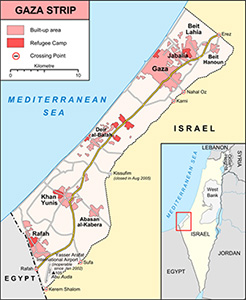
Wikimedia image by Lencer.
When my Israeli friend Boaz said that he wanted to visit the Gaza Strip, I gulped while images of violence and pain flashed through my mind. A Buddhist nun, I am supposedly fearless in promoting compassion and peace; yet my first reaction is self-protection. I wrote back, “Yes,” and decided not to tell my parents about the visit until it was over.
At breakfast that morning, we discussed Israeli men being macho. Ity, a 30-year-old man explained: “At eighteen, we begin three years of compulsory army service. We see violence; we know people get killed during military service, and we don’t know how to handle the emotions that come up about this. In addition, peer pressure dictates that we look fearless, so we stuff our emotions deep inside and put on a mask. Some people get so used to the mask that they forget to take it off later. We get numb emotionally.”
Getting permission to go to Gaza required months of phone calls to the Palestine Authority and Israel Security, but final permission did not come until we arrived at the Erez border. The border crossing was at least a quarter of a mile long, a dusty, bland, walled gateway. In recent years, factories and warehouses had been built at the border for businesses that the Palestinians and Israelis could both profit from, but these were not in full operation at the moment due to the stalled implementation of the peace accords. We passed through the Israeli checkpoint where armed, young soldiers wearing bullet-proof vests worked at computers. Half a kilometer beyond that was the Palestinian checkpoint with its young, armed soldiers and the photo of a smiling Arafat.
It took us about an hour to cross the border. I thought of the 40,000 Palestinians who crossed the border each day to work in Israel. They have to leave home at 4:00 a.m. to be at work by 7:00. Every evening they return home, again crossing the border: due to Israel’s fear of terrorists, they were prohibited from staying overnight in Israel.
The bus appeared and we met our Palestinian hosts from The Palestinian Abraham Center for Languages. Special security forces the school invited to protect us boarded the bus, and we were off. We drove through the Jabaliya refuge camp, where the Intifadeh had begun. Gaada, a young Palestinian woman with Western slacks and an Arabic scarf encircling her head, pointed out the new traffic lights on the way to Gaza City. Cars, trucks, and donkey carts flowed along the dusty road together.
Gaada and I talked on the way. Initially I didn’t know what to expect in discussions with her and our other Palestinian hosts. Since each of them had probably faced personal difficulties and tragedy, would I hear nonstop angry tirades, tales of persecution, and accusations against Israel and the USA? Would they hold me personally accountable for the actions of my country? This type of language appears in reports and interviews in the Western press, so I assumed we would hear more of it in person.
Fortunately, my preconceptions were wrong. Born in one of the eight refuge camps in the Strip, she moved to Gaza City after she married, has a child, and teaches at the school. Bubbly, cheerful, and ready to joke, she pointed out various landmarks. She asked personal questions and responded to them as well. By the end of the bus ride, we were holding hands as Mediterranean women often do. Similarly, Samira, the director of the school, and I related to each other as individuals. While she was frank about her experiences and views, hatred and blame were absent. It was a day of honest, personal conversations.
Entering Gaza City, we drove by the Palestinian Parliament building, a large flower-filled park, shops, and people going about their daily lives. Since the signing of the peace accords, many new buildings had sprung up. Several others were half built, their completion pending progress in the peace accords. Ity turned to me, and his eyes were happy. “It’s wonderful to see people relaxed and smiling in the streets now. When I was here during the Intifadeh, a 24-hour curfew reigned over this city. No one could leave their homes, and we had to patrol the streets for curfew violators. People threw stones at us, and we had to hit them with clubs, push them away, or worse. The villages and cities were drab, impoverished, depressed. But now there is life and certainly more optimism here. It’s amazing,” he said, deep in thought. I could almost see the flashback scenes that were appearing to him. As a woman, I had been spared such experiences as a young person, although many of my teenage friends, who had been soldiers in Vietnam, had not.
Our bus stopped across the street from the Palestinian Abraham Center for Languages, the security guard descended, and we followed them. All that day, we were outdoors only long enough to cross a street. The staff and friends of the school warmly welcomed us with cold drinks and snacks. They showed us the classrooms and slides of the schools activities, and described future plans for a Palestinian Folk High School, based on the Scandinavian model. At present they teach Arabic, Hebrew, and English, principally to Palestinians in the Gaza Strip. However, they held a week-long course for Israelis in prior years and encouraged people from different cultures to get to know each other on a personal level by studying and living together. On a previous trip to Israel, I had visited Ulpan Akiva, a school with a similar philosophy in Netanya, Israel.
Back on the bus, our group – twelve Israelis, twenty Palestinians, and me, an American Buddhist nun – drove through the Gaza Strip. We passed the university where groups of female students, most in traditional dress, a few in Western dress, almost all with their hair shielded by a scarf, stood in groups talking. We saw the refuge camps, with their streets, no more than a meter or two wide, the most densely populated places on the planet. We passed mile after mile of drab brown buildings, some old and some new, with very few trees in the city streets, until suddenly, a small oasis appeared—greenery and some nice houses. What was this? One of the Israeli settlements in the Gaza Strip.
I had heard about these. Of the 1.1 million people in the Gaza Strip, only 3,000 or 4,000 were Israeli, many Jewish immigrants from New York. In recent years, they had set up communities in the Gaza to “reclaim Jewish land.” Their settlements were small, but each required a protective buffer area and the stationing of Israeli troops to protect them. Because of these few settlers, 33% of the land in the Gaza Strip was still under Israeli control. Armed convoys were required to shuttle a bus with Jewish settlers in and out of the Gaza, with Palestinian and Israeli soldiers jointly patrolling the roads on which they traveled. The Palestinians could not go to most of the beautiful beaches in their land, but had to travel around these Israeli occupied places. I tried to understand the mentality of these settlers who, motivated by what they considered devotion to God, created situations that were like time bombs. Gilgi told me of her friend’s son who was stationed there to protect the settlers. A secular Jew, he told his mother, “I hate the Ultra-orthodox Jews (all of whom are exempt from military service). I hate the Palestinians. Why must I risk my life to keep the peace between them, in a situation that is bound to explode?” Although my first reaction was one of sympathy for him, I was also taken aback by the vehemence of his hatred. How did he learn to hate at such a young age? To me, teaching young people to hate did them a drastic injustice, tainting their lives for years to come.
The bus drove on. Shabn, a tall young Palestinian man sitting next to me on the bus, told me that they would like me to give a talk after lunch and that he would translate it into Arabic. His English was impeccable, and no wonder—he was born and raised in Canada. His aunt, Samira, had asked him to come and help with the school, and now all the weekend afternoons of his childhood spent studying Arabic were paying off. There was a quick affinity between us, as I could understand what a culture shock it was for him to live in Palestine. “The people are very conservative,” he explained. “Activities that are normal for people my age in Canada are prohibited here.” Gaada also commented on the conservative nature of Palestinian society after I noted with delight the number of educated, articulate, Palestinian women that were in prominent positions in the Abraham School. “Muslim women in North African societies have more opportunities and fewer restrictions than we do.”
We arrived at Hope City, a large building constructed by Yasar Arafat’s brother. It housed a clinic, a center for the handicap, and a large plush auditiorium, among other things. Our hosts were clearly proud of it. After a delicious lunch—they were curious why so many of us Buddhists were vegetarians—we went to the top floor to look out on the Gaza. The Mediterranean Sea shone in the distance, behind the sand dunes with an Israeli military station protecting the Jewish settlement. The bustling streets of the cities, villages, and refugee camps spread around us. Palestinians who had lived in the Gaza for generations inhabited the fours cities and eight villages in the Strip, while refugees who arrived in 1948 after the Israeli Independence War or 1967 after the Six-day War lived in the refugee camps.
We chatted in small groups for a while, topics varying from the personal to the political. A Palestinian man explained that Muslim leaders in the Gaza drew out different points to emphasize and a wide variety of religious and political views grew from that. Some are moderate; others, like the Hamas, engage in benevolent social welfare projects for the Palestinians and at the same time promote terrorism against the Israelis. He wanted there to be more cross-cultural contact with Israelis, less rhetoric, and more person-to-person “diplomacy.” Ity asked him if he thought of teaching in the Palestinian schools to encourage children to have such open views. “No,” he responded sadly, “I don’t think some people would be open to that.” “But I haven’t lost hope,” he added quickly.
Gathering us together, our hosts asked Boaz to speak first and to explain what kind of group we were and why we came to the Gaza. This was not a commonplace answer. A group of Israeli Buddhists had invited me to teach in Israel, and as the main organizer, Boaz thought it would be good for me, and all of us, to visit the Gaza. Although he did not say this, I suspect it was a way for him to bring together diverse parts of his still-young life: his six years in the Israeli army, his subsequent trip to India where he attended a Tibetan Buddhist meditation course I taught, and his return to Israel where he endeavored to make Buddhist teachings and meditation available to his compatriots. “Many people today have asked me if this is my first trip to Gaza. Unfortunately, it is not, but it is the first one in which I am a welcomed guest in your land. I hope to visit an independent Palestine in the future and also hope that the peoples in the Middle East can live together in mutual respect and peace.”
Later, I asked him how he felt being in Gaza that day, for he had been a captain in the Israeli army and had been stationed there during the Intifadeh. He shook his head, “When I was here before, I thought that someone had to do the horrible job of going into Palestinian homes to search for weapons and explosives and to arrest potential or actual assailants. And I thought that I could do it with less violence and more tolerance than others. But now it’s hard to understand. I can’t believe that I did that, that I didn’t resist.” Now, on pacifist grounds, he has refused to do the reserve duty required of all Israeli men each year. Facing the military board that threatened to send him to prison last year, he calmly told them, “I’m doing what I have to do. You do what you have to do.” They gave him what is comparable to our conscientious objector status.
It was my turn to speak, and I wondered how to put Buddhist thought into this Jewish-Muslim mix. “The Buddha said that hatred is not conquered by hatred, but by tolerance and compassion,” I began. “The cause of suffering lies with the disturbing attitudes and negative emotions in our hearts and minds. We each have our individual responsibility to look in our own hearts and root out the anger, bitterness, and revenge there and to cultivate kindness and compassion. Peace cannot be legislated by politicians; it comes through personal transformation on an individual level. We are each responsible for that and for teaching that to our children.” I then went on to describe the Four Noble Truths and to answer the many questions they had about Buddhist belief in rebirth and about the Dalai Lama and Tibet.
Mr. Mahmoud Khalefa, the Director of the Gaza Office of the Palestinian National Authority’s Ministry of Information, spoke next. He sat looking sternly with his arms folded on his chest in front of him, and my preconception machine went to work, hauling up old images of Yasar Arafat attending peace talks with a gun on his belt. Meanwhile, Mr. Khalefa spoke: “Trying to figure out who started which incident is senseless. Blaming each other is useless, for both parties have erred and at fault. We need to come together and talk. It took you a long time to cross the border this morning. I want you to be able to come to Palestine and walk in our streets freely, and we want to be able to go to your country and do the same. We need more cultural exchange between our peoples, so that we can learn about each other’s culture and religion and develop tolerance and acceptance.” I couldn’t believe what I was hearing. It certainly wasn’t what the Western press had conditioned me to expect from a representative of the Palestinian Authority.
We boarded the bus again and drove through beautiful orchards and fields to the Egyptian border. One man explained that some houses were half in Egypt and half in Gaza, the border running through the middle of the house. Why? After the Israelis occupied the Sinai, initially there was no thought of returning the land, so buildings were constructed anywhere. However, when they later signed a peace treaty with Egypt, the latter want to return to the exact borders before the war, thus some houses were half in one country and half in another.
On the bus went to the Gaza Airport. Our hosts beamed with pride as we approached this symbol of their independence. Indeed, the new airport was beautiful, with Arabic mosiacs bordering graceful arches. The Palestinian Airlines flies to four places: Cairo, Jordan, Dubai, and Saudi Arabia, and hopes to expand in the future. Meanwhile, Samira and I continued our conversation on the bus. For years, she has worked to promote understanding among Palestinians and Israelis. Before the Intifadeh, she worked at Ulpan Akiva school, a language school in Israel designed to promote tolerance and cultural understanding. One of her young Israeli students at the school told her he wanted to be a pilot when he grew up. “I will protect our country and bomb those who try to harm my people, but I love my Samira very much and I will not bomb your house in the Gaza,” he told her. She responded, “But there are many Samiras in the Gaza, many people who are kind and wish to live peacefully. Please don’t bomb their homes either.”
I wondered if the little boy understood what Samira said and how long it would take him to become aware of his conditioning. The horror of the Holocaust still reverberates through the generations of Jews born after it occurred, and the “never again” attitude deeply influences Israeli policy. When one feels powerless, one may get a sense of power by lording over others. This holds true for the kindergarten bully, the adult perpetrator of abuse, and persecuted ethnic and religious groups. But this is a false sense of power, one that ultimately destroys oneself and others as well as contaminates the minds of future generations. Persecution and oppression abound, but the only way to heal the pain in our hearts is through developing tolerance and compassion. No other choice exists but for each of us to make an effort to do this.

Venerable Thubten Chodron
Venerable Chodron emphasizes the practical application of Buddha’s teachings in our daily lives and is especially skilled at explaining them in ways easily understood and practiced by Westerners. She is well known for her warm, humorous, and lucid teachings. She was ordained as a Buddhist nun in 1977 by Kyabje Ling Rinpoche in Dharamsala, India, and in 1986 she received bhikshuni (full) ordination in Taiwan. Read her full bio.