In the Holy Land, Israel and Palestine
 Venerable Thubten Chodron
  Travels
  Aug 18, 1999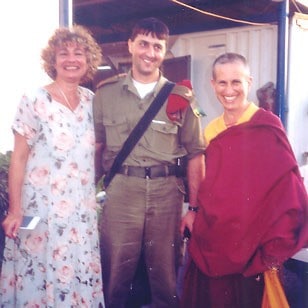
The recent trip to Israel was remarkable, with interactions and connections to people that I never anticipated. Young Israelis who had visited India and met the Dharma there invited me to their country to teach the Dharma and meditation. This was my third visit since December, 1997. Although I was there primarily to teach, I loved the program the organizers had set up, for I had the opportunity to meet many different people from different walks of life. The contact with people who ordinarily wouldn’t have met a Buddhist was rich, and I especially appreciated the opportunity to visit Palestine. Rather than relate the trip chronologically, I’ll speak according to themes that emerged, focusing on the Israeli part of the trip.
Love and connection with people
Much to my surprise, I found strong connections with people appearing when I least expected them. Here are some examples.
The visit to Yemin Ode, a youth village for refugee, displaced, impoverished, or homeless teenagers was built in the 1950s and is located on a hill overlooking the Mediterranean Sea. It has been home to thousands of immigrant and displaced Jewish youth coming in waves of refugees over the years from Iran, Yemen, Russia the former Soviet countries, and most recently Ethiopia. Chaim Peri, the director, took us around the village and the adjacent high school. As he stopped and introduced us to students, it was clear he knew the names and stories of most of the 500 teenagers there. He spoke to and of them with respect and love, explaining that once a child comes to Yemin Orde, that is his or her home forever. They will never be asked to leave, no matter how they act or what happens. Imagine the secure and stable feeling that gives these kids! As Chaim showed us around, whenever he saw litter on the ground, he bent over and picked it up. What an example to the kids! (and to me!)
On the lawn, an international group of kids gathered around me to ask questions and before I knew it, I was talking about the disadvantages of anger, how to cultivate patience, and the need for compassion in conflict situations. They listened eagerly. At lunch Chaim called an Ethiopian girl to eat with us, explaining that she had faced much trauma in her life and just that day a severe difficulty had landed on her. She told us that she wanted to have children so someone would love her, and two mothers in our group told her that although they felt that way initially too, they discovered that wasn’t sufficient or even practical once they had children. One said, “Something was still missing in my life. When I met the Dharma, I knew what it was.” When we got up, I went over to hug her and she held me, sobbing. Tears filled my eyes too, and others, seeing what was happening, moved on to continue the tour. We stood there hugging each other for quite a while, while I thought of Tara and silently recited her mantra. Afterwards, hand in hand, we joined the others, and the girl was now smiling.
Another event with kids was just as intense, but in a different way. I spoke to about 70 or 80 teenagers at a Rudolph Steiner school at Kibbutz Hardut. They asked questions about the meaning of life, about anger and so forth, one after the other. A group of boys, who I later found out were from a class of kids with problems, were especially involved. After an hour, there was a break when they could go back to their regular classes or stay and ask questions in a small group. One of the “problem” boys was overheard saying (excuse the language), “Hell, I don’t want to go back to class. This is f___ interesting!” This was one of the biggest compliments I’ve ever received!
The seminar at Kibbutz Gilikson, in which we explored the four immeasurables—equanimity, love, compassion, and joy—was also heart opening. At the conclusion, one man commented to me, “You are planting incredible seeds here. It’s going to move boulders.” And several of the people who attended various events told me that afterwards they had wonderful discussions with their parents and old tensions in their families melted. In one family with previous inter-generational strife, the father said to me, “Chodron, what happened to my son? He’s so different now!”
Our weeklong retreat at Kibbutz Lotan in the Negev Desert was a treat not only for us, but also for our hosts on the kibbutz. The kibbutz was begun by Reform Jews, who strive to integrate their spiritual practice into the daily life of rearing children, working in the date palm orchards, and otherwise surviving in the intense heat of the desert. They said that having us there made them pause and reflect. There we were, eating in silence, walking slowly in our periods of walking meditation, spending time checking our motivations and looking into our own hearts. This inspired them and set them to thinking about their own practice. They asked me to give a talk to the kibbutzniks.

At the Gaza Strip.
At the Gaza border I was able to visit the Gaza Strip again (more about this later in the letter). The border crossing into Palestine is a pretty drab, not to say potentially dangerous, place as the young soldiers who check our passports wear bulletproof vests and guns slung over their shoulders. They don’t seem too happy to be there, and I don’t blame them. It took the three of us a while to cross the border because one of our group was both an Israeli and a British citizen, so we started talking to the soldiers. One was Druse, an Arabic people with their own religion and culture. He relaxed and started smiling and we ended up taking photos together. Another young soldier sauntered in with a disaffected expression. He took one look at me and said, “What are you?” I explained I was a Buddhist nun and taught meditation. To make a long story short, he got excited because wanted to learn meditation, and since he had the next day off, he came to the workshop I was leading in Tel Aviv!
After teaching for almost three weeks, I did private retreat in Amirim, a community in the hills in the Galilee. A friend of a friend kindly offered the hut he lived in for my retreat, while he and my friend, who cooked for me, slept outdoors. I did Chenresig retreat—that seemed most appropriate for that part of the world—and with the view from the hill, which included Israel, Jordan, Syria, and a fraction of Lebanon, sending Chenresig’s compassion to heal the people in that area was easy. One of my friend’s friend in the village had just had a horrible car accident and was in a semi-coma. The woman’s boyfriend asked me to come to the hospital, which I did at the conclusion of the retreat, on the day I was flying off to India. She was in and out of consciousness, was not very mobile, and had not spoken for the two weeks since the accident. We visited the hospital and I spoke to her—I believe that people in comas have some awareness of what is going on around them—recited some mantras, and did the taking and giving meditation. A few days after I returned to Seattle, I called her mother in Sacramento, who told me that just hours after we had visited the hospital, she had begun to speak! It was especially nice to talk to her on the phone that day and to hear how well she was doing.
Challenges
Judaism strictly prohibits idol worship and for people new to the Dharma, the sight of older students and myself bowing in front of the altar with its Buddha images pushed buttons. I explained that we were not idol worshippers, that the statues and pictures were there to remind us of enlightened qualities and it was to those qualities that we paid respect, not to the material of the statue. It is like carrying a photo of our family when we travel. When we take it out and feelings of affection arise, those feelings aren’t directed at the photo, but at the people they represent.
It is easy to misunderstand others’ customs if we just look superficially and project our own meanings onto them. For example, during the Jewish delegation’s visit to Dharamsala in 1990, the rabbis invited some older Tibetan monks who did not speak English to come. The event began with prayers ushering in the Sabbath. Since Jerusalem is west of Dharamsala, the rabbis faced the setting sun as they welcomed the Sabbath through prayers and dancing. Later, some of us Ju-Bu’s asked the Tibetans how they liked the event. “Why do they worship the sun?” they queried.
I also said that if Tibetans visited the Wailing Wall, the holiest site in Judaism, they could easily think that the Jews were worshipping a wall. The Tibetans would ask, “Why do people from all over the world fax prayers to be put in niches in a wall? How can a wall protect them from suffering?”
But changing symbols can be difficult for people, especially when that people has been persecuted in many times and many places for its symbols. As one man said, “At least the Wailing Wall is our idol worship, not someone else’s.”
Each group that comes to retreat has its own personality, and for whatever reason, the particular group at the weeklong retreat did not easily become a community. A number of new people were skeptical, not just as in curious, but actively hostile. On the third day of the retreat I had to think about whether or not to give the eight Mahayana precepts for one day. Part of my mind said, no, that I just didn’t want to hassle with explaining and trying to convince this group of the benefits of the practice. But then I thought, “That’s not fair to the majority of the people who are sincere and do want to practice the Dharma.” So I decided to stop teaching primarily to the skeptics, who were relatively small in number, but to teach to the people who were earnest and interested instead. I did that, and the energy of the group changed. They became a community, and although a few left early, by the end of the retreat people were very happy, smiling from ear to ear and saying how beneficial the week had been.
A center for the physically challenged in Jerusalem asked me to speak to its members. A TV crew was supposed to arrive early to the talk to interview me, but they arrived late and there was not a private space available for the interview. We were faced with going to someone’s home nearby and beginning the talk late. I hesitated because so often the physically challenged get the raw end of the deal and I didn’t want this to happen here. The TV people, however, didn’t understand my insistence that we do the interview quickly because speaking to the group of physically challenged was my priority. From their viewpoint, anyone in their right mind would stop everything in order to be on TV. Fortunately, a friend volunteered to tell the group stories from the Buddha’s life until I arrived. During the talk, they listened intently and got very involved, asking one question after the other. My friend, who was translating (this was one of the few times there was a Hebrew translation), tried to calm them down, but to no avail. I couldn’t finish answering one question before another one was asked. Pretty soon the whole room was talking excitedly, and even after the meeting ended, our heads were whirling!
Another challenge of “crowd control” was at a talk I gave at a drug rehab center. It was a comparatively small group of perhaps 15 or 20 counselors, many of whom had previously been addicts. The director warned me that some of them might be cynical (I think he may have been as well) because they knew nothing about Buddhism. That was true for two or three, but they were enough to interrupt my responses to others’ questions and to initiate cross talk in the circle. In addition to their talk, the friend who had set up the meeting was giving me her ideas of what I should say. So I found myself being a traffic director, holding out one hand to tell some people to stop speaking and using the other to encourage others. At the end, I led them in some meditation, and that changed the energy in the room. They mellowed, and even the obstreperous ones thanked me for coming. The director said that he was sorry that he hadn’t asked the inmates to attend as well and asked me to come back and talk to them again.
Interreligious contacts
Seven of us visited the Muslim Sufi Sheik in Nazareth that we had met last spring. Dressed in traditional garb, he received us warmly. We met his four-year-old grandson, wearing a Nike T-shirt, who will be trained to be the next sheik. Some family friends came over—a young Palestinian woman wearing tight jeans and jewelry, with her Ukrainian husband that she met when they were both attending the conservatory in Moscow—and we could see how the traditional Muslim society, like so many others in the world, is encountering modernity.
The meeting with the American Orthodox rabbi, David Zeller, and later that afternoon with some Orthodox Jewish women, was a treasure, with real listening and give and take. This was definitely different from my meeting with the Reform rabbi who is the director of the Interreligious Coordinating Council in Israel. I was very excited about meeting the latter as I’d read about his excellent work arranging meetings between Israeli and Palestinian high school girls. However, at our lunch appointment, he talked continuously of his own work in interreligious dialogue, made very little eye contact, and only at the end of our meeting asked me a question, “How long will you be in Israel?”
And then there was the uncle of the young woman who was in semi-coma after a car accident. She was half American-Jewish and half Latino, but her uncle was an American Jew who became Orthodox ten years ago. When greeting the four of us who arrived to visit his niece, the uncle said hello to the other three and quite pointedly did not greet me. Later, he tried to convert the Buddhist man who had accompanied me, and finally, when he decided to speak to me, he tried to do the same. I politely answered his questions, knowing his intent, and only later did I realize that I should have been honest with him and said compassionately, “Your comments are making me uncomfortable. I feel they are not sincere and rather than respecting my religious choice, are directed at trying to convert me.” That may have helped him recognize the effect he was having on others.
One time, while visiting the Orthodox uncle and aunt of a Buddhist friend, I was similarly ignored when the uncle greeted everyone. I wonder why these people are so afraid of me? I’m just a simple nun who means no harm. But obviously something is triggered inside them. One friend hypothesized that it was because I am/was Jewish but have chosen another path and am evidently happy as a Buddhist. Who knows? But I hope for their own well-being that their fear may go away.
The uncle later warmed up and told us some of his philosophy, which I found fascinating. He thought that Israel would be destroyed in his lifetime because the Jews were not living according to Torah law. This would be another incident in God’s continual effort to bring his Chosen People to goodness, with similar ones had occurred in the past: just as God has punished the Jews by sending them into exile because they did not follow his law at the time of the first and second temples, he inflicted the Holocaust because the Jews did not return to Palestine during the Zionist movement in the late nineteenth and early twentieth centuries. (That was a heavy one. I had to catch my breath after he said that.) This family has lived in the occupied territories in West Bank since 1975, and raised their four children there. Theirs was a small family, they explained; most of the other families in the settlement had ten or so children. When I asked about over-population in the world, the aunt responded that the Jews had been killed repeatedly in history and over-population did not pertain to them. In fact, they needed to re-populate the land. In the middle of our Succoth meal, the uncle, who was in charge of the settlement’s security, was called away to investigate a report of an unknown person in the area. He returned to the dinner table after this false alarm, with his gun in his belt. I was impressed, however, that the settlement had no fences (they undoubtedly had elaborate radar, etc.) and that he did not speak ill of his Arab neighbors. He said he instructed his men, as they did their security rounds on horseback each morning, to greet the shepherds and talk with them.
My continuing contact with Kabala scholar (maybe he’s a rabbi, too, I’m not sure) David Friedman and his wife, Miriam, is enriching. David and Miri used to be rigidly Orthodox, but have been broadening their horizons in recent years (Miri loves the meditation tapes I sent her). They walk a tight line. On one hand they live in Safat, a religious town, populated by “blacks,” as the ultra-religious who dress in the black suits of 18th century Eastern Europe are called. David is a respected Jewish scholar on one hand, on the other he isn’t satisfied spiritually by the standard rituals. On Yom Kippur, they had gone to synagogue, but found the worship dry and came home to do healing and meditation with their friends. David finds the “culpa mea” breast beating of the Orthodox on Yom Kippur off-putting. By holding onto one’s sins in that way, one doesn’t really believe God is forgiving, and that in fact, contradicts one’s own beliefs in a merciful God. It also, curiously, gives rise to judging others, i.e., “I am such a sinner, but at least I am religious and follow the commandments. Look at all the Jews who don’t even do that!”
But the nicest interreligious event by far was our Chenresig retreat on Yom Kippur. People who had been on past retreats with me in Israel gathered at Kibbutz Inbar in the Galilee. We fasted from one evening to the next, Jewish style, and spent the day in silence, reviewing our actions and purifying what needed to be purified by doing the Chenresig practice with the four opponent powers. At the conclusion, we had a big meal, Jewish style, complete with some Jewish songs.
Working for peace
There is a new spirit of peace in the Middle East and I met some exceptional people contributing to it (in addition to the rabbi mentioned above). Several of them are at the Ibrahimi Center in Gaza City. I visited there last spring, so since we already knew each other, our discussions deepened. Samira, the woman who is the director is very grounded and clear, and she has gone through many personal difficulties and dangers in order to keep the language school open and to continue cross-cultural exchange between Palestinians, Israelis, and others. For example, her husband is from Liberia; I believe they met in Israel prior to the Oslo agreements when she was working in an Arabic-Hebrew language school in Netanya. After the agreements, she returned to Gaza. Her husband was in Liberia until the political upheaval there turned him into a refugee. He went to Israel as he had friends there. But due to tight security, it is difficult for her to stay in Israel or for him to stay in Gaza, so they get to meet one or two days a week on either side of the border! Adele, a Christian Palestinian who was a teacher and school administrator, lived in the USA for several years. After her husband died, she left the comfort here to return to Gaza to help the language school. Another young woman was from an Indian Muslim family in South Africa. Her English was perfect and she was clearly educated and intelligent. Yet, since in her culture, parents arrange the marriages, she married a Palestinian man she did not know and moved to Gaza. She came to the Ibrahimi Center to use her skills to benefit others and to help her deal with the lonely situation in which she lived.
Also in Gaza we visited Peter and Zeljka, from Denmark and Croatia respectively, who work for the UNRWA (This is the UN organization that aids refugees, in this case Palestinian refugees in Gaza from 1948 and 1967). We had met them during the Yom Kippur retreat as they were guests at the same kibbutz and asked to attend some of our meditation sessions even though they were new to Buddhism. They are dedicated people who work in a humanitarian, non-political way to aid the refugees. They have a good understanding of the complexity of the situation in the Middle East and are as impartial as possible. They work to educate others (me included) as well as to keep the hospitals, schools, and other service facilities for the refugees running.
Ferial, a 25-year-old Bedouin woman, insisted on going to school when she was a child, even though girls did not traditionally go to school. When her father did not want her to continue to high school, she refused to eat and said, “Either I go to school or I die.” Now she is a nurse who teaches groups of Bedouin women health care so that they, in turn, can go to the remote areas and educate others. She just went to Malta for a youth conference as a representative of Israel. The situation of the Bedouins resembles that of Native Americans in some ways: they are a nomadic, tribal people being pushed off their land by the government who wishes to develop it. They are relocated in villages, a life style counter to their traditional one. Because village life has split up families and tribes, the Bedouin society is in crisis with high alcoholism, insufficient modern education, and high unemployment. Ferial walks a fine line: she is loyal to her people, adheres to traditional Bedouin culture and customs, and wants to use her talents to benefit her people. On the other hand, she must ask permission from her father or elder brother for everything she does, and obey them, however conservative or restrictive they may be. For example, her brother recently ordered her three younger sisters to stop going to school. Ferial is searching for a way to change his mind. Despite difficulties, her spirit is strong, and she is determined to go ahead.
In Jerusalem, I met Falestin, a woman in her mid-twenties who grew up in Germany as one parent is Palestinian and the other German. She initially contacted me because she had been studying Buddhism in the USA before going to Israel and wanted to know of Dharma groups there. She works with a group called Seeds of Peace which holds a summer camp each year in Maine for Israeli and Palestinian teenagers. There they work together on projects, learn about each other’s culture, and train in conflict resolution. Deep personal friendships are also formed. The kids have made a video together, publish their own newsletter, and keep contact with each other via email which transcends all border hassles and parental fears. Now Falestin and others are opening a Jerusalem Seeds of Peace center so that the Israeli and Palestinian teenagers can continue to meet after they return to the Middle East, for there, it is not so easy for them to visit each other’s families or to gather together.
This was my third visit to Israel in less than two years, and Dharma energy there is growing. There are several other Buddhist groups—followers of Thich Nhat Hanh, Goenka, and so forth—also in the formative stages. Let’s pray that the love and compassion that the Buddha taught us how to develop will pervade this war-torn part of the planet and bring peace.

Venerable Thubten Chodron
Venerable Chodron emphasizes the practical application of Buddha’s teachings in our daily lives and is especially skilled at explaining them in ways easily understood and practiced by Westerners. She is well known for her warm, humorous, and lucid teachings. She was ordained as a Buddhist nun in 1977 by Kyabje Ling Rinpoche in Dharamsala, India, and in 1986 she received bhikshuni (full) ordination in Taiwan. Read her full bio.