On pilgrimage in Tibet and China
 Venerable Thubten Chodron
  Travels
  Dec 18, 1993
 On the road: discovering the past and examining the present Buddhism in China
- Venerable Thubten Chodron’s humbling and eye-opening experiences while visiting holy sites in China
- Inspiring, sobering and often comical anecdotes of Venerable Thubten Chodron’s journey
- Grim reminders of Communist destruction and commercialization of many places that were once sacrosanct in the Buddhist tradition
China 1993: Part 1 (download)
Beginningless samsara and the possibility of enlightenment
- Disadvantages of cyclic existence
- Incredible feeling that enlightenment is possible
China 1993: Part 2 (download)
Finding hopes in the midst of hunger for Dharma in China
- Sadness to witness the pervasive paranoia and lack of access to Dharma in China
- Finding hope from the experience of Sanghahood with people in dire need of Dharma
China 1993: Part 3 (download)
A group of Singaporeans kindly invited me to join them on a three-week pilgrimage to Tibet and China in September and October 1993. In all my years of traveling, I had never gone on an organized tour, so this was a new experience. The luxury of hotels with hot showers, the convenience of a mini-bus that could take us to hard-to-get-to places, and the restrictions of being with a tour guide were all new to me. So was the landscape: although I had been in Tibet in 1987, Amdo (incorporated into Qinghai Province) and China proper were unfamiliar.
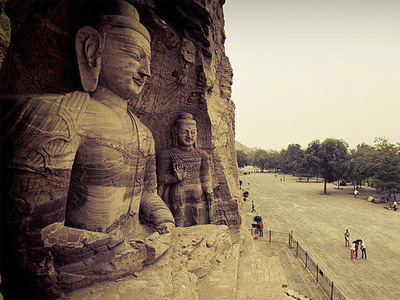
Yungang Caves in Datong. (Photo by Guillermo Vale)
Since we were on pilgrimage, most of our time was spent in the countryside. We flew to Xining and visited Kumbum Monastery; drove the bus through stupendous gorges to Xiahe, the site of Labrang Monastery (these are both in eastern Tibet, in Qinghai and Gansu Province respectively). Leaving Lanzhou to land in Jiayuguan, in the Gobi Desert, and driving to Dunhuang, the site of ancient Buddhist caves, put us in oasis towns along the Silk Road. Datong, an over-night train ride west of Beijing in Shanxi Province, was a coal-town with caves and huge Buddhas carved in the mountainside. The ride to Wutaishan, the Five-Terraced Peaks of Manjushri, took us past the Hanging Temple (which literally hangs on the side of a cliff), and an ancient pagoda used centuries ago both as a military outlook and a religious site with huge Buddha statues on each level. Of course, there were the usual tourist sites in Beijing, but at the end of the tour I excused myself from them in favor of spending time with some Chinese Buddhist friends.
Inspiring and sad—I used those two adjectives to describe my 1987 trip to central Tibet—and they apply to eastern Tibet and China as well. The Buddhist sites were inspiring. Not only was the artwork delicate and moving, but the devotion of those who, over so many centuries, created it as their lives’ work, left me in awe. In the Dunhuang caves, the statues and wall-murals were created with the viewer incorporated into the scene. That is, you don’t feel like you’re watching a picture of the Buddhas and bodhisattvas, you feel like you’re there in that place with them. In Datong, the ceiling of the caves were crowded with carved Buddhas, so you didn’t need to visualize Buddhas falling into you like snowflakes. Just standing there left you with the impression that they actually were.
But the places were sad too. So much has been destroyed, either by the elements and time, or by humans in previous dynasties or in the last few decades. Many towns in formerly Buddhist areas don’t have a single functioning temple. Datong, a city of two and a half million, was fortunate. It had one functioning temple, the others being taken over by the government and converted to museums. The Chinese government is putting money into restoring temples and monasteries, but the reason is to draw tourists. The work of most monastics is to collect tickets and to ring a gong when tourists bow at the shrine. Even Kumbum, the birthplace of Je Rinpoche, seemed desolate. More monks were in the bazaar than in the temples and the sounds of active Dharma study were absent.
Happily, Labrang, was more alive, with the sound of young monks memorizing, older monks debating, and all of them doing puja. Wutaishan had several functioning monasteries (even a nunnery with nuns studying and practicing, and an additional 18 nuns in three-year retreat), and we were able to join in prayer services with them. The abbot of one temple told me, “Buddhism has been damaged in China. It’s wonderful that people in other countries are practicing. We are all of one family, we are all Buddha’s children, no matter what our race or country.”
Inspiring and sad—this describes my contact with some Chinese Buddhist friends. Through some karmic quirk, two young Buddhists in China had gotten my address and we had been corresponding for some months. We finally met in China—they took two overnight trains without sleeping to find us in Datong. Why? Because they were starved for teachings. During our days in Datong and Wutaishan, we spent almost every spare moment in Dharma discussion, with part of a conversation on the bus, another part walking somewhere, another part during a meal. In the evenings we went over the Eight Verses of Thought Training and other lamrim subjects, and they asked many intelligent and thoughtful questions about sutra and tantra. Their interest, eagerness, and devotion to the Dharma made my heart sing. The Singaporeans were similarly impressed.
“The boys,” as we came to call them, told us how difficult it was to receive teachings. It’s difficult to find teachers and when one does, the teachers may not be qualified or if they are, they are often busy with administrative work. I thought of how often in the West we take the presence of our teachers for granted. We’re too busy to attend teachings, and fall asleep or are distracted when we do.
The boys took me to meet two of their teachers, an elderly couple who were disciples of Venerable Fa Zun (a Chinese monk who translated many Tibetan works, including the Lamrim Chenmo into Chinese). This couple told us stories of the Cultural Revolution. They tacked Buddhist texts under tables and buried statues in the ground to keep the Red Guards from finding them. Doing their daily practices at night, under quilts, with the lights out, they never missed a day. Nor was there a break in doing tsog twice a month, even though it was done under similar conditions. The Red Guard broke into their house several times, and they regularly faced danger. When I asked them what gave them the strength to keep up their Dharma commitments under such conditions, they responded that it was due to faith in the Triple Gem and in the Vajrayana. Now circumstances are more relaxed and they are in charge of a lay Buddhist organization, but the government imposes restrictions on Buddhist activities and they still face a variety of difficulties.
The boys’ sincere interest in the Dharma touched me deeply. At the end of the trip, my departing flight left for the States many hours before the Singaporeans’ flight home. Thus, my young Chinese friends, not the tour guide, accompanied me to the airport. They asked if I could stay longer because they wanted more teachings. At the airport, we were able to change my reservation to two days later, and we spent the next days at their flat, meditating and having teachings.
One of the most inspiring experiences was visiting a cave in Wutaishan, called “The Buddha’s Mother’s Womb.” I don’t know the story exactly, but a practitioner once sought shelter in this cave, and because he was protected from harm there, he promised to make a Chenrezig (Kuan Yin) shrine. It was far up the side of a mountain. Walking there in the spacious countryside made my heart joyful. There are two caves, one in front and a smaller womb-like one behind. They are connected by a small channel, like a birth canal, which you have to squeeze through. You put one hand up, the other by your side, put the top part of your body in the channel and have a friend push your feet until your hands can feel the bottom of the inside cave. You have to go out feet first, with someone outside pulling your feet which is quite a trick in monastic robes. It’s said many people feel reborn after this experience. The cave has a small Kuan Yin statue and a single candle. Having been in Tibet, I knew that one should look for self-arisen figures of Buddhas in such a place, and sure enough, there were some. (Alternatively, you could simply say I have a lively imagination.) Sitting alone in the cave, chanting Chenrezig’s mantra—a moment of silence in a life largely overwhelmed by distractions.
Another heartfelt place was a cave/temple in a village at the base of the Qillian Mountains near Jiuquan, in the Gobi. We were told there was nothing much there, but hearing that it was a Manjushri temple, we decided to go anyway. What a surprise to find a Tibetan temple at the site where the Dalai Lama III had had a vision of Manjushri!! The old, toothless monk who was the caretaker was likewise surprised by our visit. The cave and small temple were largely destroyed in the Cultural Revolution—we could see the blackened, scratched-out remains of what must have been lovely murals. Recently new statues have been installed and murals painted in the outer room. Reading the Heart Sutra and Praise to Manjushri, I began to cry—the place where Manjushri appeared to the third Dalai Lama, the destruction of the temples and harm of practitioners, the indestructibility of the real Dharma, the kindness of the present Dalai Lama—can we ever say clearly why tears fill our eyes?
Humor
There was lots of humor in our pilgrimage too. The older Singaporean women sang old lovesongs on the bus to Lake Kokonor. But they excelled in the Perfection of Shopping. I was host to this secret and sacred practice, passed on in a direct lineage from those who had clear vision while on pilgrimage. To practice this seventh, and most valuable, of the bodhisattvas’ perfections, one must first generate a good motivation: “Since beginningless time, I and others have been circling in cyclic existence due to not accumulating merit and wisdom from the practice of the Perfection of Shopping. Having attained a precious human life endowed with two special qualities 1) enough money to spend, and 2) many shops around me, I will not waste this precious opportunity. Therefore, to lead all sentient beings to full enlightenment, I will engage in the perfection of shopping.”
You must practice this perfection together with the other six perfections. The generosity of the perfection of shopping is to shop in order to give things to your friends and relatives, whether they need these things or not. The ethics of the perfection of shopping is to pay all overweight charges on the airline, and to avoid stepping on others’ toes in line, flirting with the salesperson to obtain a lower price, bargaining him/her down unreasonably, or slandering him/her to other shoppers. The patience of the perfection of shopping is to wait patiently for shops to open or for salespeople to attend to you, to shop whether you feel well or not, to carry your packages, no matter how large or clumsy, without complaining; in short to patiently bear all the burdens of shopping. The joyous effort of the perfection of shopping is to shop as much as possible, day and night without laziness. The concentration of the perfection of shopping is to not get distracted by useless activities while shopping, but to remain fully concentrated in the present shop. And the wisdom of the perfection of shopping is to get as many deals as you possibly can! Although I was with perfect gurus who had mastered this practice, I, a lazy nun, did miserably, and left China with the same number of bags I entered with.
Adventures
The first day in China, we visited the Lama Temple in Beijing. I talked with people there and gave them small pictures of the Buddha and some mani pills. Maybe eight or nine people were standing with me when the plainclothes police came, took the things away, and asked me to follow him. One Singaporean woman who translated for me came too, and instead of seeing the temple, we spent most of the morning in the office. The police told me that they have a regulation about giving out religious items in public (apparently some Taiwanese tourists do it too). They wrote a confession in Chinese, which I had to sign, although they assured me nothing would happen. Our guide didn’t know that tourists weren’t supposed to give religious items out in temples and thought what the police did was strange.
Everywhere we visited, people were interested and happy to see a Western nun. While visiting a temple in Lanzhou, one woman came up, bowed to me (I always feel it should be me bowing to other people) and with a joyful face, gave me her mala “to make the karmic connection.” At the same time, another woman came and said Om Mani Padme Hum again and again and wanted me to say it with her. Both of them had such incredible faith in the Triple Gem that I chanced it and gave them Buddha pictures. Later, the second woman, who may have been mentally unbalanced (or a dakini), appeared by the bus. Surrounded by a group of children, she held the picture up high and sang out Om Mani Padme Hum. One woman in our group, who wasn’t a Buddhist, got angry and told me I was stupid to endanger all of them by giving her a picture of the Buddha. Later, our guide said, “Do you have photos or books of the Dalai Lama? Do you have any letters with important information from him to other people?” She was worried that I might be carrying news from His Holiness to the Tibetans about when to have another demonstration. Could a science fiction writer dream up anything stranger?
Her complaint reminded me of the Cultural Revolution, with its ridiculous suspicions and unfounded accusations. When I thought about it, however, it was a compliment of sorts—my faith in His Holiness was apparent enough that someone could fantasize that I could be that close and important to him!!! A few days later, while we were at the Ming Tombs, I had a small Buddhist trinket in my pocket, which I had planned to give to the guide. It accidentally fell out and a member of our group handed it to me. The guide asked, “What’s that?” and I said, “It’s something for you, but this is a public place, and maybe the police will come if I give it to you here.” She and I both laughed at this, but that same woman in our group got upset again. Pilgrimage isn’t just going to holy places; it’s practicing with all the stuff that comes up while you’re trying to get there.
A Tibetan friend in India told me about a particular Rinpoche in Amdo, who was a good lama, and wrote a letter of introduction. At Labrang, we found his place, but he had left for Beijing. His disciples showed us the newly reconstructed stupa there, a special place indeed. In addition to new statues, they had many old scriptures written in gold. The gold doesn’t impress me so much as the devotion of the people who copied the scriptures and those who hid them so they wouldn’t be destroyed. The lama’s disciples gave us an address in Lanzhou where people could give us his Beijing address. But in Lanzhou, the guide said that the address was on a small street that no one knew, and there were no maps of Lanzhou containing all the small streets. A few obstacles, no? Later, we learned the Rinpoche was attending a meeting of the Chinese Buddhist Association in Beijing. We went to the hotel in the evening to meet him, unannounced. He had quite a presence, and I asked him to say something which would help our minds in the Dharma. He responded, “This isn’t a good circumstance to talk. I’m close to HHDL, so are you. People could see us together and talk, and it could be dangerous for me and for you.” Nevertheless, he gave us the oral transmission of the Manjushri mantra and a short verse. All over Beijing, there are signs, “A More Open China Awaits the 2000 Olympics.” It’s enough to make you think you’re hallucinating!!
We arrived in Beijing on the overnight train very early in the morning and our guide took us to Tianamen Square to see the raising of the national flag. While others watched, I walked around the square, doing Chenrezig visualization and mantra (inconspicuously), to purify the place. So much sorrow.
On the trip, we met many people in their late twenties, who were born at the beginning of the Cultural Revolution. They don’t remember it, although they have heard stories of their parents’ suffering and may remember the poverty. They want to get on with life, but I still need to digest the quantity of suffering people in Tibet and China have gone through since the Communist takeover.
Some of the Singaporeans had visited China in the 1970s or 80s and remarked at the change. Previously men and women alike dressed in dark, plain colors and behaved stiffly with foreigners. Buildings were run down. Now brightly colored clothes light up the drab towns, people are more relaxed, and construction abounds.
However, despite the improvement of living conditions and greater economic freedom, people lack freedom as we know it in the West. I returned to the States with a much deeper appreciation for the gift we have here of being able to think, say, and do what we wish. For people who want to practice the Dharma, such freedom to listen to teachings and to practice is essential. Small things I used to take for granted—listening to a tape of His Holiness the Dalai Lama, visiting lamas and talking freely, being in a temple free of police observation—have new meaning for me.
I pray that we who have worldly freedom use it to attain the real freedom of enlightenment and that those who live in constricted places may be free of such obstacles and able to delight in the Dharma as they wish.

Venerable Thubten Chodron
Venerable Chodron emphasizes the practical application of Buddha’s teachings in our daily lives and is especially skilled at explaining them in ways easily understood and practiced by Westerners. She is well known for her warm, humorous, and lucid teachings. She was ordained as a Buddhist nun in 1977 by Kyabje Ling Rinpoche in Dharamsala, India, and in 1986 she received bhikshuni (full) ordination in Taiwan. Read her full bio.